EasyManua.ls Logo

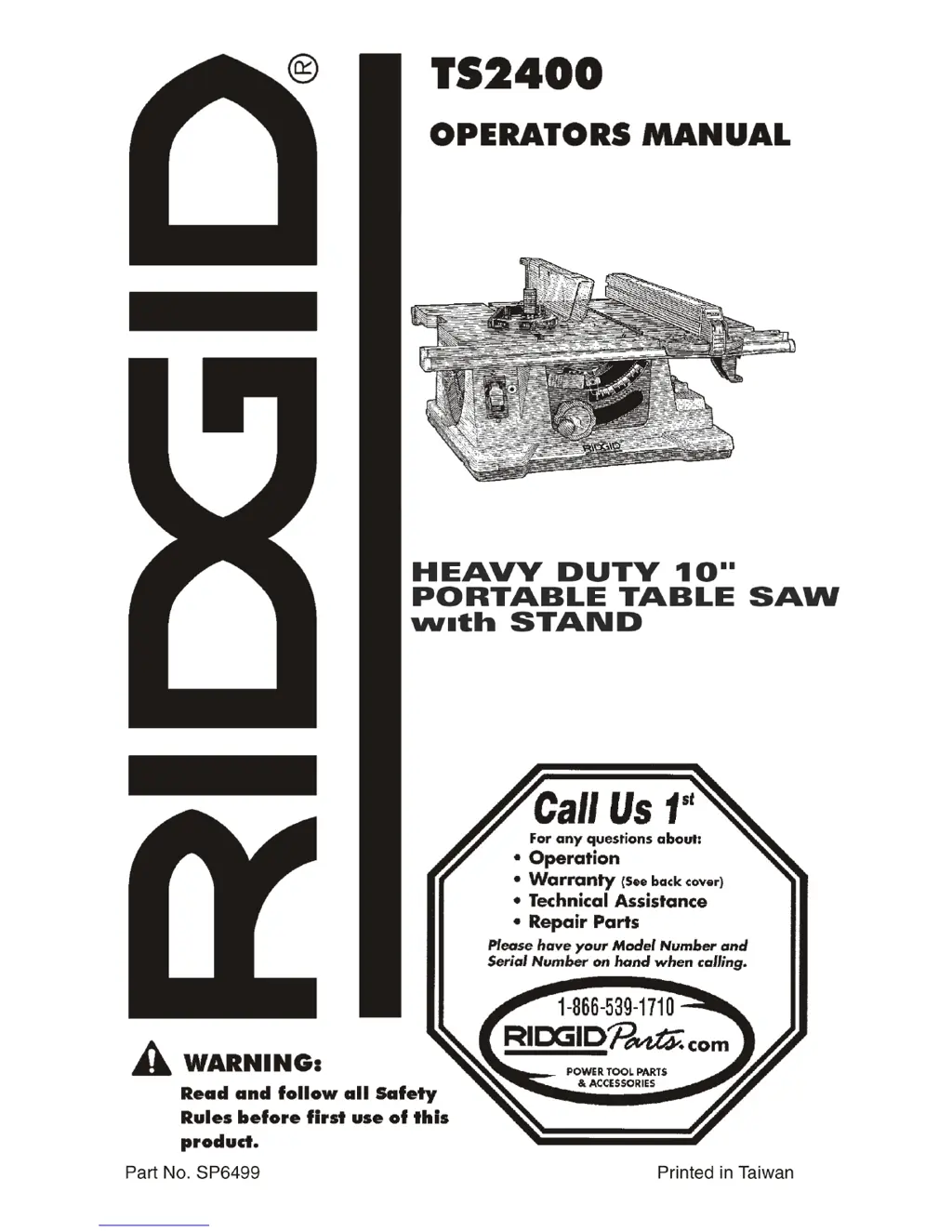
RIDGID TS 2400 - User Manual

RIDGID TS 2400
68 pages
Print Icon
To Next Page IconTo Next Page
Loading...

Table of Contents

Questions and Answers

  • K
    Kevin SanchezAug 15, 2025
    Why does my RIDGID Saw keep tripping the circuit breaker?
    • C
      Carl StanleyAug 16, 2025
      Your RIDGID Saw might be tripping the circuit breaker because the motor is overloaded, meaning you're feeding work into the blade too quickly. Alternatively, the fuses or circuit breakers may not have sufficient capacity. Try installing proper size fuses or circuit breakers.
  • S
    Stephanie SnyderAug 18, 2025
    What to do if my RIDGID TS 2400 motor stalls and blows fuses?
    • M
      matthewmendozaAug 19, 2025
      If your RIDGID Saw motor stalls, resulting in blown fuses, it could be due to voltage being too low, preventing the motor from reaching operating speed. Request a voltage check from the power company. Another cause could be that the fuses or circuit breakers do not have sufficient capacity, so install proper size fuses or circuit breakers.
  • J
    James MyersAug 22, 2025
    Why is my RIDGID TS 2400 Saw motor overheating?
    • S
      shelleyrodriguezAug 22, 2025
      Your RIDGID Saw motor may be overheating because it's overloaded; try feeding work slower into the blade. Another cause could be improper cooling. Clean out sawdust to provide normal air circulation through the motor.
  • A
    Aaron CastroAug 26, 2025
    Why doesn't my RIDGID Saw motor develop full power?
    • A
      Amy RojasAug 26, 2025
      If your RIDGID Saw motor fails to develop full power, the circuit could be overloaded with lights, appliances, and other motors; avoid using other appliances on the same circuit when using the saw. The wiring circuit (extension cord) might also be too long or undersized; increase wire sizes or reduce the length of the circuit. General overloading of power company facilities could also be the cause; request a voltage check from the power company. Finally, incorrect fuses or circuit breakers in the power line could be the reason; install correct fuses or circuit breakers.
  • C
    Christy Smith DDSAug 28, 2025
    How to fix excessive vibration in my RIDGID TS 2400 Saw?
    • M
      Michael WilliamsAug 28, 2025
      Excessive vibration in your RIDGID Saw is often due to a blade that is out of balance or damaged. Replace the blade to resolve this issue.
  • B
    bartlettdouglasAug 31, 2025
    What to do if the cut binds or the motor stalls when ripping with my RIDGID TS 2400?
    • B
      Brendan WhiteAug 31, 2025
      If the cut binds, burns, or stalls the motor when ripping with your RIDGID Saw, it could be due to a dull blade or improper tooth set; sharpen or replace the blade. Another reason may be that the blade is heeling. A warped board could also be the cause, so make sure the concave or hollow side is facing “down” and feed slowly. The rip fence may not be parallel to the blade. Finally, the spreader could be out of alignment.
  • R
    ricardo01Sep 4, 2025
    Why does my RIDGID TS 2400 Saw motor start slowly?
    • T
      Tiffany OchoaSep 4, 2025
      If your RIDGID Saw motor starts slowly or fails to come up to full speed, low voltage could be the cause. Request a voltage check from the power company. Alternatively, the windings may be burned out or open; have the motor repaired or replaced.
  • J
    John LawsonSep 7, 2025
    Why is my RIDGID TS 2400 making excessive noise?
    • E
      Erica BrownSep 7, 2025
      If your RIDGID Saw is making excessive noise, the motor may be the source of the problem. Have the motor checked by a qualified service technician. Repair service is available at your nearest Authorized Service Center.
  • T
    twebsterSep 12, 2025
    What causes a RIDGID TS 2400 motor to run intermittently?
    • N
      nicholas07Sep 12, 2025
      If your RIDGID Saw motor runs intermittently, sparks excessively, or fails to start, it could be due to worn or damaged brushes. Replace the brushes.

Summary

Safety Instructions for Table Saw

Safety Signal Words

Explains DANGER, CAUTION, and WARNING terms used in the manual.

Before Using The Saw

Essential safety warnings and steps before the initial use of the saw.

Installing and Moving the Saw

Safety precautions and advice for installing and moving the table saw.

Pre-Use Inspections

Critical checks and inspections to perform before each use of the saw.

Preventing Jams, Slips, and Kickbacks

Detailed instructions to minimize the risk of jams, slips, and kickbacks.

Personal Protection

Safety guidelines for eyes, hands, face, and ears, including PPE.

Sawblade Spinning Safety

Crucial safety measures to follow when the sawblade is spinning.

Rip and Crosscut Specific Safety

Additional safety instructions tailored for rip and crosscut operations.

Glossary of Terms for Woodworking

Definitions

Definitions of key woodworking terms used in the manual.

Key Terms

Definitions for terms like Push Stick, Rip Cut, Thru-Sawing, and Workpiece.

Motor Specifications and Electrical Requirements

Power Supply and Motor Specifications

Details on the saw's motor and required power supply specifications.

General Electrical Connections

Safety guidelines and procedures for making electrical connections.

Wire Sizes

Guidance on selecting appropriate extension cord wire sizes for safety.

Getting to Know Your Table Saw

Component Identification

Diagram and labels identifying the main parts of the table saw.

Key Controls and Features

Explanation of controls like Rip Fence, On-Off Switch, and Blade Guard.

Blade Adjustment Mechanisms

How to operate the blade elevation and bevel adjustment controls.

Storage Features

Locations for storing accessories like the blade guard and wrenches.

Alignment and Adjustments

Tools Needed and Initial Checks

List of tools for alignment and initial checks like table insert.

Blade Parallelism and Squareness

Procedures to ensure blade parallelism and squareness to the table.

Rip Fence and Table Extension Alignment

Steps for aligning the rip fence and sliding table extension.

Sawblade Installation and Removal

Safe procedures for removing and installing the sawblade.

Miter Gauge Alignment

How to align the miter gauge stops and ensure smooth movement.

Mounting Your Saw

Workbench and Legset Mounting Procedures

Detailed steps for securely mounting the saw to a workbench or legset.

Alternative Mounting Methods

Instructions for alternative mounting using C-clamps or sawhorses.

Basic Saw Operations

Using the Miter Gauge

Guidance on using the miter gauge for various cuts like crosscutting.

Crosscutting Techniques

Procedures and safety for performing crosscuts and repetitive cuts.

Rip Cutting Techniques

Instructions and safety for performing rip cuts using the rip fence.

Specialized Cuts

How to perform specialized cuts like resawing, dadoing, rabbeting, and molding.

Maintenance and Troubleshooting

Routine Maintenance Procedures

Regular maintenance tasks including cleaning, sharpening, and lubrication.

Troubleshooting Common Issues

Identifying and resolving common problems like vibration and inaccurate cuts.

Motor Troubleshooting

Diagnosing and fixing issues related to the saw's motor.

Repair Parts

Parts Identification - Figure 1

Diagram and list of parts for the main table saw assembly.

Parts Identification - Figure 2

Diagram and list of parts for various components of the saw.

Parts Identification - Figure 3 (Miter Gauge)

Diagram and list of parts specifically for the miter gauge assembly.

Parts Identification - Figure 4 (Fence)

Diagram and list of parts for the fence assembly.

Parts Identification - Figure 5 (Guard)

Diagram and list of parts for the guard assembly.

Warranty Information

Satisfaction Guarantee and Limited Warranty

Details on the 90-day guarantee and three-year limited warranty.

Obtaining Service and Exclusions

Procedures for service, warranty limitations, and exclusions.

RIDGID TS 2400 Specifications

General IconGeneral
TypeTable Saw
Blade Diameter10 inches
Motor Power15 Amps
Max Cut Depth at 90 Degrees3-1/8 inches
Max Cut Depth at 45 Degrees2-1/4 inches
Weight90 lbs
Arbor Size5/8 inches
Voltage120V
Dust Port Size2-1/2 inches
Max. RPM5, 000 RPM

Related product manuals