2587
8
4.4 COMBUSTION HEAD SETTING
This is done when fitting the nozzle, with the blast tube removed. It depends on the output of the burner and
is carried out by rotating the regulating rod, till the terminal plane of the blast tube is level with the set-point,
as indicated in the schedule.
4.5 AIR DAMPER ADJUSTMENT
The settings indicated in the schedule refer to the combustion-chamber with “zero” depression.
These regulations are purely indicative. Each installation however, has its own unpredictable working con-
ditions: actual nozzle output; positive or negative pressure in the combustion-chamber, the need of excess
air, etc.
All these conditions may require a different air-damper setting.
4.6 PUMP PRESSURE:
The pump leaves the factory set for kerosene working.
10 bar: maximum pressure for kerosene.
FOR GAS OIL INCREASE PRESSURE
12 bar: pressure suitable for gas oil in most cases.
14 bar: improves flame retention; it is therefore suitable for ignitions at low temperatures.
4.7 BURNER START-UP CYCLE
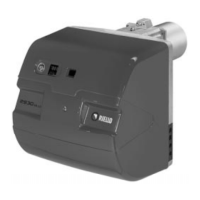
Lock out is indicated by a lamp on the control box (3, fig. 1, page 1).
Combustion head settings indicated in the
schedule are valid for most cases.
The setting of the fan output according to the
installation should normally be done only
through the air damper.
Blast tube
Regulating rod
Shutter
Terminal plane of the blast tube
D5398
2
135
In the sketch on the
left, the combustion
head is set for an
output of 1.10 GPH
at 12 bar (
for gas oil
)
or 1.65 GPH at 8 bar
(
for kerosene
).
489 T50
The shutter is level with set-point 3, as required
by the schedule at page 6.
In the sketch on the
left, the combustion
head is set for an
output of 1.50 GPH
at 12 bar (
for gas oil
)
or 2.25 GPH at 8 bar
(
for kerosene
).
488 T50
Normal
Thermostat
Motor
Ignition transformer
Valve
Flame
Lock-out lamp
~ 12s
D5229
~ 12s
~ 5s
Lock-out due to failure to light
E
E


 To Next Page
 Loading...