Copyright © 2020 River Systems - All rights reserved
2A - PRODUCT’S DESCRIPTION
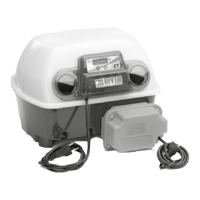
The ET incubator by River Systems
®
is designed to hatch chicks of hen, pheasant, guinea fowl, quail, partridge,
grey partridge, rock partridge, turkey, palmipeds (goose, mallard, all breeds of duck, etc.), peacock, pigeon,
exotic birds and birds of prey.
The heat necessary for incubation is generated by a heating element controlled by a state-of the-art digital
PID microcomputer controller, which allows to adjust the average internal temperature thanks to the keys on
the display, in a constant and precise manner. A fan impeller performs the ventilation, evenly distributing the
hot and humid air. Thanks to the water contained in the basins at the bottom of the incubator, natural surface-
humidication takes place. The basins are lled through the two external openings, without needing to open
the machine.
SEMI-AUTOMATIC INCUBATOR INCUBATOR WITH EGG TURNING UNIT
It is equipped with a semi-automatic system
for the inclination of the eggs, which can be
activated from the outside thanks to a titling
handle connected to the egg tray at the base of
the incubator.
It is equipped with an automatic system for the
inclination of the eggs that fulls a complete cycle
every 4 hours, which works from the outside
thanks to a motor.
- 23 -
3.
EGG SELECTION AND STORAGE FOR INCUBATION
• It is important to note that eggs that have travelled can have hatching rates below 50% due to:
- Stress;
- Vibrations;
- Sudden temperature changes;
- Asphyxiation of embryos caused by occlusive packaging.
• Should it be necessary to use eggs that have traveled, let them rest for at least 24 hours in an egg tray,
with their point downwards before incubating them.
• Choose eggs from parent stock that are well developed, well fed and healthy because some domestic and
wild poultry diseases are transmitted from hens to eggs, and can cause the death of the embryo.
• Parent stock mustn’t be blood-related: males must come from a different source; interbreeding can
produce eggs with weak embryos destined to die in the hatching phase, or, if they do hatch, they will be
vulnerable animals with poor health.
• To have a higher percentage of fertile eggs, pay attention to the ideal age of the breeding animals, keeping
in mind that the ideal age varies according to the species (for examples must be from 1 to 5 years for
roosters and from 2 to 4 years for hens). It is also necessary to respect the correct ratios between males
and females and to establish a suitable environment to respect the animals’ well-being.
• The embryo starts developing before the hen lays the egg; a newly laid fertilised egg can be compared
to a 5 day old baby. After laying, embryonic development stops and can resume, in the case of articial
incubation, within after 7 days.
The following rules will help obtain adequate eggs for incubation:
1. Collect the eggs often, possibly early in the morning and by noon, in order to prevent them from being exposed
to direct light, ultraviolet rays and high temperatures.
2. Never store the eggs in the refrigerator.
3. Do not incubate dirty eggs: contamination causes chick mortality.
4. Wash the eggs delicately and with lukewarm water, to avoid thermal excursion. It is possible to use a specic
disinfectant that causes the physical destruction of pathogenic microorganisms of fungal, bacterial and
viral origin. Avoid brushing them, in order not to affect the outer membrane thus facilitating the entry of
bacteria.
5. Keep the eggs in a cool room with temperature between +14°C and +18°C and humidity of about 65-75%. In
case the eggs have been, for short periods, subjected to different temperatures from the abovementioned,
make sure that they were not below +5°C or above +24°C.
6. It is essential to keep the eggs in the egg trays with their point downwards.
7. Eggs are good for incubation from 2nd to 6th/7th day from laying. Incubating eggs older than 8 days
considerably reduces the hatching rate.
8. Eggs chosen for incubation should never be collected when the animals suffer stress from high or low
temperatures.
9. Choose eggs with normal shape: they should not be oblong, spherical, corrugated or misshapen in any way.
10. The egg shell must not be cracked, thin, broken, soft, tapered or blue spotted (old eggs).
EN


 To Next Page
 Loading...