Copyright © 2020 River Systems - All rights reserved
- 25 -
harmful bacteria including Salmonella, Campylobacter, Staphylococcus, Legionella, Escherichia coli, etc.
b) Place the incubator on a at table, in a horizontal position, stable and secure. The table must
be at least 50 cm high. The base of the incubator must rest directly on the table in order to prevent
any obstruction of the ventilation holes and from it being submerged by water in the event of ooding.
Moreover, draughts at oor level can adversely affect the incubation process.
c) Remove the lid and place it beside the machine keeping the grill downwards.
d) Remove the hatching oor from the base of the incubator, as it is necessary only for hatching
(last 3 days). DO NOT LEAVE IT INSIDE THE MACHINE DURING INCUBATION! (photo A).
NB: store the hatching oor on a at surface so that it will not deform (photo B).
e) - Semi-automatic incubator: check that the egg tray is correctly positioned in its seats and that the elements
tilt freely in both directions (photo C).
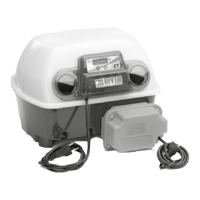
- Incubator with egg turning unit OVOMATIC: check that the metal tongue of the unit, positioned in the
front of the incubator is perfectly inserted into the corresponding slot at the head of the egg tray, which
must then remain rm and immobile. Make sure that the rows of the egg tray are properly housed in their
respective seats (photo D).
f) Fill the basin on the left with lukewarm, preferably demineralized water. Pour the water into the corresponding
opening in the base of the incubator (photo E). Do this slowly, taking care not to allow the water to overow
from the basin: too much liquid would increase the humidity rate lowering the hatching percentage. The
second basin (on the right) will be used only for the hatching phase. You can top up the basin(s) even when
the incubator is working.
g) Replace the lid. Make sure that the edge of the lower box is perfectly inserted into the slot in the lid
(photo F).
h) Insert the lid plug into a suitable socket. The fan impeller will start immediately, followed by the display that
shows the temperature inside the incubator. The LED indicates that the heating element is working (photo
G). The LED will remain illuminated until the set temperature is reached; it will then ash intermittently.
i) The machine is pre-set to a temperature of 37.7°C, ideal for all species of birds. However, it is preferable
to reset the temperature as described in pos. 4C.
j) After having set the temperature, when you start the incubator run it empty (without eggs) for at
least 2-3 hours in order to stabilize temperature and humidity. After ensuring that the machine is
working correctly (see pos. 4C), unplug and remove the lid, placing it next to the incubator. Gently place
the eggs into the tray cradles with their point downwards. Replace the lid and reinsert the plug. The
incubator must be lled to at least 80% of its capacity.
k) Do not cover the incubator or keep it inside a box whilst in use. This would prevent the air exchange inside
it, necessary for the development of the embryo, which takes place through the ventilation holes present
in the base of the incubator and through the two inspection windows.
l) The incubation cycle starts now. It is recommended to mark the day on a calendar and to follow the
instructions given in the table in section 4D “Information for a correct incubation”. Monitor the presence of
water in the tray daily, checking its level through the opening (the level inside the lling opening corresponds
to the one in the basin). When necessary, top up with preferably demineralized, clean and lukewarm water
(+ 35/40°C).
m) Be aware that it is the water surface and not its quantity that generates the humidity, therefore the height of
the water in the basin will not affect the humidity rate. The punctual and constant check for the presence of
water will help ensure the necessary humidity, preventing the environment inside the incubator from going
dry. In case of power failure, surround the 4 sides of the incubator with bottles containing hot water and
cover everything with a blanket. This allows the temperature inside the incubator to be retained to a certain
extent. Remove everything as soon as the power returns.
n) Change the position of the eggs every 5 days, swapping those in the centre with those on the sides, to
guarantee a better homogeneity of hatching.
WARNING:
• IF THE FAN IMPELLER DOES NOT START, UNPLUG IMMEDIATELY AND CONTACT THE SERVICE
CENTRE.
SEMI-AUTOMATIC INCUBATOR INCUBATOR WITH TURNING UNIT
At least 4 times a day change the inclination
of the eggs housed in the egg tray by titling
the handle placed in the front of the incubator.
Turn the handle to the right or left alternately,
stopping it at the position corresponding to 10
or 14 o’clock (photo K). NEVER LEAVE THE
HANDLE (AND CONSEQUENTLY THE EGGS) IN
A VERTICAL POSITION (12 o’clock). Move the
titling handle gently to avoid trauma to the eggs.
Important: the number of hours the egg has been
in one position must be replicated in the opposite
position.
Start the egg turning unit by inserting the power
plug connected to the device into an appropriate
power outlet. The egg turning unit will start
working. The egg tray performs an inclination
every two hours (photo J).
Attention: the movement will not be evident
as it is very slow. However, make sure this
happens.
EN


 To Next Page
 Loading...