Maintenance
16
7
6 MAINTENANCE
6.1 WARNINGS
Correct maintenance prevents problems, assures
eciency and keeps running costs low.
Any operation on internal components may exclu-
sively be performed by the TAC.
Before performing any operation, switch o the
appliance by means of the control device and wait
for the end of the shutdown cycle, then disconnect
the gas supply, by closing the gas valve.
The eciency checks and every other "check and
maintenance operation" must be performed with
a frequency according to current regulations or,
if more restrictive, according to the provisions set
forth by the manufacturer, installer or TAC.
Responsibility for eciency checks, to be carried
out for the aims of restricting energy consumption,
lies with the system manager.
6.2 CLEANING AND MAINTENANCE
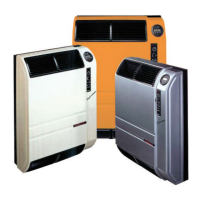
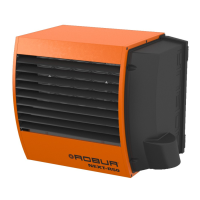
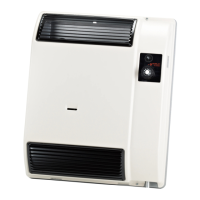
The only operation required by this kind of gas-red con-
vector is the cleaning of the outer casing (which must al-
ways be carried out with the appliance cold and without
the use of solvents) and the periodic removal of any dust
that may accumulate on the heat exchanger.
It is recommended to have a periodic (annual) check and
cleaning of the gas-red convector by contacting a TAC.
With regard to periodic maintenance of the gas-red con-
vector, follow the regulations in force.
6.3 ANY MALFUNCTIONS OF OPERATION
Before taking any particular measures, always check that:
The gas is supplied.
The supply pressure at the burner is within the
specied tolerance range.
Only at this point proceed with the specic
troubleshooting.
6.3.1 Case 1: No ignition spark
A. There is no adequate gas ow to the gas-red convec-
tor. Check that no taps or manual valves are closed. If
the appliance has not been used for a long period of
time there may be air in the pipes. Therefore, try the
ignition several times.
B. Check the connection of the ignition cable and the rel-
ative electrode.
C. Check the functionality of the piezoelectric device and
its contact with the structure.
6.3.2 Case 2: Pilot burner does not ignite
A. There is air in the gas pipe; hold down the control knob
and press the ignition button repeatedly.
B. Check the ignition through the sight glass.
6.3.3 Case 3: Pilot burner ignites but does not
stay lit
A. Check the thermocouple connections making sure
that they are tight enough.
B. Also check that the thermocouple bulb is hit by the
ame.
6.3.4 Case 4: the gas-red convector does not
provide the desired room comfort
A. Check that the room is not disproportionately large in
relation to the heat output of the appliance (in which
case comfort is lacking even though the gas-red con-
vector is operating at full power).
B. Check that the temperature control bulb is not dis-
placed from its position on the bracket inside the
appliance.


 To Next Page