Transport and positioning
8
2
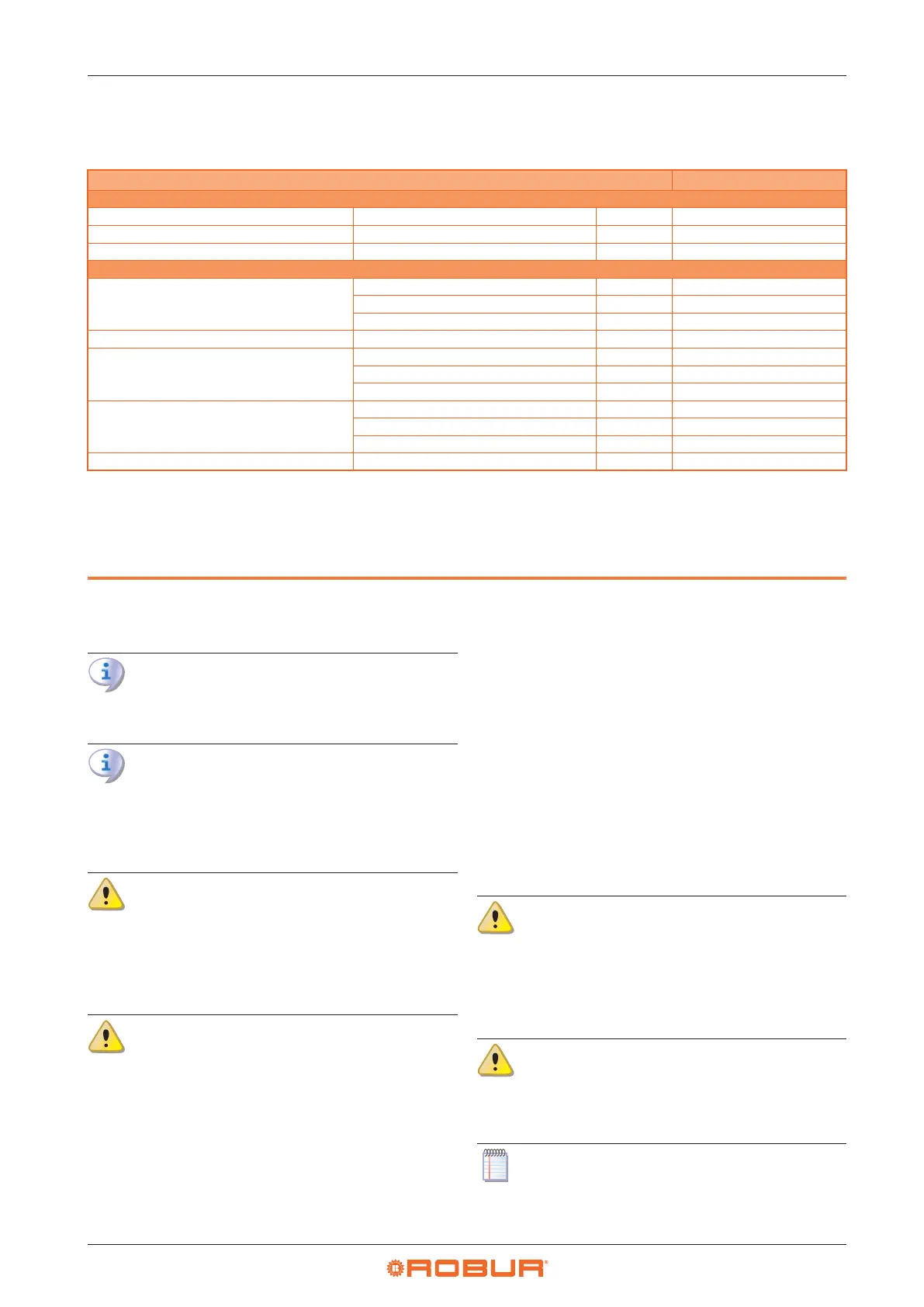
1.3 TECHNICAL DATA
Table1.1 Technical data
TS 2000
Heating mode
Heat input nominal (1013 mbar - 15 °C) (1) kW 2,0
Heat output nominal kW 1,7
Eciency nominal heat input % 85,8
Installation data
Gas consumption
G20 natural gas (nominal) m³/h 0,20
G30 (nominal) kg/h 0,15
G31 (nominal) kg/h 0,15
Gas connection thread “ 3/8
Flue gas exhaust
type of installation - C11
diameter (Ø) mm 60/100 (2)
residual head Pa 0 (3)
Dimensions
width mm 480
height mm 577
depth mm 170
Weight in operation kg 17
(1) Relative to NCV (net caloric value).
(2) Coaxial pipe: ue gas exhaust Ø 60 mm, air intake Ø 100 mm.
(3) It is not possible to use coaxial pipes other than the one supplied. The minimum wall thickness must be 150 mm, the maximum 500 mm.
2 TRANSPORT AND POSITIONING
2.1 WARNINGS
Damage from transport or installation
The manufacturer shall not be liable for any dam-
age during appliance transport and installation.
On-site inspection
Upon arrival at the site, ensure there is no transport
damage on packing.
After removing the packing materials, ensure the
appliance is intact and complete.
Packing
Only remove the packing after placing the appli-
ance on site.
Do not leave parts of the packing within the reach
of children (plastic, polystyrene, nails...) since they
are potentially dangerous.
Weight
The lifting equipment must be suitable for the load.
Lift up the appliance and secure it to its support
bracket.
2.2 HANDLING
2.2.1 Handling and lifting
▶
Always handle the appliance in its packing, as deliv-
ered by the factory.
▶
Comply with safety regulations at the installation site.
2.3 APPLIANCE POSITIONING
The appliance must be installed in the room to be heated.
2.3.1 Where to install the appliance
▶
The gas-red convector must be installed on an exter-
nal perimeter wall, respecting the distances indicated
in Figure 1.1
p.7
.
▶
Avoid placement on walls or combustible materials
without a suitable heat shield.
▶
Do not install the gas-red convector over electrical
boxes/switches or distribution cabinets that require
periodic inspection.
Installation must not be made on walls with poor
strength that do not guarantee adequate resist-
ance to the stresses produced by the appliance.
The manufacturer assumes no responsibility if the
appliance is installed on surfaces or walls that are
not suitable to support its weight.
The appliance's ue gas exhaust must not be im-
mediately close to openings or air intakes of build-
ings, and must comply with safety and environ-
mental regulations.
The ue gas exhaust terminal is accident-pre-
venting and requires no protection.


 To Next Page