12 13
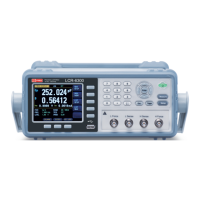
Profeesional LCR Meter / English
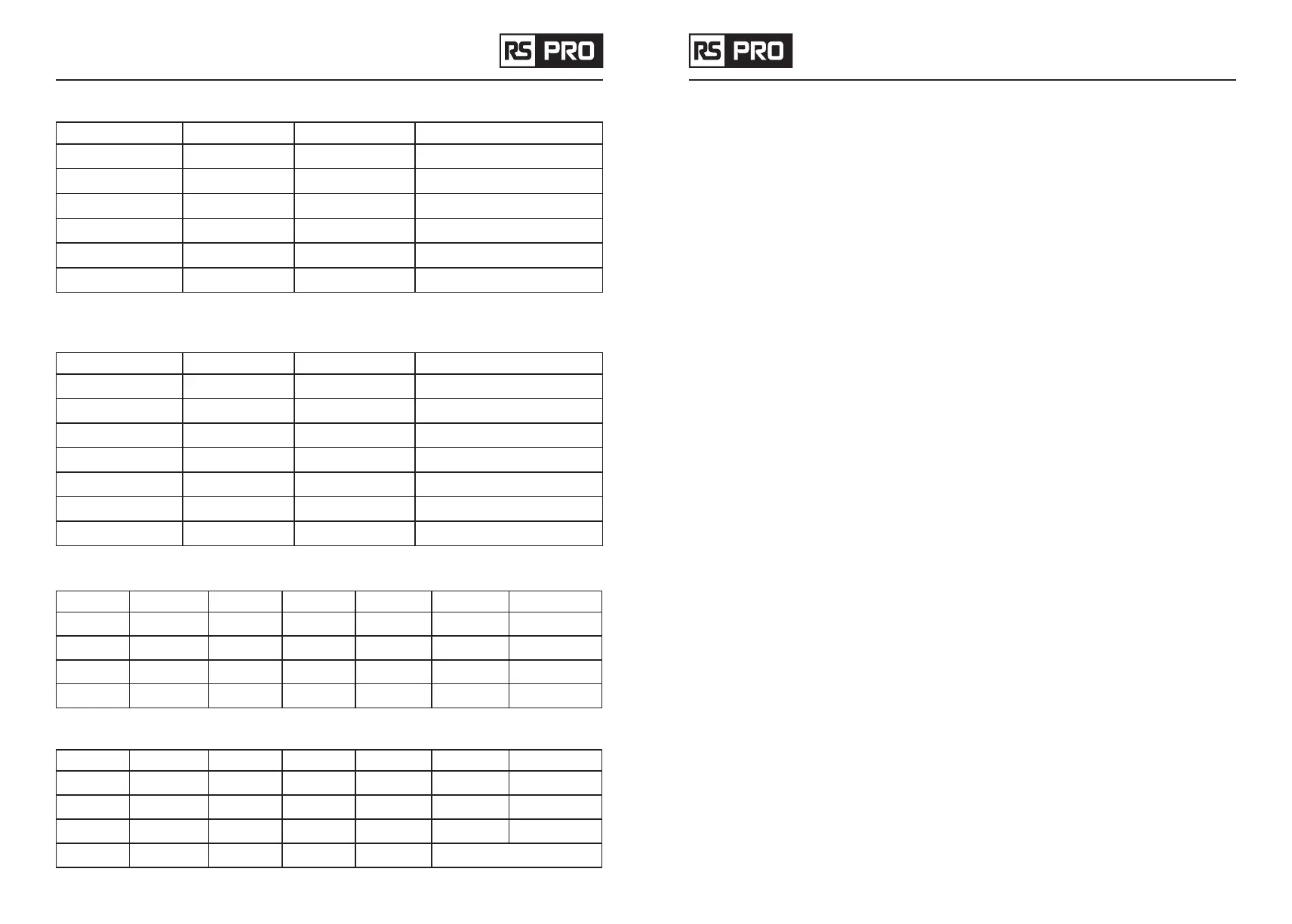
Frequency = 100kHz
Range Resolution Rx Accuracy Measurement Mode
20.000Ω 1mΩ 2.3%±10d ---
200.00Ω 0.01Ω 1.5%±5d ---
2.0000kΩ 0.1Ω 0.8%±20d ---
20.000kΩ 1Ω 0.8%±20d ---
200.00kΩ 0.01kΩ 1.5%±10d ---
2.000MΩ 1kΩ 2.5%±30d ---
DC Resistance @ Ta =18 ~ 28
o
C(De)
Frequency = 100Hz/120Hz/1kHz/10kHz/100KHz
D value Accuracy @ Ta =18 ~ 28
o
C(De)
D value Accuracy @ Ta =18 ~ 28
o
C(De)
Range Resolution Rx Accuracy Measurement Mode
200.00Ω ±0.01Ω 1.8%±10d ---
2.0000kΩ ±0.1Ω 0.6%±20d ---
20.000kΩ ±1Ω 0.6%±10d ---
200.00kΩ ±0.01kΩ 0.5%±3d ---
2.0000MΩ ±0.1kΩ 1.5%±5d ---
20.000MΩ ±1kΩ 2.0%±5d ---
200.0MΩ ±0.1MΩ 2.5%±5d —
Freq. / Z 0.1- 1Ω 1–10Ω 10–100kΩ 100k–1MΩ 1M–20MΩ 20M−200MΩ
100/120Hz ±0.030 ±0.010 ±0.009 ±0.010 ±0.020 ±0.040
1kHz ±0.030 ±0.010 ±0.009 ±0.010 ±0.020 ±0.090
10kHz ±0.030 ±0.010 ±0.009 ±0.009 ±0.010 ±0.040
100kHz ±0.040 ±0.030 ±0.010 ±0.010 ±0.020 ±0.040
Freq. / Z 0.1- 1Ω 1–10Ω 10–100kΩ 100k–1MΩ 1M–20MΩ 20M−200MΩ
100/120Hz ±0.65
o
±0.36
o
±0.23
o
±0.45
o
±0.65
o
±1.35
o
1kHz ±0.65
o
±0.36
o
±0.23
o
±0.45
o
±0.65
o
±3.63
o
10kHz ±0.65
o
±0.36
o
±0.23
o
±0.45
o
±0.65
o
N/A
100kHz ±1.27
o
±0.65
o
±0.49
o
±0.65
o
±1.35
o
Profeesional LCR Meter / English
7.Supplemental Information
This section provides supplemental information for user consideration when operating the LCR meters.Some
recommendations and explanations are provided to help aid in the use of some functions and features,in
which can help the user gain optimal and accurate measurement results.
7-1 Selecting Test Frequency
Test frequency can greatly affect the results of measurement reading,especially when measuring inductors
and capacitors.This section provides some recommendations and suggestions to consider.
Capacitance
When measuring capacitance selecting,the right frequency is important in obtaining the most accurate
measurement results.
Generally,a 1 kHz test frequency is used to measure capacitors that are 0.01μF or smaller.For capacitors
that are 10 μF or larger, a lower frequency of 120 Hz is used.Following this trend,high test frequencies are
best for testing very low capacitance components.
For large capacitance components,low frequency would be optimal.
For example,if the capacitance of the component is to be in the mF range,than selecting 100 Hz or 120
Hz for test frequency would give much better results.The results will also be obvious because if the same
component was tested with 1 kHz or 10 kHz, the measured readings may look erroneous on the display.
In all cases,it is best to check with the manufacturer’s data sheet in order to determine the best test
frequency to use for measurement.
Inductance
Typically,a 1kHz test frequency is used to measure inductors that are used in audio and RF circuits.This
is because these components operate at higher frequencies and require that they be measured at higher
frequencies such as 1 kHz or 10 kHz.
However,a 120 Hz test signal is used to measure inductors that are used for applications such as filter
chokes in power supplies, in which are typically operated at 60 Hz AC (in U.S.) with 120 Hz filter
frequencies.
In general,inductors below 2 mH should be measured at 1 kHz frequency while inductors above 200 H
should be measured at 120 Hz.
In all cases,it is best to check with the manufacturer’s data sheet in order to determine the best test
frequency to use for measurement.
7-2 Selecting Series or Parallel Mode
Just as test frequency can greatly affect measurement results, selecting between series or parallel
measurement mode can also affect the accuracy of the meter,especially for capacitive and inductive
components.Below are some recommendations to consider.
Capacitance
For most capacitance measurement,selecting parallel mode is the best.Most capacitors have very low
dissipation factor (high internal resistance) compared to the impedance of the capacitance.
In these cases,the paralleled internal resistance has negligible impact upon the measurement.


 To Next Page