Basic boost pressure
BAR
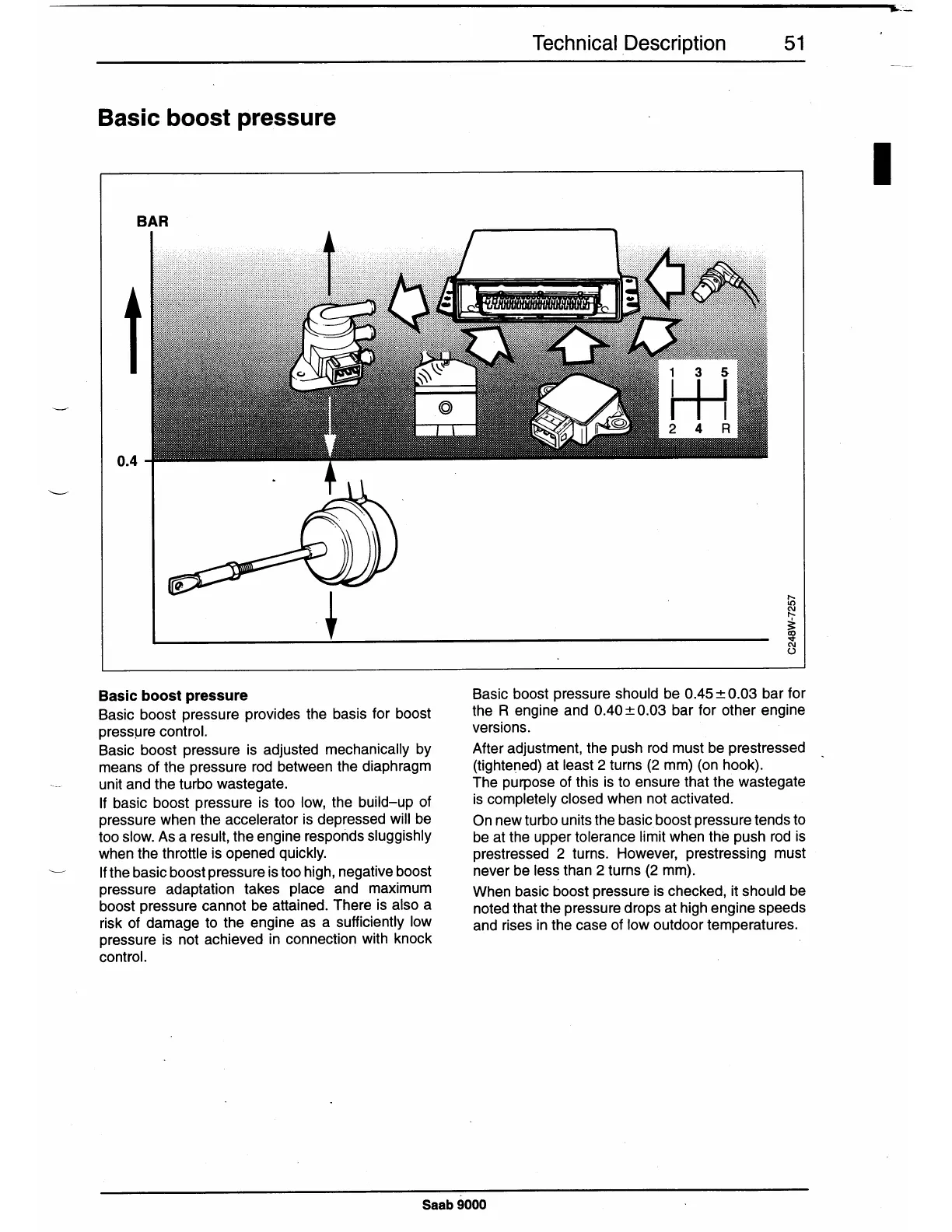
Basic boost pressure
Basic boost pressure provides the basis for boost
pressµre control.
Basic boost pressure is adjusted mechanically by
means of the pressure rod between the diaphragm
unit and the turbo wastegate.
If basic boost pressure is too low, the build-up of
pressure when the accelerator is depressed will be
too slow. As a result, the engine responds sluggishly
when the throttle is opened quickly.
If the basic boost pressure is too high, negative boost
pressure adaptation takes place and maximum
boost pressure cannot be attained. There is also a
risk of damage to the engine as a sufficiently low
pressure is not achieved in connection with knock
control.
Technical _Description 51
Basic boost pressure should be 0.45
±
0.03 bar for
the R engine and 0.40
±
0.03 bar for other engine
versions.
After adjustment, the push rod must be prestressed
(tightened) at least 2 turns (2 mm) (on hook).
The purpose of this is to ensure that the wastegate
is completely closed when not activated.
On new turbo units the basic boost pressure tends to
be at the upper tolerance limit when
the
push
rod is
prestressed 2 turns. However, prestressing must
never be less than 2 turns (2 mm).
When basic boost pressure is checked, it should be
noted that the pressure drops at high engine speeds
and rises in the case of low outdoor temperatures.
Saab 9000
I



 To Next Page