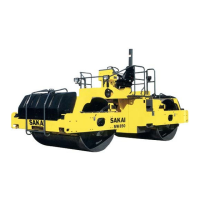
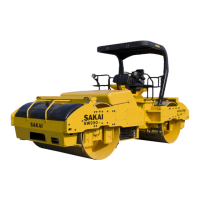
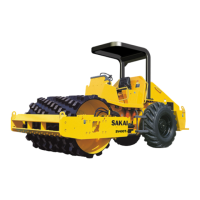
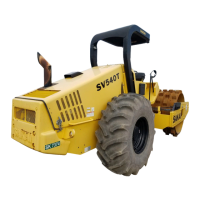
This document is a shop manual for the SAKAI SW800-II/850-II roller, providing important information for safe operation and maintenance. It emphasizes that operators and maintenance personnel must read and understand the manual before operating or servicing the unit, as improper operation can lead to injury or death. The manual also states that all information, specifications, and illustrations are based on the product information available at the time of publication and may change without prior notice due to model modifications.
Function Description:
The SAKAI SW800-II/850-II roller is designed specifically for the compaction of asphalt or soil road construction materials. Its primary function is to apply vibratory force to compact these materials, ensuring a dense and stable surface. The machine features a hydraulic transmission for propulsion and vibration, and an articulated steering system for maneuverability.
Important Technical Specifications:
General:
- Engine Model: DEUTZ TCD2012L04 2V Diesel engine (EPA Tier3), water-cooled, 4-cycle, 4-cylinder, in-line, with turbocharger.
- Displacement: 4.038 L (246 cu.in.).
- Rated Speed: 2,300 min⁻¹ (2,300 rpm).
- Rated Output: 95 kW (127.4 HP).
- Max. Torque: 495 N·m (365 lbf·ft) at 1,600 min⁻¹.
- Fuel Consumption: 236 g/kW·h (0.388 lb/HP·h) at 1,600 rpm.
- Electrical System: 14 V 95 A alternator, 12 V 3.0 kW starter, 12 V CCA 760 × 2 pcs. (12 V) battery.
SW800-II Specifics:
- Operating Weight: 10,900 kg (24,030 lbs.).
- Overall Length: 5,620 mm (221 in.).
- Overall Width: 1,905 mm (75 in.).
- Compaction Width: 1,700 mm (67 in.).
- Drive Speed: 1st gear 0 to 7.5 km/h (0 to 4.7 mph), 2nd gear 0 to 12.5 km/h (0 to 7.8 mph).
- Vibration Performance (Low Amplitude): Frequencies of 67 Hz (4,000 vpm), 50 Hz (3,000 vpm), 42 Hz (2,500 vpm). Centrifugal forces of 121 kN (27,120 lbs.), 68 kN (15,210 lbs.), 47 kN (10,580 lbs.). Amplitude 0.33 mm (0.013 in.).
- Vibration Performance (High Amplitude): Frequencies of 50 Hz (3,000 vpm), 42 Hz (2,500 vpm). Centrifugal forces of 108 kN (24,250 lbs.), 76 kN (16,980 lbs.). Amplitude 0.55 mm (0.022 in.).
- Water Spray Tank Capacity: 500 L × 2 (132 gal. × 2).
SW850-II Specifics:
- Operating Weight: 13,170 kg (29,030 lbs.).
- Overall Length: 5,820 mm (229 in.).
- Overall Width: 2,205 mm (87 in.).
- Compaction Width: 2,000 mm (79 in.).
- Drive Speed: 1st gear 0 to 7.0 km/h (0 to 4.3 mph), 2nd gear 0 to 11.0 km/h (0 to 6.8 mph).
- Vibration Performance (Low Amplitude): Frequencies of 67 Hz (4,000 vpm), 50 Hz (3,000 vpm), 42 Hz (2,500 vpm). Centrifugal forces of 148 kN (33,290 lbs.), 82 kN (18,520 lbs.), 58 kN (13,010 lbs.). Amplitude 0.33 mm (0.013 in.).
- Vibration Performance (High Amplitude): Frequencies of 50 Hz (3,000 vpm), 42 Hz (2,500 vpm). Centrifugal forces of 141 kN (31,750 lbs.), 100 kN (22,490 lbs.). Amplitude 0.55 mm (0.022 in.).
- Water Spray Tank Capacity: 600 L × 2 (159 gal. × 2).
Hydraulic System:
- Propulsion Pump Displacement: 90 cm³/rev (5.49 cu.in./rev).
- Vibrator Pump Displacement: 56 cm³/rev (3.42 cu.in./rev).
- Steering Control Type: Hydraulic type (articulated type) with a steering control angle of ± 37°.
- Hydraulic Oil Tank Capacity: 80 L (21 gal.).
Usage Features:
- Safety First: The manual emphasizes safety with DANGER, WARNING, and CAUTION labels, requiring operators to be fully aware of risks and to use protective equipment.
- Qualified Personnel: Operation, maintenance, and repair must be performed by qualified personnel with comprehensive training and necessary skills.
- Pre-Start Inspection: Daily inspection of the machine, including checking for malfunctioning or missing parts, readable safety stickers, fuel levels, seat belt condition, and clean operating platforms.
- Safe Operation: Always ensure no obstructions or persons are in the line of travel, remain seated with the seat belt fastened, use caution in congested areas, obey traffic regulations, and use hand signals when necessary. Avoid working near edges or on steep grades that could cause roll-over.
- Stopping Procedures: Always park on solid, level ground, apply the parking brake, move the travel lever to neutral, turn off the starter switch, and lock all compartments.
Maintenance Features:
- Scheduled Maintenance: Adherence to recommended routine inspections and adjustments at prescribed intervals is crucial for safe operation and optimum performance.
- Engine Maintenance: Refer to the engine manufacturer's shop manual for specific engine inspection and adjustment procedures.
- Hydraulic System: Do not work on the hydraulic system while the engine is running or under pressure. Wait for the system and fluid to cool down before disconnecting hoses. Use cardboard and wear gloves/safety glasses when checking for leaks.
- Electrical System: Disconnect battery cables when working on the electrical system or welding. Use only original fuses with specified ratings. Electrical work should only be performed by qualified electricians.
- Vibratory Drum Disassembly/Reassembly: Detailed precautions are provided for removal, installation, disassembly, and reassembly of the vibratory drum, including specific tightening torques for bolts and instructions for handling heavy components with appropriate lifting equipment.
- Fluid Management: Proper draining and filling of coolant, fuel, engine oil, vibrator case oil, and hydraulic oil are outlined, with instructions to check levels and circulate fluids after maintenance.
- Troubleshooting: Comprehensive troubleshooting guides are included for electrical and hydraulic systems, covering issues such as engine starting problems, propulsion issues, vibrator malfunctions, water spray system failures, and lighting problems. It provides step-by-step inspection procedures using a tester and lists possible causes and actions for various symptoms.
- Tightening Torque Chart: A detailed chart for tightening torques of metric coarse and fine screws, categorized by strength classification, is provided to ensure proper assembly.

 Need help?
 General

 To Next Page