Page 10
An optional SANWA 6 cell 1500mAh Ni-MH rechargeable battery and 100v〜240v AC charger are available separately and can be
used in place of the standard 4 cell Alkaline batteries. This option, while adding slightly more weight, still results in a lightweight,
well-balanced transmitter, but provides much longer battery life with reduced cost over the life of the transmitter, since there is no
need to continuously purchase 'AA' Alkaline batteries.
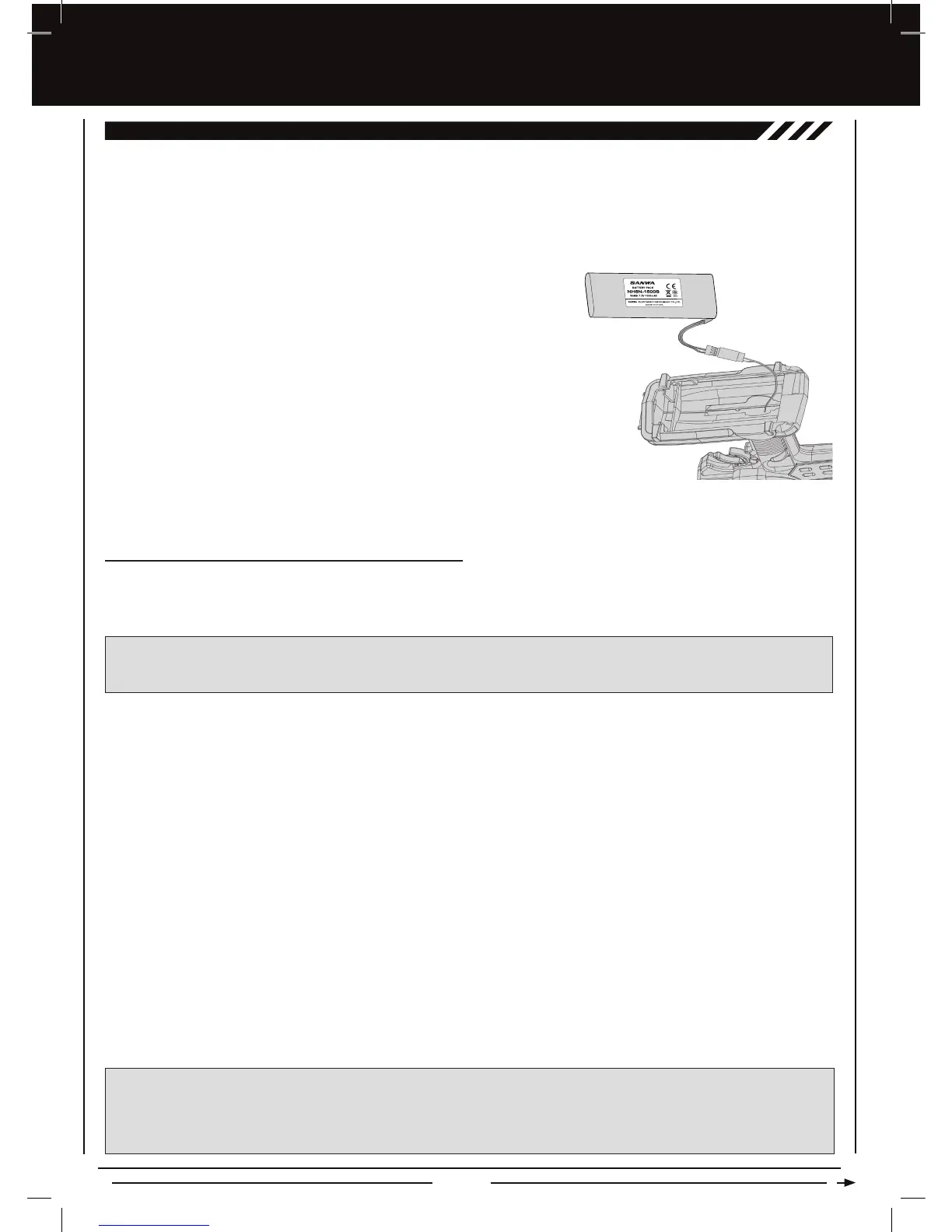
To install the optional 6 cell 1500mAh Ni-MH rechargeable battery, follow the
steps below:
1) Remove the battery cover from the transmitter.
2) Carefully pull the two pieces of foam rubber and the dry cell battery holder out
of the transmitter and unplug it.
3) Plug the 6 cell 2200mAh Ni-MH rechargeable battery into the battery power
plug in the transmitter, making sure that the polarity matches.
4) Place the battery into the middle of the transmitter, then cut the piece of foam rubber into four pieces and use them to
hold the battery centered within the battery compartment. Reinstall the battery cover.
Optional SANWA 6 cell 1500mAh Ni-MH Rechargeable Battery*.
OE-156CE or OE-156CU(UK) - Optional SANWA 100v〜240v AC Charger*.
*For availability and pricing, please see your local SANWA dealer.
Charging the Optional 6 Cell 1500mAh Transmitter Battery
The MX-3X 2.4GHz FHSS-3 transmitter features a Charging Jack located below the Wrist Strap Anchor, allowing you to recharge
the optional 6 cell 2200mAh Ni-MH battery without removing it from the transmitter. Use ONLY the recommended optional
SANWA 100v〜240v AC charger OE-156CE or OE-156CU.
Always follow the charging procedures described below to ensure safe and correct use of your Ni-MH battery.
The Ni-MH battery is not charged when purchased. It is necessary to charge the Ni-MH battery before operation.
Before charging the Ni-MH battery, double-check that the transmitter power switch is in the OFF position.
Overcharging reduces the life of the battery and can result in electrolyte spills, overheating, and bursting. This may cause
personal injury and/or property damage.
Do not plug the recommended charger into anything other than an AC 110v power outlet. Plugging the charger into anything
Do not short-circuit the Ni-MH battery terminals with wire or any other object.
WARNING Do NOT attempt to recharge 'AA' Alkaline batteries. Do NOT attempt to charge any type of battery other than the
optional Airtronics 6 cell 2200mAh Ni-MH battery using ONLY the recommended charger. Do not use the Charging Jack with
any other after-market fast charger or Peak-Detection charger, or the transmitter could be damaged.
WARNING An after-market peak-detection charger and/or cycler can be used to charge the Ni-MH transmitter battery,
interfere with the peak-detection charger's normal operation, resulting in over-charging and damaging the battery and possibly
the transmitter itself. Damage caused by charging the battery through the transmitter or using an incorrect battery type will not
be covered under warranty.
1) Plug the OE-156CE or OE-156CU charger into a 100v〜240v AC wall socket. The charger LED will illuminate green, indicating
that the charger is plugged in.
2) Plug the round connector from the charger into the Charging Jack in the transmitter. The charger LED will illuminate red,
indicating that the charger is charging.
3) Transmitter charger output is 150mAh, therefore, it will take approximately 10 hours to recharge a fully-discharged battery.
We suggest leaving the charger on overnight. Once fully-charged, the charger LED will once again illuminate green.
TX AND RX OPTIONS AND CONNECTIONS
USING THE optIONAL 6 CELL NI-MH BATTERY AND 110V AC CHARGER
however, the battery must first be removed from the transmitter to be charged. The circuitry within the transmitter will
Do not throw the Ni-MH battery or abuse it in any manner. Do not dispose of the NI-MH battery in the fire or allow it to overheat.
other than AC 110v outlet may result in smoking, sparks, or fire.


 To Next Page