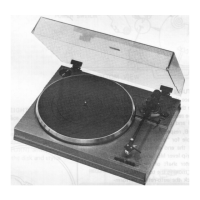
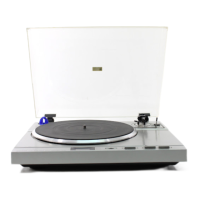
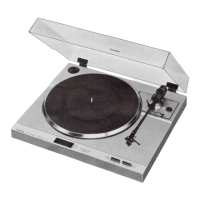
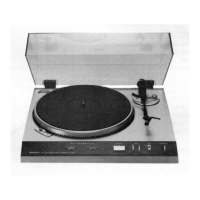
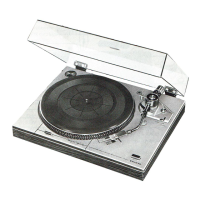
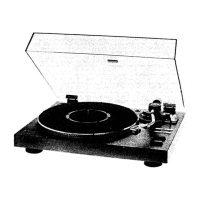
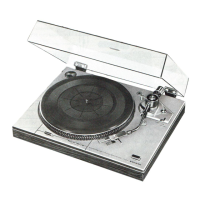
This document is a service manual for the Sanyo Stereo Turntable TP20 (Europe model). It provides detailed information for the operation, adjustment, and maintenance of the device.
The Sanyo TP20 is a stereo turntable designed for playing vinyl records at two standard speeds: 33 1/3 and 45 RPM. Its primary function is to convert the physical grooves of a record into an electrical audio signal, which can then be amplified and played through speakers. The turntable features a belt-drive system, which is known for reducing motor noise and vibration transmission to the platter, resulting in cleaner sound reproduction.
Important Technical Specifications:
- Motor: DC motor
- Drive system: Belt drive
- Speeds: 33 1/3 RPM and 45 RPM
- Wow & flutter: 0.05% WRMS (Weighted Root Mean Square), indicating very low speed variations, which is crucial for stable pitch.
- Signal to noise ratio: Better than 60 dB, signifying a good ratio of desired audio signal to background noise.
- Turntable platter: 11 1/2" (29.2 cm) diameter, likely made of aluminum or a similar material for stability and inertia.
- Tone arm: Static-balance type, a common design that allows for precise tracking force adjustment.
- Tracking error: ±1.5°, indicating the maximum deviation of the tonearm from the ideal tangent to the record groove.
- Cartridge: Magnetic stereo cartridge (MG-10J).
- Stylus: 0.5 mil diamond stylus (ST-10J), a standard size for playing microgroove records.
- Stylus pressure: 1.5 – 2.5 g, the recommended force for the stylus to track the record grooves effectively without excessive wear.
- Frequency response: 20 – 20,000 Hz, covering the full range of human hearing, ensuring accurate reproduction of audio frequencies.
- Overhang: 15 mm, a critical tonearm adjustment for minimizing tracking error across the record surface.
- Channel separation: Better than 25 dB, indicating good stereo imaging and distinction between left and right channels.
- Power source: AC: 220V, 50Hz (specific to the European model).
- Power consumption: 6W, relatively low power usage.
- Dimensions: Approximately 17-1/2" (W) x 5-5/8" (H) x 14-1/4" (D) (440 x 140 x 360 mm).
- Weight: Approximately 9 lbs. 1 oz. (4.1 kg), making it a moderately portable and stable unit.
Usage Features:
The Sanyo TP20 is designed for straightforward operation. It includes a tonearm with an auto-return function, which automatically lifts the tonearm and returns it to its rest position at the end of a record, preventing unnecessary stylus wear and extending record life. The turntable platter is designed to accommodate standard 12-inch and 7-inch vinyl records. The two selectable speeds (33 1/3 and 45 RPM) allow for playback of LPs, EPs, and singles. The static-balance tonearm allows users to adjust tracking force and anti-skate, which are crucial for optimal sound quality and stylus/record longevity.
Maintenance Features:
The service manual provides comprehensive instructions for various adjustments and maintenance procedures, ensuring the turntable operates at its peak performance.
- Adjustment of Tonearm Lever: This involves setting the cueing lever to UP and adjusting the distance between the stylus and the record to about 9mm by adjusting the arm lifter screw. This ensures proper clearance when lifting and lowering the tonearm.
- Adjustment of Tonearm Lifter: The turntable unit is set upside down, and the tone-arm is secured. The set screw (w/hex hole) is loosened, and the protrusion of the micro-switch contact is moved to the foremost end of the lever. This adjustment is crucial for the auto-return mechanism.
- Adjustment of Micro-Switch: The turntable unit is placed in its normal position, with the turntable platter at the top. The round head screw (Y3) is loosened with a screwdriver, and the micro-switch protrusion is adjusted so that the micro-switch moves a little toward the turntable center when the tonearm is moved. The micro-switch should be correctly positioned at a place where it provides a rotational start for the turntable when the tonearm head centers an area 35 through 38mm away from the center. This ensures the auto-start and auto-return functions operate correctly.
- Adjustment of Auto-Return: This involves turning the shaft, which is accessible with a long shaft screwdriver through the hole below the tonearm. When the stylus has reached a point approximately 65mm from the turntable center, the shaft clockwise or counter-clockwise is turned to select a position where it actuates the auto-return. This fine-tunes the auto-return point.
- Adjustment of Headshell: The headshell should be matched to either the right or the left. If necessary, the two screws on the bottom of the tubular arm are loosened, and the headshell is adjusted to ensure the stylus is normal to the record surface. This is vital for accurate tracking and minimizing record wear.
- Adjustment of Lift-Up Lever Spring: This involves switching off power when the auto-return has worked and adjusting spring tension to provide a clearance of 11mm between the stylus and the record. This ensures the tonearm lifts high enough to clear the record.
- Adjustment of Turntable Speed: The manual details how to set the fine speed control dials to their center positions (each has two protrusions, of which only one can be set to the center). Adjustments are made by inserting a screwdriver into the holes. When properly adjusted, the strobe scope marks on the turntable platter should appear stationary at the selected speed (33 or 45 RPM). This ensures accurate playback speed.
The manual also includes an exploded view of the cabinet and mechanism, along with a comprehensive parts list for packing, cabinet, arm, electrical parts & arm (JPU1005UM), mechanism (PM1005UM), and screw mounting. This detailed breakdown is invaluable for identifying and replacing components during repair. Schematic and wiring diagrams are also provided, which are essential for troubleshooting electrical issues.
Overall, the Sanyo TP20 is a well-engineered stereo turntable with a focus on reliable performance and ease of maintenance, making it a suitable device for enjoying vinyl records.

 Need help?

 To Next Page
 General