5
QUICKCAT
®
SAFETY
Interrupting operation
– Before leaving the operator's position:
- Park on level ground;
- Disengage the PTO;
- Set the parking brake;
- Shut off the engine and remove the key.
– Disengage the PTO and wait until the blades quit
rotating:
- before raising cutterdeck;
- when not mowing;
- for transport;
- when crossing surfaces other than grass.
– Stop the engine, disengage the PTO and wait
until the blades quit rotating:
- before refueling;
- before removing grass catcher;
- before making height adjustment unless the
adjustment can be made from the operator's
position.
– Stop the engine, disengage the PTO and
disconnect the spark plug wire(s) or remove the
key:
- before clearing blockages or unclogging chute;
- before checking, cleaning or working on the
machine;
- after striking a foreign object. Inspect the
machine for damage and make repairs before
restarting.
- if the machine begins to vibrate abnormally:
Inspect and make repairs as needed before
restarting;
- except for repairs or adjustments as
specically noted, such as for carburetor
adjustment, where the engine must be running.
Keep hands and feet clear of moving parts in
these circumstances.
– Allow the blades to come to a complete stop
when stopping operation to clear blockages,
unclog, inspect the machine, do maintenance or
repair.
– Reduce the throttle setting during engine shut-
down and, if the engine is provided with a shut-
off valve, turn the fuel off at the conclusion of
mowing.
MOWING SLOPES
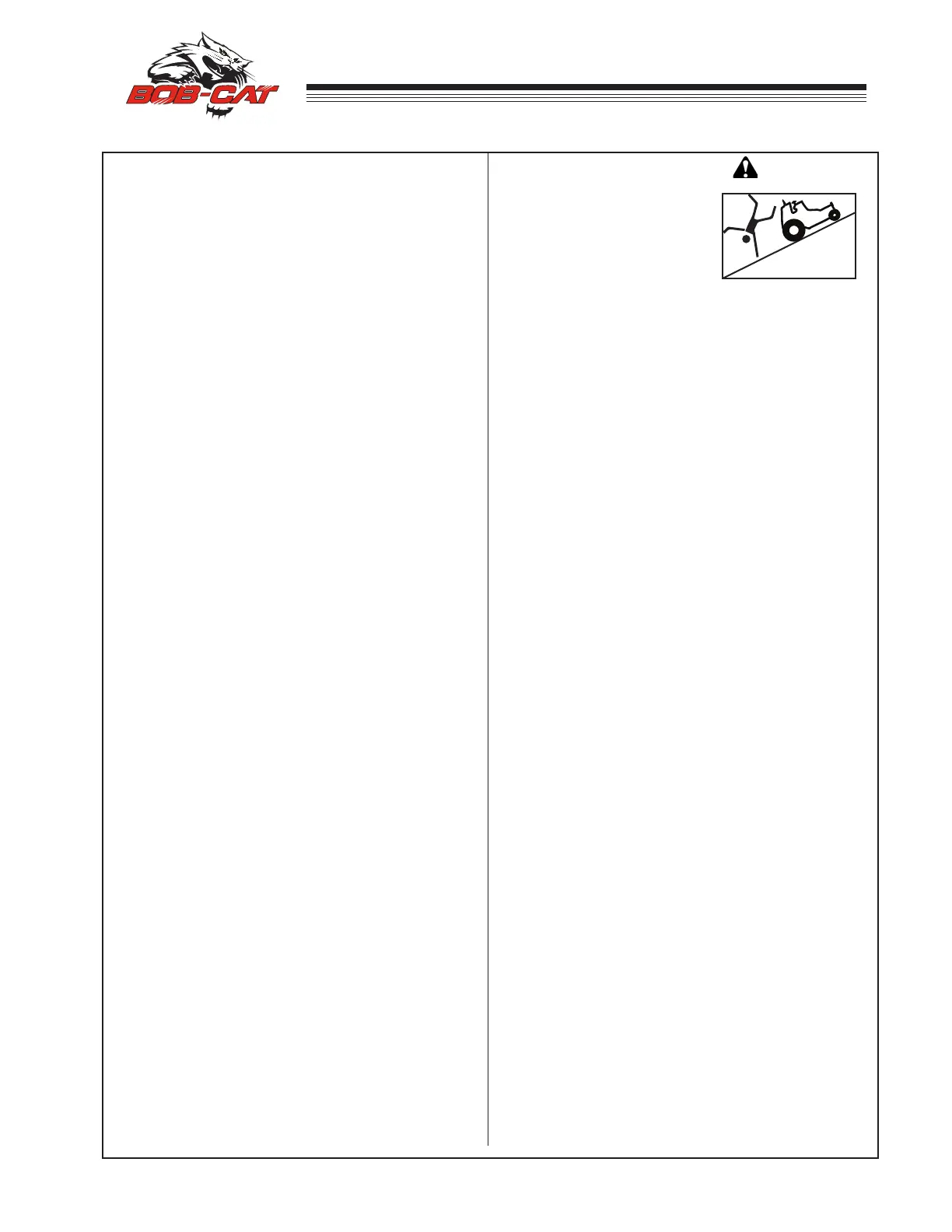
Slopes are a major factor in loss-
of-control and tipover accidents
that sometimes lead to severe
injury or death. All slopes
require extra caution.
– Do not mow on slopes if
uneasy or uncertain. Ultimate reponsibility for safe
operation on slopes rests with the operator.
– Do not mow excessively steep slopes.
– With ride-on machines, including articulated
steering machines, mow up and down slopes, not
across, except for zero turn machines. Zero turn
machines should mow across slopes.
– With walk-behind machines, always mow across
slopes, not up and down.
– Avoid starting or stopping on a slope. If tires lose
traction, disengage the blades and proceed slowly
straight down the slope.
– With a zero turn machine, if tires lose traction
going down a slope, steering control may be
regained by speeding up.
– Mid-mount zero turns (belly mounted deck) have
much greater traction pointed up slope than down
slope. Be aware that traction may be lost going
down a slope. Do not operate a mid-mount zero
turn on slopes it cannot back up.
– Keep all movement on the slopes slow and
gradual. Do not make sudden changes in speed
or direction.
– Do not turn on slopes unless necessary, and then
turn slowly and downhill when possible.
– Stay away from slopes if the ground is loose or if
caught in the rain during mowing.
– Use lower speeds on a slope to avoid stopping or
shifting.
– Use extra care with grass catchers or other
attachments. These can change the stability of the
machine.
– Avoid driving over ruts, holes, rocks and roots
whenever possible. Be alert to dips and rises.
Uneven terrain can overturn a mower or cause it
to slide.
– Do not mow dropoffs, ditches or embankments.
The machine could suddenly turn over if a wheel
runs over the edge or an edge caves in.
– Follow the manufacturer's recommendations
for wheel weights or counterweights to improve
stability.
WARNING



 To Next Page