4-56 SELOGIC
®
Control Equations
Date Code 20000616 SEL-300G Instruction Manual
In multibreaker applications or in applications where only the generator current is measured,
separate breaker failure protection should be provided for each breaker.
BREAKER FAILURE PROTECTION WITH BREAKER FLASHOVER DETECTION
Prior to synchronizing, if the generator terminal voltage is out of phase with the system voltage,
up to two per unit voltage can appear across the open breaker. If a breaker pole insulation fails at
this point, tripping the breaker will not deenergize the generator. It is useful in this case to
initiate breaker failure timing.
The SEL-300G1 Relay can provide breaker flashover detection as an addition to the breaker
failure protection, if the relay neutral current input is not being applied for generator neutral
overcurrent protection. In this case, the neutral current input is connected to the generator
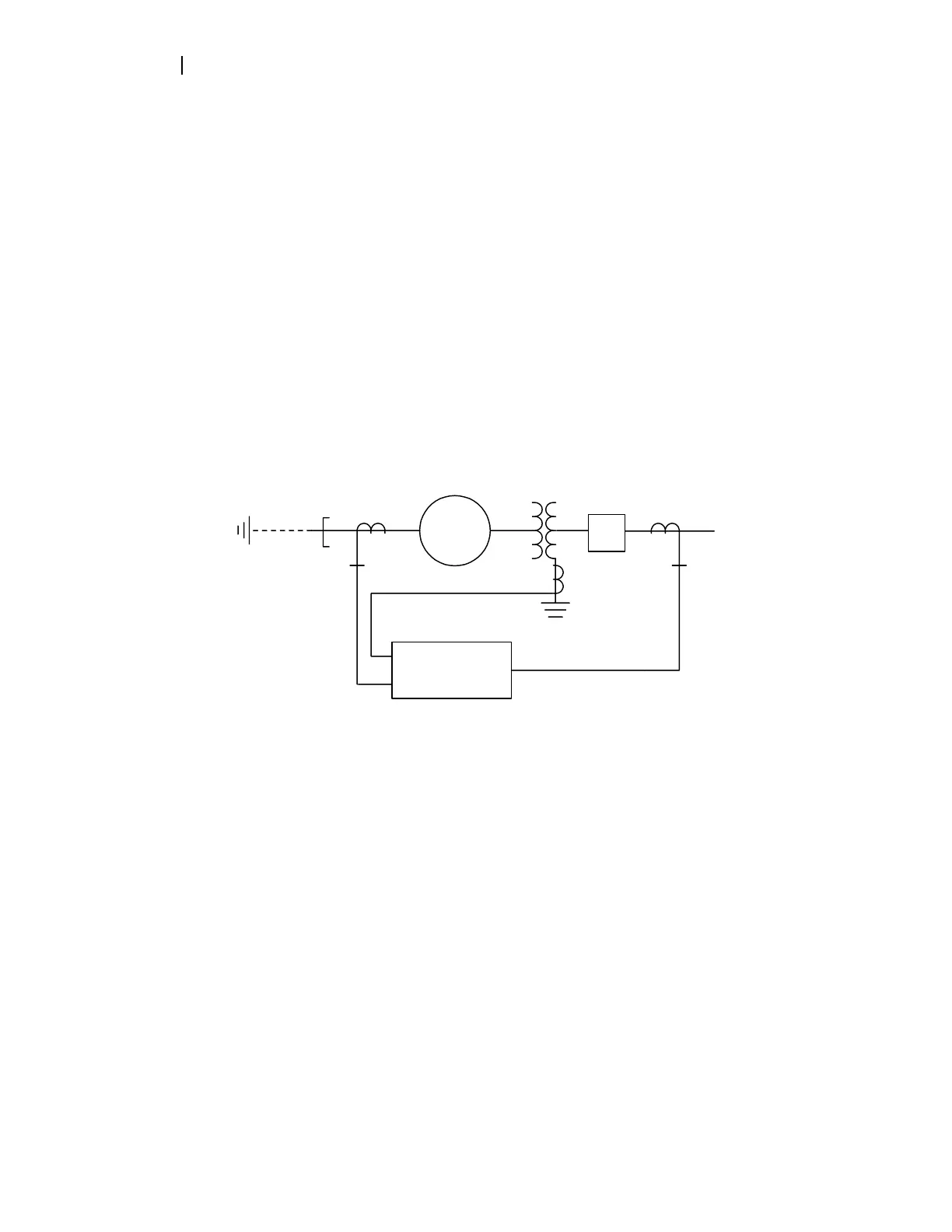
step-up transformer high-side neutral CT as shown in Figure 4.29.
DWG: M300G165
SEL-300G1
(Partial)
GEN
52
87 Inputs
33
Optional
Step-Up
Transformer
IN Input
Figure 4.29: Generator/Breaker Topology Where SEL-300G1 Relay Offers
Breaker Failure and Breaker Flashover Protection
In this topology, the SEL-300G Relay is able to measure directly current flowing in the generator
breaker and step-up transformer neutral circuit. The SV7 SEL
OGIC Control Equation below
creates a breaker failure plus breaker pole flashover function based on circuit breaker current,
transformer neutral current, and the breaker auxiliary contact, 52A, state. The SEL
OGIC Control
Equation logic is shown in Figure 4.30.
SV6 = 50N1*!52A
SV6PU = 0.10 s
SV6DO = 0.00 s
SV7 = (SV7 + IN103 + TRIP1 + SV6T) * (50H1 + 50R1 + 52A)
A breaker pole flashover is detected by the SV6 SEL
OGIC Control Equation variable. If a single
breaker pole flashes over, the 50N1 element picks up and the 52A input remains deasserted. If
after 0.10 second the 52A input does not indicate that the breaker has closed, the SV6T Relay
Word bit asserts and initiates breaker failure timing.


 To Next Page