Relay Element Settings 2-1
SEL-300G Instruction Manual Date Code 20020206
SECTION 2: RELAY ELEMENT SETTINGS
RELAY FUNCTIONAL OVERVIEW
In preparation to calculate settings for the various relay functions and elements, it is helpful to
understand what the relay does with those settings once entered. The SEL-300G Relay
• Measures generator voltages and currents,
• Acquires optoisolated control input states,
• Performs protection element algorithms,
• Evaluates built-in and user settable logic conditions, and
• Controls output contacts.
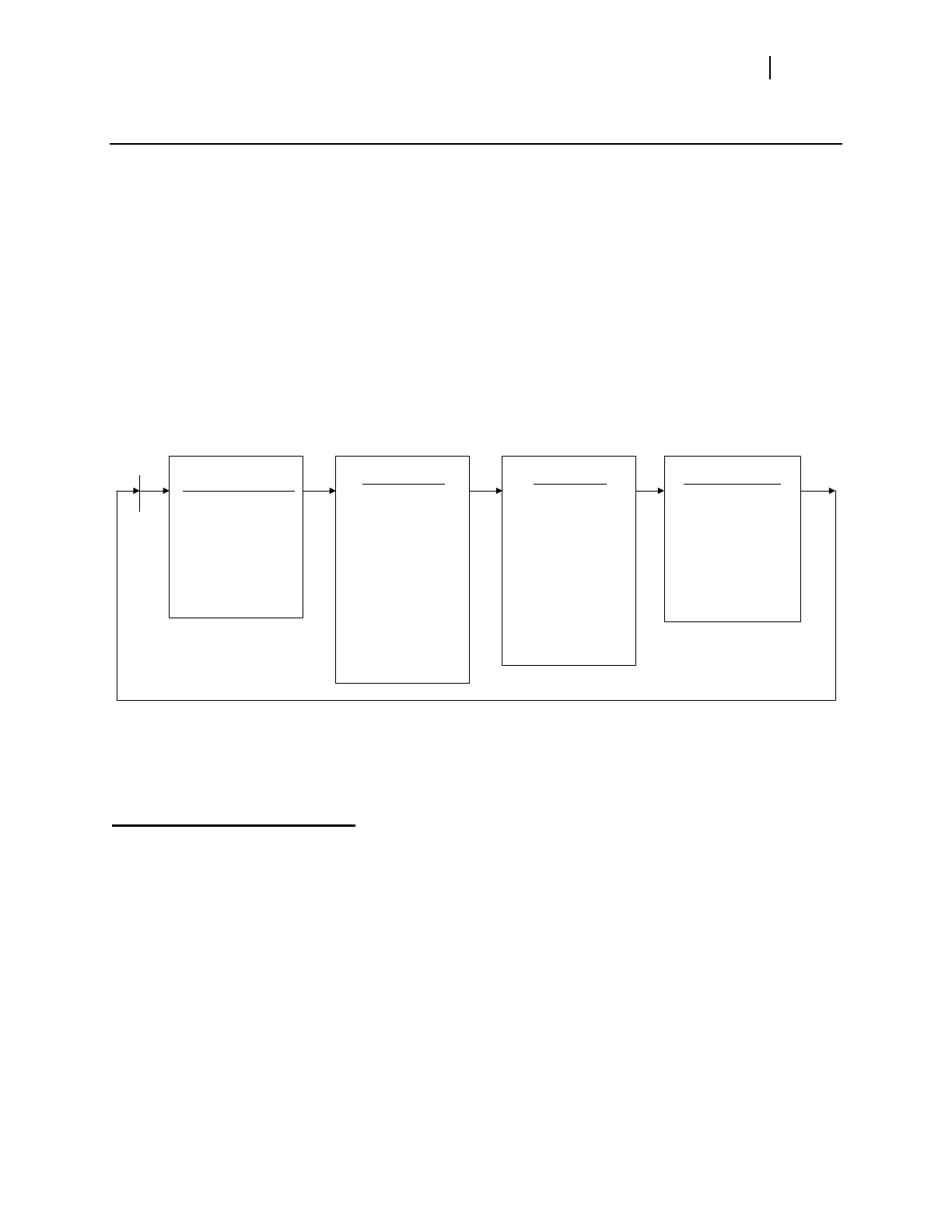
Figure 2.1 illustrates this process.
DWG: M300G039
Data
Acquisition
& Filtering
- Sample Low-Pass
Filtered AC Signals
- Digitally Filter Sampled
AC Signals
- Acquire Control Input
State
Process
Relay Elements
- Process Enabled
Element Algorithms
- Evaluate Torque-
Control Equations
- Process Torque-
Controlled Element
Algorithms
- Advance Timers
- Update Relay Word
Process Logic
- Evaluate Fixed Relay
Logic
- Evaluate SEL
OGIC
â
Control Equation
Variables
- Control Output
Contacts
- Generate Front-Panel
Targets, Messages
Perform
Background Tasks
- Perform Relay Self-
Tests
- Store Event Reports
and SER Records
- Respond to Serial Port
and Front-Panel
Commands
Figure 2.1: Relay Processing Order
Data Acquisition and Filtering
The SEL-300G Relay contains current and voltage transformers that step down the secondary
voltage and current signals to levels that are safely handled by the internal electronic
components. The low-level ac signals pass through analog low-pass filters and a multiplexer to
an analog-to-digital converter. The multiplexer and analog-to-digital converter sample the
voltage and current signals and convert them to digital values used by the microprocessor.
The SEL-300G Relay tracks the frequency of the ac voltage. The relay adjusts the sampling rate
to the present system frequency (in the range from 20 to 70 Hz) and takes 16 digital samples of
the analog signals every cycle. When ac voltage is removed from the relay, the sampling clock
automatically adjusts to the user settable nominal frequency, FNOM, either 50 or 60 Hz.
The relay digitally filters the latest current and voltage samples to remove unwanted signal
components. There are digital filters to extract the fundamental frequency voltages and currents,
third-harmonic voltages, and second-harmonic currents. The majority of protection and metering


 To Next Page