Schweitzer Engineering Laboratories, Inc. SEL-787-3, -4 Data Sheet
9
alarm function. The element is supervised by the
SEL
OGIC torque control equation, which enables or
disables the element as required by the application.
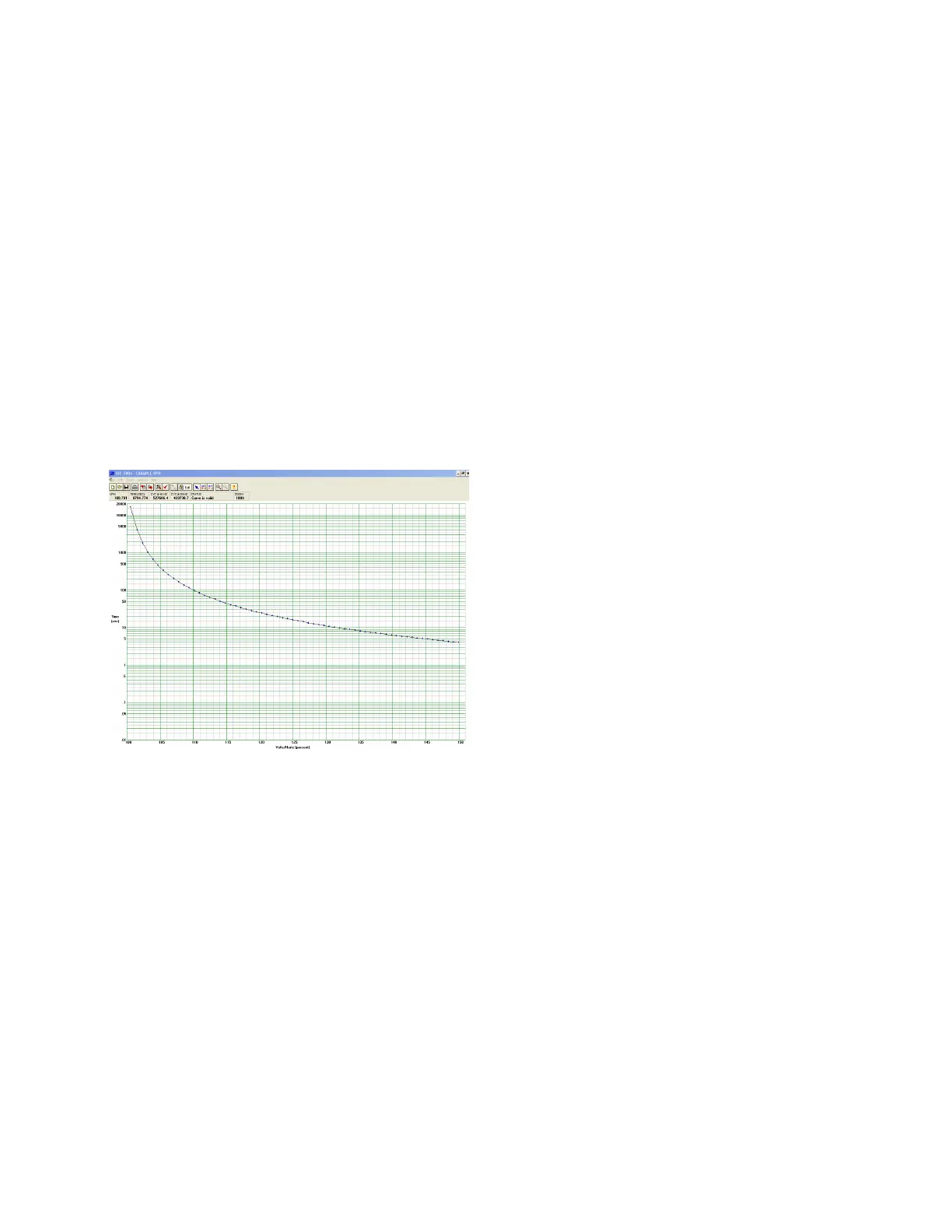
Use the SEL-5806 Volts/Hertz User Curve Design
Software to set the user-defined curve (see Figure 6). For
tripping, the relay provides a time-integrating element
with a settable operating characteristic. You can set the
relay element to operate as an inverse-time element; a
user-defined curve element; a composite element with an
inverse-time characteristic and a definite-time
characteristic; or a dual-level, definite-time element.
For any of these operating characteristics, the element
provides a linear reset characteristic with a settable reset
time. The torque control setting also supervises this
element. The tripping element has a percent-travel
operating characteristic similar to that used by an
induction-disk, time-overcurrent element. This
characteristic emulates the heating effect of
overexcitation on transformer components.
Figure 6 SEL-5806 Volts/Hertz User Curve Design
Example
Over- and Undervoltage Protection
The SEL-787 with voltage inputs contains phase over-
and undervoltage, and sequence overvoltage elements
that help create protection and control schemes, such as
undervoltage load shedding or standby generation
start/stop commands. All voltage elements provide two
pickup levels with definite-time delay settings. The fol-
lowing over- and undervoltage elements are available:
➤ Phase undervoltage (27P) and overvoltage (59P) ele-
ments that operate on the measured phase-to-neutral
voltages.
➤ Phase-to-phase undervoltage (27PP) and overvoltage
(59PP) elements that operate on the measured
phase-to-phase voltages.
➤ Negative-sequence overvoltage (59Q) and residual-
ground overvoltage (59G) elements that operate on
the calculated negative-sequence and residual-ground
voltage, respectively.
➤ Phase undervoltage (27S) and phase overvoltage
(59S) elements that operate on VS channel voltage.
Loss-of-Potential Detection
The SEL-787 with optional voltage inputs contains loss-
of-potential (LOP) detection logic on the three-phase
voltage input to the relay. The LOP logic detects open
voltage transformer fuses or other conditions that cause a
loss of relay secondary voltage input. The SEL-787 with
optional voltage inputs includes LOP logic that detects
one, two, or three potentially open fuses. This patented
LOP logic is unique, because it does not require settings
and is universally applicable. The LOP feature allows for
the blocking of protection elements to add security
during voltage transformer fuse failure.
Synchronism Check/Station DC
Battery Monitor
The SEL-787 with the voltage option allows you to pro-
gram the VS/Vbat voltage channel for use as either syn-
chronism check or station dc battery monitor. When
programmed as a synchronism-check channel, single-
phase voltage (phase-to-neutral or phase-to-phase) can
be connected to the voltage input for synchronism check
or hot/dead line check across the circuit breaker to which
the three-phase voltages are assigned. When the channel
is programmed for battery monitor, the station dc battery
voltage can be monitored. The relay also allows you to
program over- and undervoltage elements on the voltage
channel.
Over- and Underfrequency Protection
The SEL-787 with optional voltage inputs contains four
frequency elements. Each element operates as either an
over- or underfrequency element with or without time
delay, depending on the element pickup setting.
If the element pickup setting is less than the nominal
system frequency setting, the element operates as an
underfrequency element, picking up if the measured
frequency is less than the set point. If the pickup setting
exceeds the nominal system frequency, the element
operates as an overfrequency element, picking up if the
measured frequency exceeds the set point.
The SEL-787 with optional voltage inputs uses the
positive-sequence voltage to determine system
frequency. All frequency elements are disabled if the
positive-sequence voltage is less than the minimum
voltage threshold.



 To Next Page