Boston Electronics Corporation, 91 Boylston Street, Brookline MA 02445
(800)347-5445 or (617)566-3821 * fax (617)731-0935 * boselec@boselec.com * www.boselec.com
Bartles Industrial Estate, North Street, Redruth, Cornwall TR15 1HR
Tel. (01209) 314608 E-mail: scitec@scitec.uk.com
Fax. (01209) 314609 Web: http://www.scitec.uk.com
3.3 Single Ended DC Coupled Input (Default Setting)
The default setting is for a single ended DC coupled input. This mode gives the best noise
performance. Although the input is DC coupled, the input will not saturate with up to the
following DC offsets on the input:
Input Gain Setting Maximum DC Input Offset Before
Saturation Occurs
1V to 300µV ±10V
100µV to 10µV ±1V
3µV ±300mV
The input impedance of the lock-in in this mode is 10
12
Ω ||1nF.
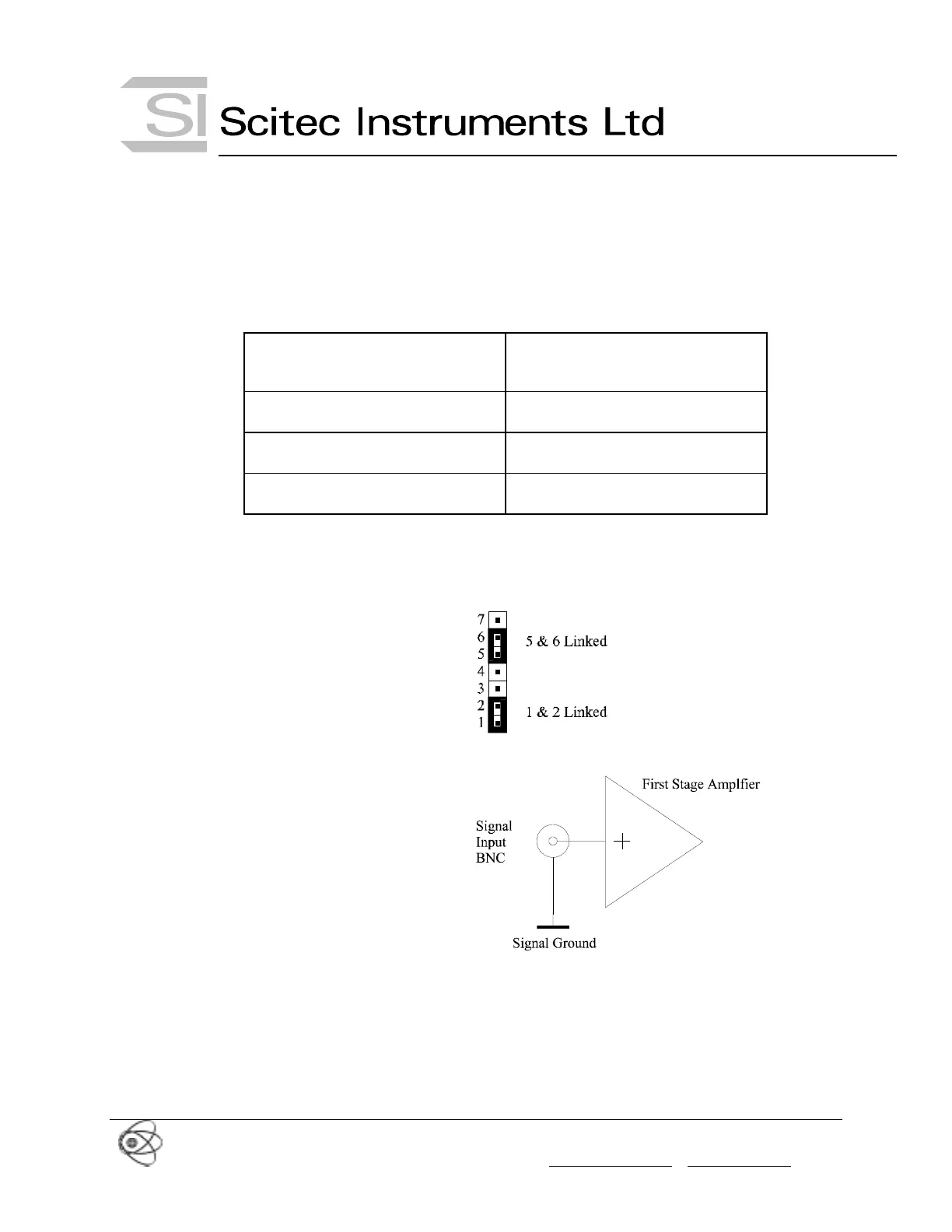
The jumper settings for this mode is given in Figure 3. The equivalent circuit is shown in
Figure 4.
Figure 3 Single Ended DC Coupled Input Settings
Figure 4 Single Ended DC Coupled Input Circuit
3.4 Single Ended AC Coupled Input
For applications where large amounts of DC offset are expected on the input, the input stage
can be AC coupled with an RC network. Please note that the high value resistor will add a
large amount of thermal noise to the input. (This mode of operation is common to a lot of other
manufacture’s lock-in amplifiers. When measuring the input noise of their instruments, it is
standard practice to short the input which has the nice result of removing the thermal noise of



 To Next Page