
 Need help?
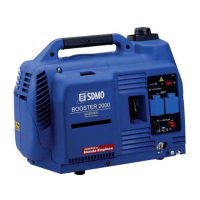
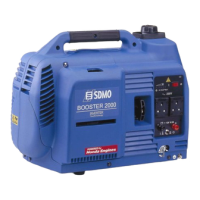
Do you have a question about the SDMO BOOSTER 2000 UK and is the answer not in the manual?
Provides guidance on reading the manual and offers contact information for feedback.
Explains the meaning of various safety pictograms and identification plates found on the generating set.
Lists and identifies the main parts of the generating set based on diagram A.
Details hazard symbols and their implications for health and safety.
Provides essential advice on handling, maintenance, and pre-operation checks.
Outlines crucial safety measures to prevent electrical shock hazards during operation.
Details precautions to prevent fire hazards, especially regarding flammable materials.
Warns about toxic exhaust gases and the need for proper ventilation.
Provides safety instructions for refueling, emphasizing fire prevention.
Advises caution regarding hot engine parts and oil.
Specifies safety measures when handling batteries, including avoiding sparks and acids.
Offers guidance on responsible disposal of oil and noise reduction.
Warns against interacting with moving parts while the generator is running.
Explains how to calculate and avoid overloading the generating set.
Details the standard conditions under which the set's performance is rated.
Step-by-step guide to checking and topping up engine oil before starting.
Instructions for checking and filling the fuel tank safely.
Guidance on inspecting the air filter for cleanliness and proper working order.
Explains the procedure for earthing the unit for safety and static dissipation.
Recommendations for placing the generating set in a suitable location.
Detailed steps for starting the generator, including checks and choke operation.
Procedures for operating the generator for AC and DC power output.
Instructions for using the generator for AC power output.
Guidelines for using the 12V DC output for charging batteries.
Steps for safely shutting down the generator, including cool-down.
Describes the mechanism that stops the engine due to low oil level.
Explains the function of circuit breakers in protecting against overloads and short circuits.
Details the indicator and shutdown for electrical overcharge.
Notes that maintenance intervals may vary based on operating environment.
Provides a schedule for routine maintenance tasks based on usage frequency.
Step-by-step guide for cleaning the air filter elements.
Procedure for draining and refilling engine oil.
Instructions on inspecting, cleaning, and gapping spark plugs.
Emphasizes the importance of daily checks for loose fasteners.
Guidance on cleaning the exterior of the generating set.
Procedure for draining and refilling oil for long-term storage.
Steps to prepare the fuel system for storage, including draining.
Instructions on treating the spark plug and cylinder for storage.
Details what types of defects are covered under the guarantee.
Specifies the duration of the guarantee and when it commences.
Clarifies limitations on the supplier's liability for damages.
Defines the supplier's responsibility concerning their own staff and equipment.
 General
| Voltage | 230V |
|---|---|
| Frequency | 50Hz |
| Fuel | Petrol |
| Fuel Tank Capacity | 3.6L |
| Fuel Type | Petrol |
| Noise Level at 7 m | 68 dB(A) |
| Maximum Power (LTP) kVA | 2.2 kVA |
| Maximum Power (LTP) kW | 2.0 kW |
| Continuous Power (COP) kVA | 2.0 kVA |
| Continuous Power (COP) kW | 1.8 kW |
| Rated Power | 1.8 kW |
| Maximum Power | 2.0 kW |


 To Next Page