
 Need help?
Do you have a question about the SDMO R33C3 and is the answer not in the manual?
General advice for using and maintaining the generating set.
Explains the warning symbols used in the manual for immediate and potential danger.
Explains various pictograms used on the equipment for safety and information.
Guidelines for installing, using, and maintaining the equipment and protecting personnel.
Safety measures related to electrical hazards, including risk of electric shocks.
Safety measures to prevent fire, burns, and explosions related to fuel and pressurized fluids.
Precautions regarding toxic risks from exhaust gas, coolant, and fuels/oils.
Safety measures for handling phases of the equipment to prevent risks of dropping.
Safety measures to prevent hearing loss from high sound levels.
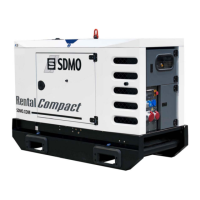
Overview of the generating set and its main components.
Detailed technical data for the generating set, including dimensions, output, and engine data.
How to identify the generating set and its components using identification plates.
Information on the fluid retention system for collecting leaks or spills.
General information on fuels, lubricants, and coolants used with the generating set.
Warnings to be observed while transporting the generating set.
Steps to prepare the equipment for transportation.
Procedures for transporting generating sets by road.
Procedures and safety measures for safely unloading the generating set.
Overview of the steps for correctly connecting the generating set to the installation.
Measures to protect individuals and equipment, focusing on earthing systems.
General information and standards for making electrical connections.
Detailed inspection of the engine compartment and checking of fluid levels before starting.
Presentation of the NEXYS control panel, including buttons, LEDs, and display functions.
Overview of the TELYS control panel, including its front panel layout and components.
Step-by-step procedure for starting the generating set using the TELYS control panel.
How alarms and faults are displayed and indicated on the TELYS control panel.
Reminder on the importance of following the maintenance schedule.
Essential safety precautions to observe before performing maintenance.
A schedule detailing maintenance tasks and their intervals based on operating hours and time.
Maintenance schedule for the trailer, including checks and lubrication.
Guidance on troubleshooting by referring to appended manuals.
Procedures and recommendations for performing no-load and on-load tests on the generating set.
How to check and maintain the electrolyte level in the starter batteries.
Procedure for checking battery voltage and acid density to determine charge status.
Guidelines for charging starter batteries, including current and time recommendations.
How to clean battery terminals and maintain connections to prevent issues.
A table outlining observed faults, probable origins, and recommended measures for starter batteries.
Procedure for configuring the generating set for dual frequency operation (50Hz/60Hz), requiring a qualified electrician.
How to select the desired neutral system for the generating set.
Description of the 3-way valve used to select fuel supply sources.
User and maintenance manual for the engine component.
User and maintenance manual for the alternator component.
Procedures for receiving and inspecting the alternator upon delivery.
Electrical and mechanical specifications for the LSA 42.2 alternators.
Steps for installing and commissioning the alternator, including safety measures.
Guidelines for regular servicing and maintenance of the alternator.
Information on available spare parts and how to order them.
Procedures for installing and maintaining the R250 AVR.
Procedures for installing and commissioning the R250 AVR, including electrical checks and settings.
Troubleshooting table for common electrical faults related to the R250 AVR.
Procedures for installing and maintaining the R438 AVR.
Procedures for installing and commissioning the R438 AVR, including electrical checks and settings.
How to adjust the settings on the R438 AVR, including potentiometer and jumper configurations.
Troubleshooting table for common electrical faults related to the R438 AVR.
 General
| Acoustic power Lwa dB(A) | 96 |
|---|---|
| Circuit breaker | Yes |
| Compression ratio | 8.5 : 1 |
| Cooling | Air |
| Engine speed (rpm) | 3000 |
| Fuel | Petrol |
| Governor | Mechanical |
| Insulation class | H |
| Number of cylinders | 1 |
| Oil capacity (L) | 0.6 |
| Output voltage (V) | 230 |
| Protection class | IP 23 |
| Voltage (V) | 230 |
| Frequency | 50 Hz |
| Fuel Type | Petrol |
| Continuous power kW | 2.8 |
| Engine distribution | OHV |
| Starting | Recoil |



 To Next Page