Safe driving
risk of injury. The following points cover part
of the saf
et
y equipment in your SEAT
1)
:
●
thr
ee-point seat belts,
●
belt tension limiters for the front and rear
side seats,
●
belt tensioners for the front and rear side
seats,
●
front airbags,
●
knee airbags,
●
side airbags in the front seat backrests,
●
head-protection airbags,
●
“ISOFIX” anchor points for child seats in the
rear side seats with the “ISOFIX” system,
●
height-adjustable front head restraints,
●
rear head restraints with in-use position and
non-use position,
●
adjustable steering column.
The safety equipment mentioned above
works together to provide you and your pas-
sengers with the best possible protection in
the event of an accident. However, these
safety systems can only be effective if you
and your passengers are sitting in a correct
position and use this equipment properly.
Safety is everyone's business!
Correct position of the vehi-
cle occupants
Correct sitting position for the driv-
er
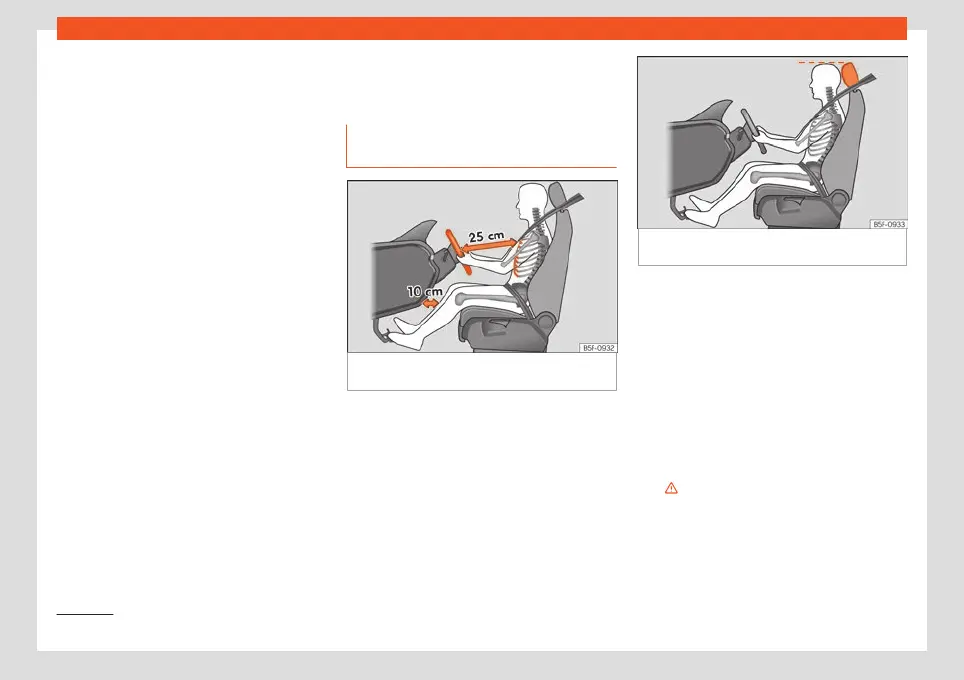
Fig. 87
The proper distance between driver
and st
eering wheel
.
Fig. 88 Correct head restraint position for the
driver.
For your own safety and to reduce the risk of
injury in the e
v
ent of an accident, w
e recom-
mend the following adjustments for the driver:
–
Adjust the steering wheel so that there is a
distance of at least 25 cm between the
steering wheel and the centre of your chest
››› Fig. 87.
–
Move the driver's seat forwards or back-
wards so that you are able to press the ac-
celerator, brake and clutch pedals to the
floor with your knees still slightly angled
›››
.
–
Ensure that you can reach the highest point
of the st
eering wheel.
–
Adjust the head r
estr
aint so that its upper
edge is at the same level as the top of your
»
1)
Depending on the version/market.
65


 To Next Page