■ Time zones and time differences
There are time differences around the world based on “Coordinated Universal Time (UTC)”.
There are 24 regions (Time Zones) around the world with a time difference of one hour. This
system has been adopted internationally by setting the total time difference around the world as
24 hours.
Further, Daylight Saving Time (DST) is individually adopted in countries and regions.
[What is UTC (Coordinated Universal Time)?]
UTC is the universal standard time coordinated through international agreement. It is used as the official
time around the world. UTC is a time coordinated by adding leap seconds to the “International Atomic
Time (TAI)” determined from atomic clocks in the world, in order to correct the deviation from the
astronomically defined universal time (UT).
[What is summer time (DST)?]
Summer time is Daylight Saving Time (DST).
Advance the watch one hour to prolong daytime during longer daylight hours in summer.
Daylight saving time has been adopted in about 80 countries, mainly in Europe and North America.
The adoption and duration of Daylight Saving Time (DST) vary depending on the country.
* Time differences between regions and daylight saving time may change due to circumstances of a country or
region.
* In some regions, time zones that differ from UTC by half- or quarter-hour time differences are established. (For
example, some parts of India)
* Each indication may differ depending on the model (design) of the watch.
EN
36
4
TIME DIFFERENCE ADJUSTMENT FUNCTION
■ Time difference adjustment Q&A
Q : When returning to Japan from overseas, is the time automatically set to Japan time?
A : Just moving does not adjust your watch to Japanese local time.
When wearing a watch in Japan, set to Japan time by use of the time difference adjustment function.
Q : The hands stop during operation of time difference setting, therefore, does time lag occur?
A : The internal circuit stores the time, therefore, no time lag occurs.
Q : When a time difference for regions out of the radio signal reception range is set, the watch will not
receive a radio signal. How is the accuracy of the watch at that time?
A : The watch has an accuracy of a normal quartz watch in that case. (Monthly rate: ±15 seconds)
Q : How is adjustment made to a local time with a time difference of 15 minutes or 30 minutes?
A : The time can be adjusted on a 1 hour basis by use of the time difference adjustment function. When
adjusting to a local time with a time difference of 15 minutes or 30 minutes, refer to
“How to manually set the time (1B21: non date-displaying model)” → P.63
“How to manually set the time (1B22 / 1B32: date-displaying models)” → P.66
EN
37
4
TIME DIFFERENCE ADJUSTMENT FUNCTION
Charging the battery
■ How to charge the battery
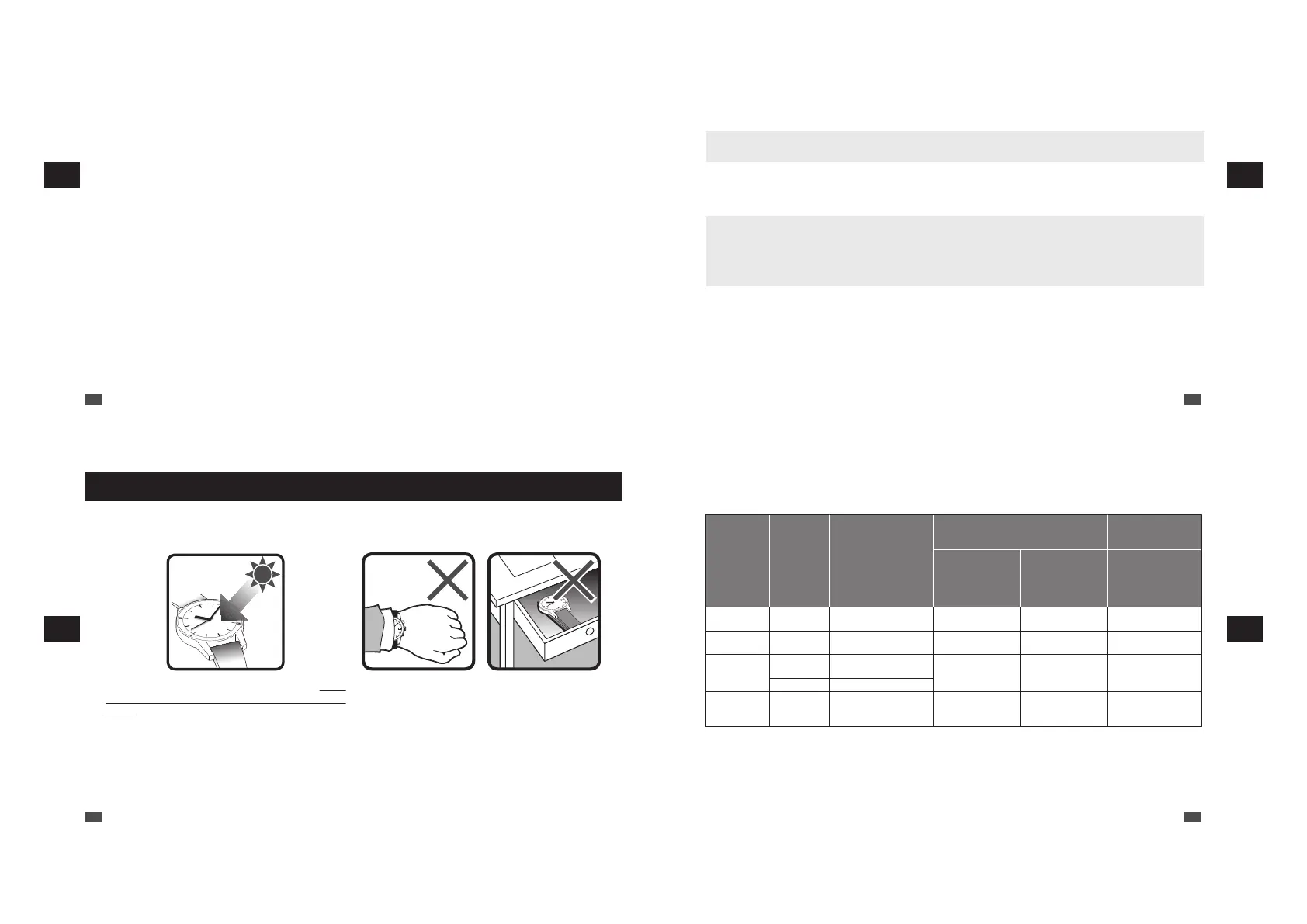
Expose the dial to light to charge the watch.
To ensure optimal performance of the watch, make
sure that the watch is kept sufficiently charged at all
times.
Under the following situations, the energy of the watch is
likely to be depleted, resulting in stoppage of the watch:
• The watch is concealed under a sleeve.
•
The watch is used or stored under conditions where
it cannot be exposed to light for a long time.
* Be careful to make sure that the watch does not get hot when it is charging. (The operating temperature range is
Between −10°C and +60°C (14°F and 140°F).)
* When you first start using the watch or starting it after it stopped due to a lack of charge, charge the watch sufficiently
using the table on P.39 as a guide.
EN
38
5
SOLAR CHARGING FUNCTION
■ Guide to charging times
Charge the watch using the times below as a guide.
Illuminance
lx (LUX)
Light source Condition (Example)
From the state where the watch is
stopped (Not charged)
In the state where
the hand moves (The
watch is charged)
Time required for
fully charging the
watch
Time required for
charging the watch
to start moving at
one-second
intervals
Time required for
charging the watch
to last for 1 day
700
Fluorescent
light
General offices - - 5 hours
3,000
Fluorescent
light
30 W 20 cm 200 hours 5 hours 1.5 hours
10,000
Fluorescent
light
30 W 5 cm
60 hours 1 hours 15 minutes
Sunlight Cloudy day
100,000 Sunlight
Sunny day (Under direct
sunlight on a summer
day)
24 hours 30 minutes 3 minutes
The figures of “Time required for charging the watch to start moving at one-second intervals” are estimations of
time required to charge the stopped watch by exposing it to light until it moves at steady one-second intervals.
Even if the watch is partially charged for a shorter period, the watch will resume one-second interval movement.
However, it may shortly return to two-second interval movement. Use the charging time in this column as a rough
guide for sufficient charging time.
* The seconds hand movement indicates the remaining amount of energy. “Checking the Charging Status” → P.18
* The required charging time slightly varies depending on the model of the watch.
EN
39
5
SOLAR CHARGING FUNCTION



 To Next Page