Setting the time and date by receiving a radio signal
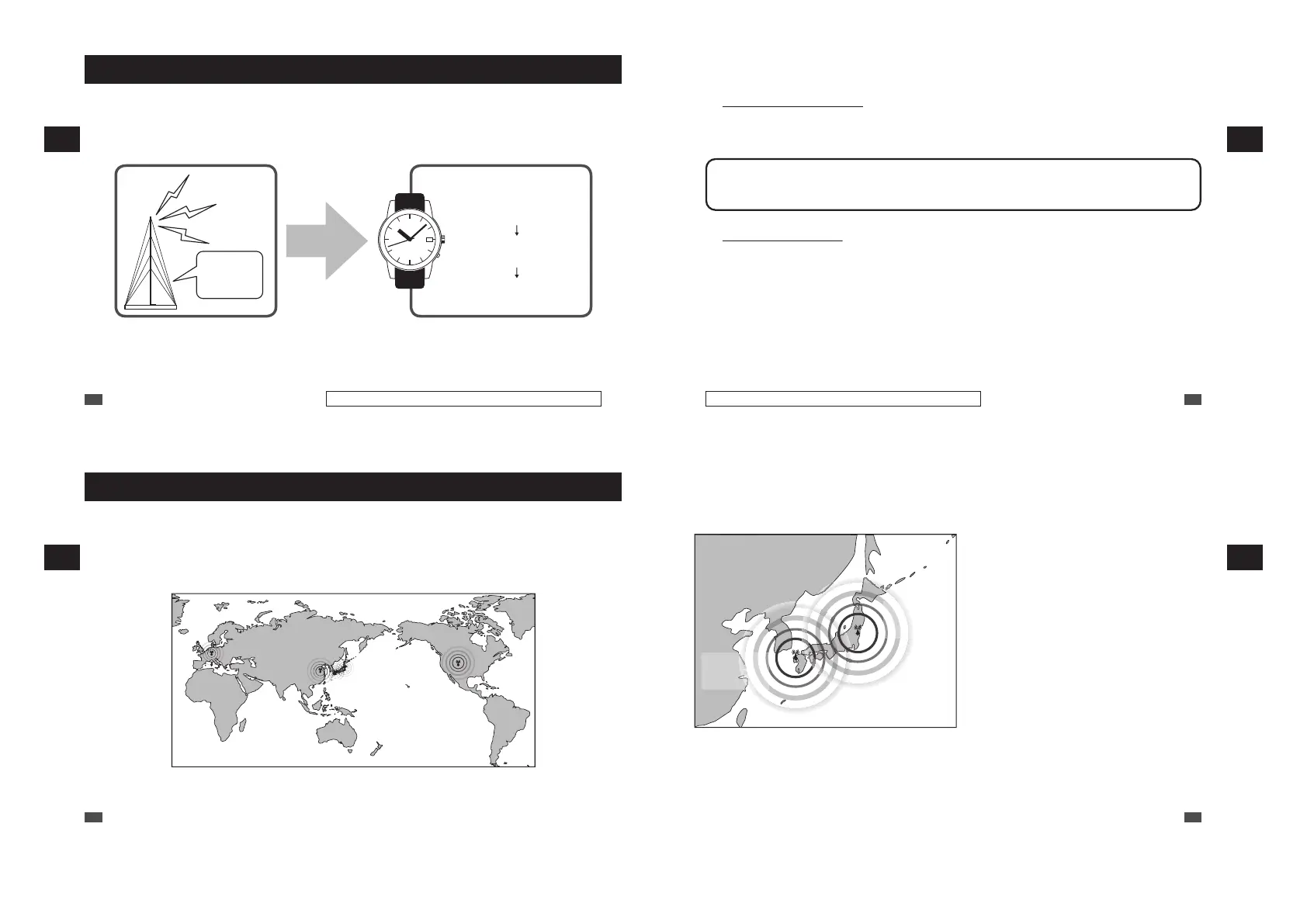
■ Mechanism of radio signal reception
The radio-controlled watch displays the precise Time and Date by automatically receiving and
synchronizing itself with the radio signal of an official standard frequency.
Transmitting
Station
Cesium
Atomic
Clock
Official standard
frequency
Radio-controlled watch
Receive radio signals through
the antenna inside the watch
Analyze time information
Display the current Time and
Date
Time signal transmitted by a standard frequency is based on a super accurate “Cesium Atomic Clock” that
may have a 1 second loss or gain per one hundred thousand years.
EN
20
Only the 1B22 and 1B32 are date-displaying models.
3
HOW TO SET THE TIME (RADIO SIGNAL RECEPTION)
■ Automatic reception and manual reception
●
Automatic reception
This watch sets the time and date by automatically receiving a radio signal at a fixed time.
This watch automatically receives a radio signal before 2:00 a.m. and 4:00 a.m.
* When the reception is successful, the watch finishes the automatic reception.
• Place the watch in a place where it can easily receive a radio signal (by the window, etc.).
• Do not move the watch during the radio signal reception.
“To improve radio signal reception” → P.27
●
Manual reception
This watch can receive a radio signal arbitrarily at any time other than the automatic reception mode.
“How to conduct manual reception” → P.60
* Radio signal reception results depend on the receiving environment. “Environments in which it is difficult to receive
a radio signal” → P.28
* The watch cannot receive a radio signal outside the radio signal reception range. “Radio signal reception range
indication” → P.22
* When the time difference is set for a region other than radio signal reception range, a radio signal cannot be
received. Check the setting of the time difference. “Setting the time difference (Setting the radio signal transmitting
station)” → P.33
*
When the watch does not display the correct time and date even after successfully receiving a radio signal, refer to
Troubleshooting. “Misalignment of the time and hand positions” → P.75, “Misalignment of the date” → P.77
EN
21
Only the 1B22 and 1B32 are date-displaying models.
3
HOW TO SET THE TIME (RADIO SIGNAL RECEPTION)
Reception environment
■ Radio signal reception range indication
This watch receives standard radio signals from Japan (2 stations), China, U.S.A. and Germany.
Select the transmitting station in the time difference adjustment function to switch the standard radio signal
to receive.
“Setting the time difference (Setting the radio signal transmitting station)” → P.33
Germany (DCF77)
P.26
China (BPC)
P.24
Japan (JJY)
P.23
U.S.A.
(WWVB)
P.25
EN
22
3
HOW TO SET THE TIME (RADIO SIGNAL RECEPTION)
■ Radio signal reception range: Japan (JJY)
The reception range from the transmitting station is approximately 1,000 km (1,000 km radius of the
transmitting station).
Hagane-yama
transmitting
station (60 kHz)
Ohtakadoya-
yama
transmitting
station (40 kHz)
1,000 km
1,000 km
JJY is operated by the National Institute of
Information and Communications Technology
(NICT).
JJY is transmitted from two stations in Japan. Each
station transmits JJY in a different frequency.
Fukushima : Ohtakadoya-yama transmitting
station
Frequency: 40 KHz
Kyushu : Hagane-yama transmitting station
Frequency: 60 KHz
* NICT: National Institute of Information and
Communications Technology
* Even within the reception range, weather conditions,
terrain, buildings, and orientation may mean that
reception is not possible.
“Environments in which it is difficult to receive a radio
signal” → P.28
EN
23
3
HOW TO SET THE TIME (RADIO SIGNAL RECEPTION)



 To Next Page