LUBRICATION AND MAINTENANCE
46
BATTERY
Keep the battery connections tight and free of cor-
rosion. An ammonia or baking soda-water solution
is good for washing the outside surface and termi-
nals of the battery. Make sure the solution does not
enter the battery. After cleaning, wash the battery
with clean water. Apply a small amount of petro-
leum jelly to the terminals to protect them from cor-
rosion.
In freezing temperatures, the battery must be
maintained in a good state of charge. When a bat-
tery is discharged or run down, the electrolyte is
weak and may freeze, causing damage to the case.
If it becomes necessary to add water (distilled), it
should be done just before using the tractor so the
charging will mix the water with the electrolyte and
prevent the water from freezing.
Determine the battery charge by checking the spe-
cific gravity of the electrolyte.
Checking Electrolyte Level:
::
:Check the electrolyte
level in the battery every 50 hours.
WARNING :
::
: When the alternator is
charging, an explosive gas is produced
inside the battery. Therefore, always
check the electrolyte level with the en-
gine stopped. Do not use an exposed
flame and do not smoke when check-
ing the battery electrolyte level.
1. Clean the top of the battery, then remove the
vent plugs.
2. If the electrolyte level is low, add distilled water.
The level is correct when the liquid is 6.35 mm
(1/4 inch) above the plates.
NOTE:
::
:Keep distilled water in a clean, well-
covered, non-metallic container.
3. Install the vent plug after making sure the vent
holes are not blocked. At below freezing tem-
peratures, be sure to run the engine for a period
of time, after adding water, so the battery will
charge and prevent the water from freezing.
ALTERNATOR
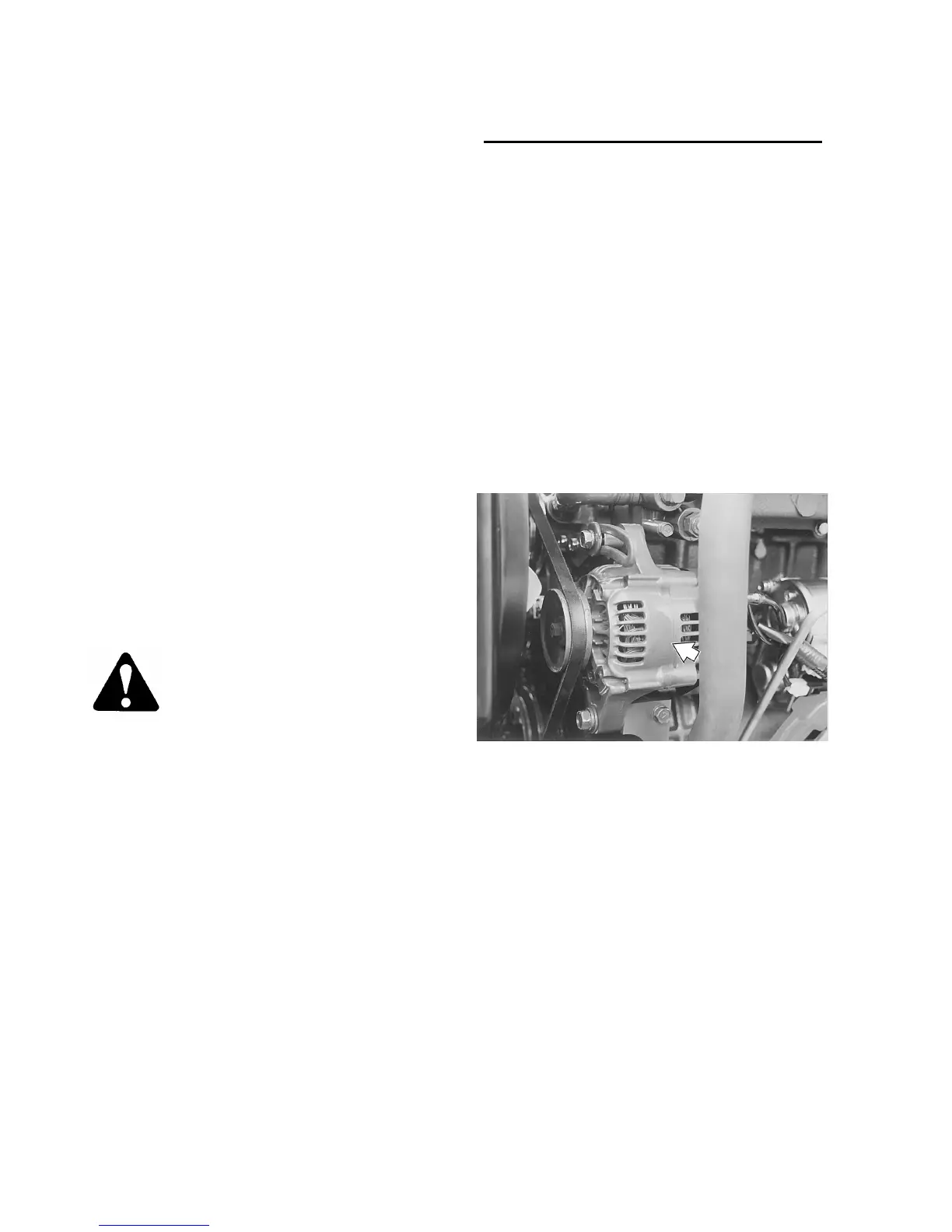
The alternator, Figure 70, is belt-driven from the
engine crankshaft pulley. It is important that belt
slippage does not occur, otherwise, the charging
rate will be affected. Details of belt adjustment are
given on page 40.
Other than belt adjustment, the only maintenance
required on the alternator is to periodically inspect
the terminals and keep them clean and tight. The
alternator cooling fan should also be cleaned
periodically.
When working on or checking the alternator, com-
ply with the following precautions to prevent alter-
nator damage.
Figure 70 - Alternator
DO NOT, under any circumstances, short the
FIELD terminal of the alternator to ground.
DO NOT disconnect the alternator output lead
or battery cables while the alternator is oper-
ating.
DO NOT remove the alternator from the tractor
without first disconnecting the negative (-)
battery cable. If the battery is to be removed,
disconnect the negative cable first.
If a battery is being installed, MAKE CERTAIN
that the positive (+) cable is connected first



 To Next Page