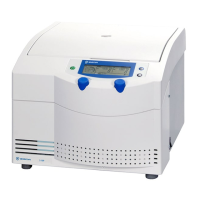
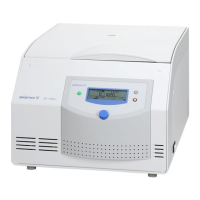
This document is an operating manual for the Sigma 2-6E laboratory centrifuge, a power-driven machine designed for separating liquids from solid matter, liquid mixtures, or solid mixtures by centrifugal force. The centrifuge is intended solely for this purpose, and any other use is considered improper.
Function Description
The Sigma 2-6E centrifuge uses centrifugal force to separate substances. It is equipped with a microprocessor-controlled electronic system that allows for a wide range of adaptations for various tasks. The centrifuge is started and stopped via an operating panel with illuminated keys and displays. The lid is secured by solid hinges at the back and two separate lid locks at the front. The drive motor is a well-dimensioned, collector-less asynchronous motor.
Important Technical Specifications
- Manufacturer: SIGMA Laborzentrifugen GmbH
- Type: 2-6E
- Protection Class: I
- IP Code: 20
- Connected Load (kVA): 0.2
- Power Consumption (kW): 0.12
- Max. Current Consumption (A): 0.8 (at 220-240V / 50-60Hz), 1.6 (at 120V / 60Hz), 1.8 (at 100V / 50-60Hz)
- Max. Speed (rpm): 3,900
- Max. Capacity (ml): 480
- Max. Gravitational Field (x g): 2,466
- Max. Kinetic Energy (Nm): 1,610
- Time Range: 10 seconds to 11 hours 59 minutes; also supports short run and continuous run.
- Storage Locations: 10 programs
- Physical Data:
- Depth: 452 mm
- Width: 365 mm
- Height: 300 mm
- Weight: 21 kg
- EMC: as per EN 61326, Class B
- Noise Level (dBA): < 58
- Ambient Temperature: +5°C to +40°C (figures valid at +23°C ± 2°C and nominal voltage ± 10%)
- Relative Humidity: Max. 80% up to 31°C with a linear decrease to 50% at 40°C.
- Lowest Storage and Transport Temperature: -20°C
Usage Features
The centrifuge offers several user-friendly features:
- Operating Panel: Features a start key, stop key, lid key, display, and two rotary knobs for setting parameters. The display shows time, speed/RCF, rotor selection, imbalance indication, run mode, and program selection.
- Time Setting: Runtime can be set from 10 seconds to 11 hours and 59 minutes. Time increments can be changed from 10 seconds to 1 second (in min:sec mode) or from 10 minutes to 1 minute (in hrs:min mode) by holding the stop key while adjusting.
- Short Run: Allows the centrifuge to accelerate at maximum power until maximum speed is reached, then decelerate at maximum power to a standstill upon release of the start key.
- Continuous Run: The centrifuge runs indefinitely until manually stopped.
- Speed Setting: Speed (revolutions per minute) can be set in steps of 100 or 10 rpm. The "max" display lights up when the maximum permissible speed of the rotor is reached.
- Relative Centrifugal Force (RCF) Setting: RCF can be set in steps of 10 x g. The RCF value is determined by rotor geometry and speed. The "max" display lights up when the maximum permissible RCF value is reached.
- Rotor Selection: Users can select from available rotors (e.g., rotor 12011) when the centrifuge is at a standstill.
- Program Storage: Ten different programs (0-9) can be saved and recalled, saving time and preventing typing errors. This function is only available at a standstill.
- Lockdown Function: Locks parameters against inadvertent changes. A padlock symbol appears on the display. A permanent lockdown can be activated by pressing the start key three times and holding it down for approximately two seconds when the lid is open.
- Automatic Lid Opening: Can be activated or deactivated by pressing the lid key five times and holding it down for approximately two seconds when the lid is open.
- Sound Signal: Can be activated or deactivated to provide an audible signal at the end of operation or in case of an error message/imbalance.
- Emergency Lid Release: In case of power failure, the lid can be manually opened using two stoppers on the front bottom panel. This should only be done when the rotor is at a standstill.
Maintenance Features
Regular care and maintenance are crucial for extending the service life and preventing premature failure of the centrifuge, rotor, and accessories.
- Checks by the Operator:
- Monthly inspection of all safety-relevant parts for visible damage (cracks, corrosion).
- Check concentricity of the motor shaft by slowly rotating the rotor by hand.
- Auditory inspection for atypical running noises.
- Special attention to rubber parts (motor cover, lid seal, adapter) for structural changes; defective parts must be replaced immediately.
- Check fastening of trunnion pins in the rotor and screw connections.
- Regular checks of rotors and accessories (service life limitations apply).
- Cleaning and Care:
- Use soap water or other water-soluble, mild cleaning agents (pH 6-8).
- Avoid corrosive, aggressive, alkaline solutions, solvents, and abrasive particles.
- Do not expose the centrifuge or rotors to intensive UV radiation or thermal stress.
- Disconnect power cord before cleaning.
- Remove all liquids from the centrifuge chamber to prevent damage to motor bearings.
- If contaminated with toxic, radioactive, or pathogenic substances, clean immediately with a suitable decontamination agent, taking appropriate safety precautions.
- Slightly grease the motor shaft after cleaning (grease for load-bearing bolts part no. 70284).
- Keep the centrifuge open when not in use to allow moisture to evaporate, preventing increased wear of motor bearings.
- Accessories Care:
- Immediately rinse rotors, buckets, or accessories under running water if they come into contact with corrosive liquids.
- Clean accessories outside the centrifuge weekly or after each use; remove rubber cushions.
- If contaminated, clean immediately with a suitable decontamination agent.
- Dry accessories with a soft cloth or in a drying chamber at approx. 50°C.
- For plastic accessories, clean thoroughly if solvents, acids, or alkaline solutions have been used.
- For aluminum accessories, avoid acid-containing and alkaline cleaning agents. Grease aluminum parts weekly with slushing oil (part no. 70104).
- Rotor, Buckets, and Multiple Carriers:
- Regularly check for cracks, visible damage, pressure marks, signs of corrosion, or other changes.
- Check bores of rotors and multiple carriers.
- Replace damaged components immediately.
- Protect rotors, lid seals, and rubber cushions with supplied slushing oil (part no. 70104) weekly.
- Grease the rotor tie-down screw with grease for load-bearing bolts (part no. 70284).
- Load-bearing bolts: Grease after each cleaning with grease for load-bearing bolts (part no. 70284) to ensure even swinging of buckets and quiet operation.
- Glass Breakage: Immediately remove all glass particles (e.g., with a vacuum cleaner) and replace rubber cushions. Grease the upper third of the centrifuge chamber with Vaseline and run the rotor at moderate speed (approx. 2,000 rpm) for a few minutes to collect particles, then remove the grease and particles with a cloth.
- Sterilization and Disinfection: Use commercially available disinfectants. Consider material compatibility. Contact the manufacturer before using unrecommended cleaning or decontamination agents.
- Autoclaving: Service life of accessories depends on autoclaving frequency. Replace accessories showing changes in color, structure, or leaks. Do not screw on tube caps during autoclaving to prevent deformation. Plastic parts may deform during autoclaving.
- Service: Service work requiring panel removal should only be performed by qualified specialist personnel due to risk of electric shock or mechanical injury. Annual inspections by the manufacturer are recommended, with dismantled inspections every three years. Rubber parts should be replaced after three years or a maximum of 15,000 cycles.
- Disposal: The centrifuge and packaging must be disposed of according to local rules and regulations, not as domestic waste.
- Warranty and Liability: Warranty and liability claims are excluded for improper use, non-compliance with safety instructions, and force majeure.

 Need help?
 General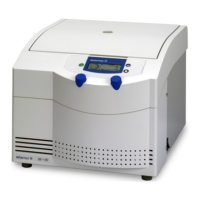

 To Next Page