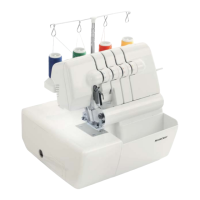
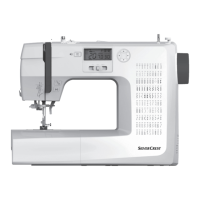
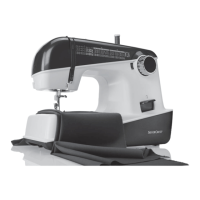
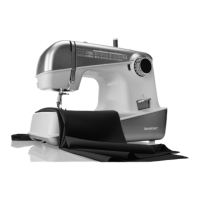
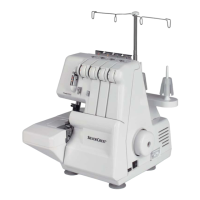
This document describes the Overlock Sewing Machine KH 4300, a versatile appliance designed for domestic household use, specifically for trimming material edges and sewing typical household textiles. It is a portable machine, not intended for permanent installation or for processing heavy materials like leather or canvas, nor for commercial or industrial applications.
The machine's primary function is overlock sewing, offering the flexibility of using either four or three threads to create various stitch types. This allows for both close and broad sewing, catering to different fabric requirements and desired seam finishes. The machine is equipped with a differential feed motion, a crucial feature for handling a wide range of materials. This mechanism helps prevent uneven seams in knitted fabrics and slippage of textile positions, ensuring smooth and wrinkle-free results, especially with very light materials. The differential feed motion can be adjusted to a "Neutral Position" for even material feeding, a "Gather Position" to prevent elasticated materials from stretching, or a "Stretch Position" to hold materials taut and avoid ruffles in delicate fabrics like nylons. These adjustments can even be made during sewing for optimal control.
The KH 4300 offers several usage features to enhance the sewing experience. The thread tree, which needs to be fully withdrawn before threading, can be turned to align the thread guides directly above the spool supports. The machine accommodates both industrial and household bobbins, with specific instructions for placing bobbin supports based on bobbin diameter. For non-industrial bobbins, bobbin caps are used. A micro safety switch ensures that the machine cannot start if the front flap is open, enhancing user safety. A waste container is provided to collect remnants, keeping the workspace tidy. The foot pedal controls the sewing speed, allowing for variable speed adjustments based on pressure applied. The handwheel should always be turned towards the user, similar to a domestic sewing machine. The front flap can be opened by sliding it to the right and pulling it towards the user, providing access for threading. The free arm can also be opened by pulling the arm support to the side, opening the front flap, and pressing the release lever while pulling the free arm downwards. This free arm feature is particularly useful for sewing trouser legs, sleeves, and cuffs.
Threading the machine is a detailed process, with specific steps for the upper looper (green), lower looper (blue), right needle (yellow), and left needle (red). The thread guides are color-coded and numbered on illustrations for simplification, and pincers are included in the accessory box to aid in threading. Correct threading is emphasized as crucial for preventing irregular stitches and yarn breakage. The yarn must be correctly positioned between the discs of the thread tension selector. After threading, a trial run is recommended to check the threads and ensure proper functioning.
Adjusting the thread tension is a key aspect of achieving quality seams. The required tension varies depending on the type and thickness of the thread and fabric. The tensioning devices are color-coded (red, yellow, green, blue) and can be adjusted by turning them to lower or higher numbers to decrease or increase tension, respectively. Specific guidance is provided for adjusting tension on both needle and looper threads to correct issues like loose stitches or overly firm threads. An overview table helps users select appropriate thread tension adjustments, stitch length, and needle types for different fabric weights (light, medium, heavy) and thread types (cotton, polyester).
Changing threads is made simple by knotting the new thread to the old one and pulling it through the machine, with specific instructions for threading into the needle eye. The stitch length can be adjusted in nine steps from 1.0 to 5.0 mm using an inner adjustment wheel, with typical overlock work using 2.5-3.5 mm. The cutting width is also variable and can be adjusted using a dedicated wheel. This allows users to select a narrower cutting width to prevent ruffles or a larger width if the yarn is sewing beyond the material edge.
The machine also supports hemstitch and narrow edging. For hemstitching, the loops of the upper looper thread are pulled to the underside of the material by adjusting thread tension. For narrow edging, suitable thread tension is selected for very thin or light materials. The sewing foot can be adjusted for normal sewing operations or for hemstitching by loosening a screw and sliding a pin.
Maintenance features are also covered in the manual. Before any maintenance, such as changing bulbs or blades, the power plug must always be removed to prevent accidental starting and potential injury. The machine requires occasional cleaning with a brush, and lubrication is needed only occasionally at designated positions due to the special materials used in its main components. Replacing bulbs involves removing a cover, unscrewing a screw, and exchanging the bulb with a type E14, 15W bulb. Exchanging the upper blade, which normally does not need replacement, involves loosening a screw, removing the old blade, inserting a new one with the flat side to the rear, adjusting its cutting edge relative to the lower blade, and then firmly tightening the setscrew.
Troubleshooting guidance is provided for common issues such as needle breakage, thread breakage, omitted stitches, irregular stitches, seams causing wrinkles, material not being cut cleanly, and material edges ruffling. Each problem is linked to a potential cause and a corresponding solution, ranging from fitting new needles and correcting threading to adjusting thread tension and differential feed motion.
Finally, the manual includes instructions for storage and disposal. When not in use, the machine should be covered with a hood to protect it from dust and stored in a clean, dry location. The appliance should not be disposed of with normal domestic waste but through an approved disposal center, in accordance with European Directive 2002/96/EC. Packaging materials should be disposed of in an environmentally friendly manner.


 To Next Page
 General