18
4.10 DC Voltage Measurement 0-1000V Range
!
Be extremely careful when working with high voltage circuits. Do not
touch the Instrument or test leads while power is on in the circuit being
measured.
Before proceeding with the following steps, review the Safety Precautions in 4.2.
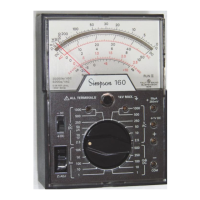
a. Set the function switch at +DC (Figure 4-
1).
b. Set the range switch at the 250V/500V/
1000V position.
c. Plug the black test lead into the – COM-
MON jack and the red test lead into the
1000V jack.
d. Be sure power is off in the circuit being
measured and all capacitors discharged.
Connect the black test lead to the nega-
tive side of the circuit being measured
and the red test lead to the positive side
of the circuit.
e. Turn on power in circuit being measured.
f. Read the voltage using the 0-10 figures
on the black scale marked DC. Multiply
the reading by 100.
PERCENT RELATIVE ERROR
+5
+4
+3
+2
+1
0
-1
-2
-3
-4
-5
10Hz 100Hz 1KHz 10KHz 100KHz
FREQUENCY
2.5 VAC RANGE
10VAC RANGE
50 VAC RANGE
250 VAC RANGE
500 VAC RANGE
1000 VAC RANGE
AC VOLTAGE RANGES
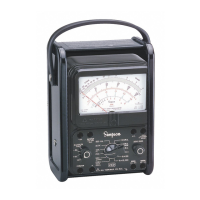
FIGURE 4-3. Jacks and Switch Positions
for Measuring DC Voltage, 0-1000V
Range
D.C
.
D
.C.
250 V.
500 V.
I000 V.
COMMON
-
- D.C.
+ D.C.
260
ALL TERMINALS 1 V MAX
1000 V.
A.C. D.C.
2.5 V.
10 V.
1V.
25 V.
50 A.
AMPS.
250 V.
500 V.
I000 V.
+
COMMON
-
A.C. VOLTS
ONLY
A.
C.
A.C.
2
.5
V.A.C
.
260
ALL TERMINALS 1 V MAX
FIGURE 4-4. Frequency Response, AC
Voltage Ranges
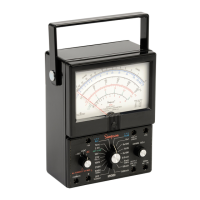
FIGURE 4-5. Jacks and Switch Positions
for Measuring AC Voltage 0-2.5 through
0-250V Ranges
NOTE: Turn off power to the circuit and
wait until the meter indicates zero before
disconnecting the test leads.







 To Next Page
