Need help?
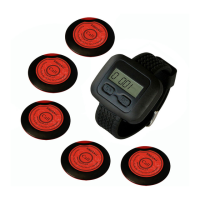
Do you have a question about the Singcall APE560 and is the answer not in the manual?
Guide to registering call pagers, not suitable for APE8800.
Adjusting receiver alert sound type and voice reporting.
Configuring how long the calling number remains displayed on screen.
Process for removing registered pagers or resetting the receiver to default.
Customizing prompt sounds for the cancel key on multi-button pagers.
Configuring display format (digits or letters) for calling numbers.
Setting sound behavior for multiple keys on specific multi-key pager models.
Steps to register a remote control with the APE8000 receiver.
Mapping remote control keys to specific receiver functions for APE8000.
Adjusting volume specifically for the APE8000 model.
Setting the perpetual calendar time on the APE8000 receiver.
Using the remote control to delete registered numbers on APE8000.
Procedure for registering call pagers with the APE8000 receiver.
Warnings regarding interference sources and product usage.
Guidance on proper installation, connection, and accessory usage.
The SINGCALL Receiver is a versatile wireless calling system designed to enhance communication and service efficiency in various settings. This device functions as a central receiver for multiple call pagers, displaying call numbers and providing audio prompts to alert staff. Its primary function is to receive signals from call pagers, process them, and display the corresponding numbers on its screen, often accompanied by customizable sound alerts. This allows for efficient notification and response in environments such as restaurants, hospitals, or service centers.
The core function of the SINGCALL Receiver is to facilitate wireless communication between call pagers and service personnel. When a call pager is activated, it sends a signal to the receiver, which then displays the pager's registered number. The receiver supports a range of operational modes, including number registration, sound customization, display time setting, and volume adjustment.
Number Registration: This feature allows users to register individual call pagers with the receiver. Each pager is assigned a unique number, which the receiver displays upon activation. The registration process involves entering a specific function mode (F1), selecting a registration number, activating the call pager, and confirming the registration. This ensures that each pager is correctly identified by the system. The APE8800 model has a slightly different registration process, indicating variations across models. For the APE8800, the call pager registration involves selecting a position (up to 300), choosing a register number, activating the pager, and confirming.
Sound Setting: Users can customize the type of sound alert emitted by the receiver when a call is received. The device offers a selection of 12 different music types ("00"–"11") and a voice reporting option ("12"). This allows for tailored alerts to suit different environments or preferences. Voice reporting, however, is exclusive to the APE1000 and APE2000 series.
Calling Display Number Time Setting: This function controls how long a received call number remains displayed on the screen. Users can set a specific duration, ranging from 1 to 99 seconds, or choose an "unlimited display" option. For the APE8800, the display time can be set from 1 to 9999 seconds. This flexibility helps manage the visibility of calls based on operational needs.
Sound Length and Voice Reporting Times Setting: This feature allows for the adjustment of the duration of sound alerts and the number of times voice reporting is repeated. The sound length can be set from 2 to 30 seconds, with "01" representing 2 seconds and "15" representing 30 seconds of music prompt. Similarly, "01"–"15" also corresponds to the number of times voice reporting is repeated.
Volume Adjusting: The receiver's volume can be adjusted to suit the environment. For models like APE9000, APE9300, APE9500, and APE9600, volume is adjusted digitally through the receiver's interface, offering 15 levels of volume. Other models typically feature a physical volume control knob. For the APE8000, volume adjustment is done via specific keys on the remote control.
Different Sounds for Different Pagers: This advanced feature, not available for all models (e.g., APE1900, APE2100, APE2900, APE8000, APE8800), allows for assigning unique sound alerts to specific pagers. This can be useful for distinguishing between different types of calls or departments. The process involves selecting a sound type and then registering the desired pager with that sound.
Time Setting: The receiver includes a time setting function, allowing users to set the current time. For models like APE1900, APE2100, APE2900, and APE8000, this is accessed via F5. For other models (APE1200, APE1800, APE2000, APE2300, APE2500, APE2600), it may be found under F8 or F9. The APE8800 has a perpetual calendar time setting, where digits flash and can be adjusted using specific keys.
Delete Registered Numbers or Initialize the Receiver: This function allows for the removal of individual registered pager numbers or the complete initialization of the receiver, which deletes all registered numbers. This is useful for reconfiguring the system or clearing old data.
Choose the Prompt Sound for the Key [Cancel] (Multi-button Pagers): For multi-button pagers, this feature allows customization of the prompt sound when the "cancel" key is pressed. Users can choose from 20 options, with "01"–"10" providing prompt sounds and "11"–"20" having no prompt sound.
Number Display Mode Setting: This feature allows users to choose between an all-digital display or a display where digits begin with an English letter. This is available for a wide range of models, including APE1200, APE1500, APE1800, APE1900, APE2000, APE2100, APE2500, APE2600, APE2900, APE9500, APE8000, and APE8800. Options "01"–"10" provide an all-digital display, while "11"–"20" display numbers beginning with letters (A, B, C, D, E, F, H, P, J, or L).
Same or Different Sounds for Multi Keys of the Multi-key Pagers: For specific multi-key pagers (APE1600, APE1800, APE2500, APE9600), this function allows users to choose whether different buttons on the same pager produce the same sound ("01") or different sounds ("00").
The SINGCALL Receiver is designed for user-friendliness and adaptability. Its menu-driven interface, accessed via the [FUN] key, guides users through various settings. The [UP], [DOWN], [MOVE], and [ENT] keys are used for navigation and selection.
Intuitive Interface: The receiver's operation relies on a simple button layout: [FUN] for function access, [ENT] for entering selections, [MOVE] for navigating options, [DOWN] for decreasing values or moving down, and [UP] for increasing values or moving up. The [ESC] key is used to exit menus and return to standby mode.
Remote Control (APE8000 Specific): The APE8000 model features a remote control with dedicated keys for various functions. Key 'D' acts as [FUN]/[MOVE], 'A' as [ENT], 'B' as [ESC], 'C' as [UP]/delete current calling number, and 'E' as [DOWN]/delete all calling numbers. This remote control also facilitates volume adjustment and registration. The remote control must be registered within 2 minutes of the receiver being turned on and needs to be re-registered each time the receiver is powered on.
Perpetual Calendar (APE8800 Specific): The APE8800 model includes a perpetual calendar with a time setting feature. Users can adjust the date and time by pressing the [FUN] key until digits flash, then using [MOVE], [UP], or [DOWN] to set the values.
Deleting Registered Numbers via Remote Control (APE8800 Specific): For the APE8800, the remote control can be used to delete registered numbers. After registering the remote control to a specific position (e.g., No.300), the 'C' key deletes the currently displayed number, and the 'A' key deletes all numbers on the screen.
Proper maintenance ensures the longevity and optimal performance of the SINGCALL Receiver and its associated pagers. The manual provides guidelines for installation, interference avoidance, and battery replacement.
Interference Avoidance: To ensure reliable operation, the receiver should be kept away from potential interference sources such as mobile base stations, high-powered electrical appliances (refrigerators, air conditioners), and large ultrasonic equipment in hospitals.
Installation Notes:
Battery Replacement (Pager APE560): The process involves inserting a key into the keyhole, gently pulling up the pager to separate it from the base, and then unscrewing four screws to access and replace the battery.
Battery Replacement (Pager APE700): For the APE700, a key is inserted halfway into the keyhole of the base. The right hand holds the key tightly while pressing the base, and the left hand rotates the pager clockwise to detach it. Once separated, the battery can be replaced.
These features collectively make the SINGCALL Receiver a robust and adaptable solution for various service and communication needs, emphasizing ease of use, customization, and reliable operation.
 General
| Model | APE560 |
|---|---|
| Type | Receiver |
| Power Supply | DC 12V |
| Frequency | 433MHz |
| Adaptor | DC12V |
| Capacity | 999 |
| Alert Mode | Vibration |

 To Next Page