EasyManua.ls Logo

Singer 645 - Sewing on Button with a Thread Shank; Satin Stitching

Singer 645
50 pages
Print Icon
To Next Page IconTo Next Page
To Previous Page IconTo Previous Page
Loading...
SEWING
ON
BUTTON
WITH
A
THREAD
SHANK
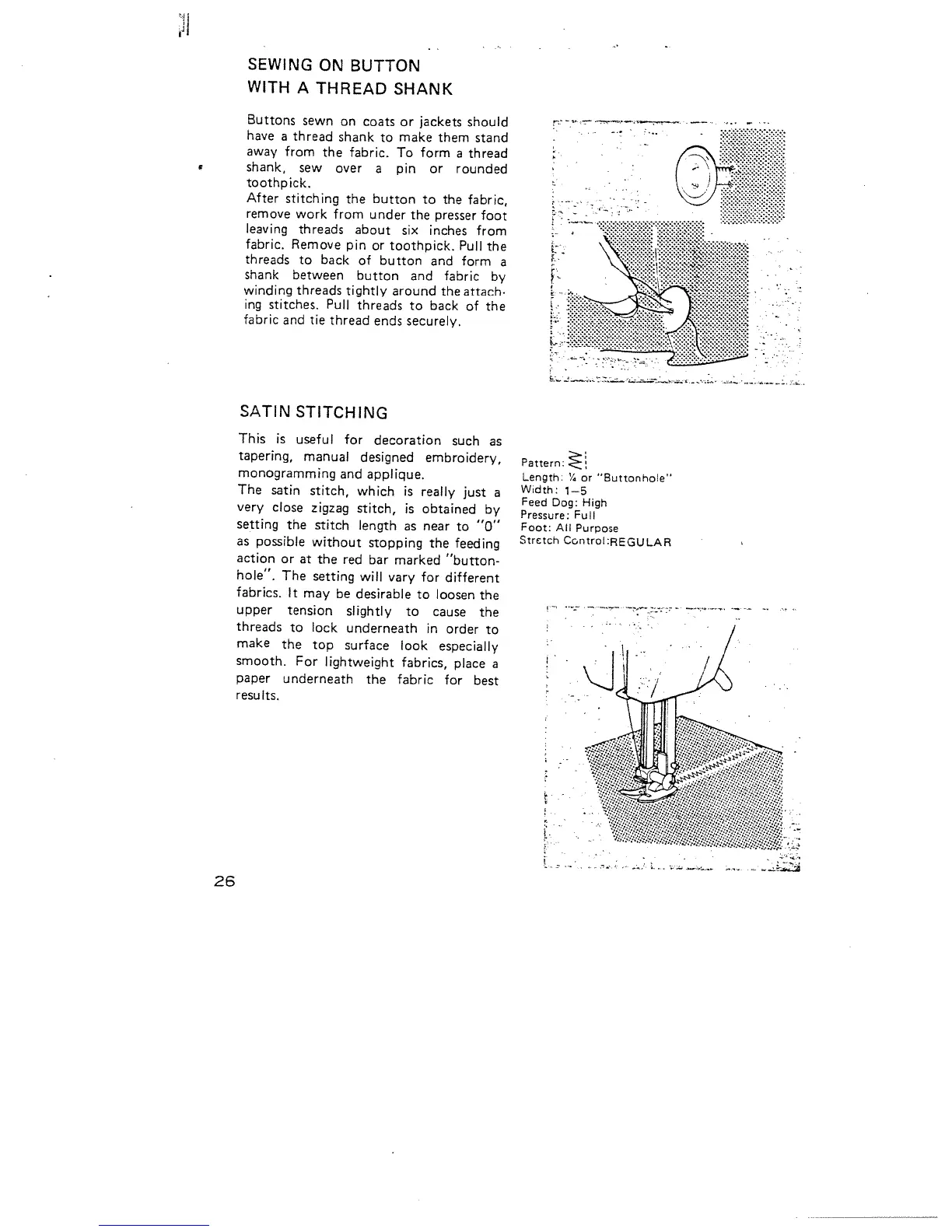
Buttons
sewn
on
coats
or
jackets
should
have
a
thread
shank
to
make
them
stand
away
from
the
fabric.
To
form
a
thread
shank,
sew
over
a
pin
or
rounded
toothpick.
After
stitching
the
button
to
the
fabric,
remove
work
from
under
the
presser
foot
leaving
threads
about
six
inches
from
fabric.
Remove
pin
or
toothpick.
Pull
the
threads
to
back
of
button
and
form
a
shank
between
button
and
fabric
by
winding
threads
tightly
around
the
attach
ing
stitches.
Pull
threads
to
back
of
the
fabric
and
tie
thread
ends
securely.
SATIN
STITCHING
This
is
useful
for
decoration
such
as
tapering,
manual
designed
embroidery,
monogramming
and
applique.
The
satin
stitch,
which
is
really
just
a
very
close
zigzag
stitch,
is
obtained
by
setting
th
stitch
length
as
near
to
“0”
as
possible
without
stopping
the
feeding
action
or
at
the
red
bar
marked
“button
hole”.
The
setting
will
vary
for
different
fabrics,
It
may
be
desirable
to
loosen
the
upper
tension
slightly
to
cause
the
threads
to
lock
underneath
in
order
to
make
the
top
surface
look
especially
smooth.
For
lightweight
fabrics,
place
a
paper
underneath
the
fabric
for
best
Pattern:
Length:
‘/
or
“Buttonhole”
Width:
1—5
Feed
Dog:
High
Pressure:
Full
Foot:
All
Purpose
Strttch
CGntrol:REGULAR
t..
results.
26

Table of Contents

Related product manuals