EasyManua.ls Logo

Singer 645 - Buttonhole Techniques

Singer 645
50 pages
Print Icon
To Next Page IconTo Next Page
To Previous Page IconTo Previous Page
Loading...
BUTTONHOLES
Various
fabrics
require
various
methods
of
sewing
C
A
buttonholes.
Four
different
methods
are
given
below,
.
C
C
with
suggested
uses.
If
you
are
in
doubt
as
to
which
method
is
best
for
your
fabric,
test
the
methods
in
question
and
choose
the
best
according
to
the
finished
appearance.
PREPARATION
For
the
best
results,
a
good
quality
mercerized
cotton
thread
should
be
used.
Polyester
threads
often
result
in
puckered
or
heavy
unattractive
buttonholes.
The
finer
your
fabric
is,
the
finer
your
cotton
thread
should
be.
An
interfacing
should
be
used
under
the
buttonholes
to
give
body,
to
strengthen,
and
to
help
them
withstand
wear.
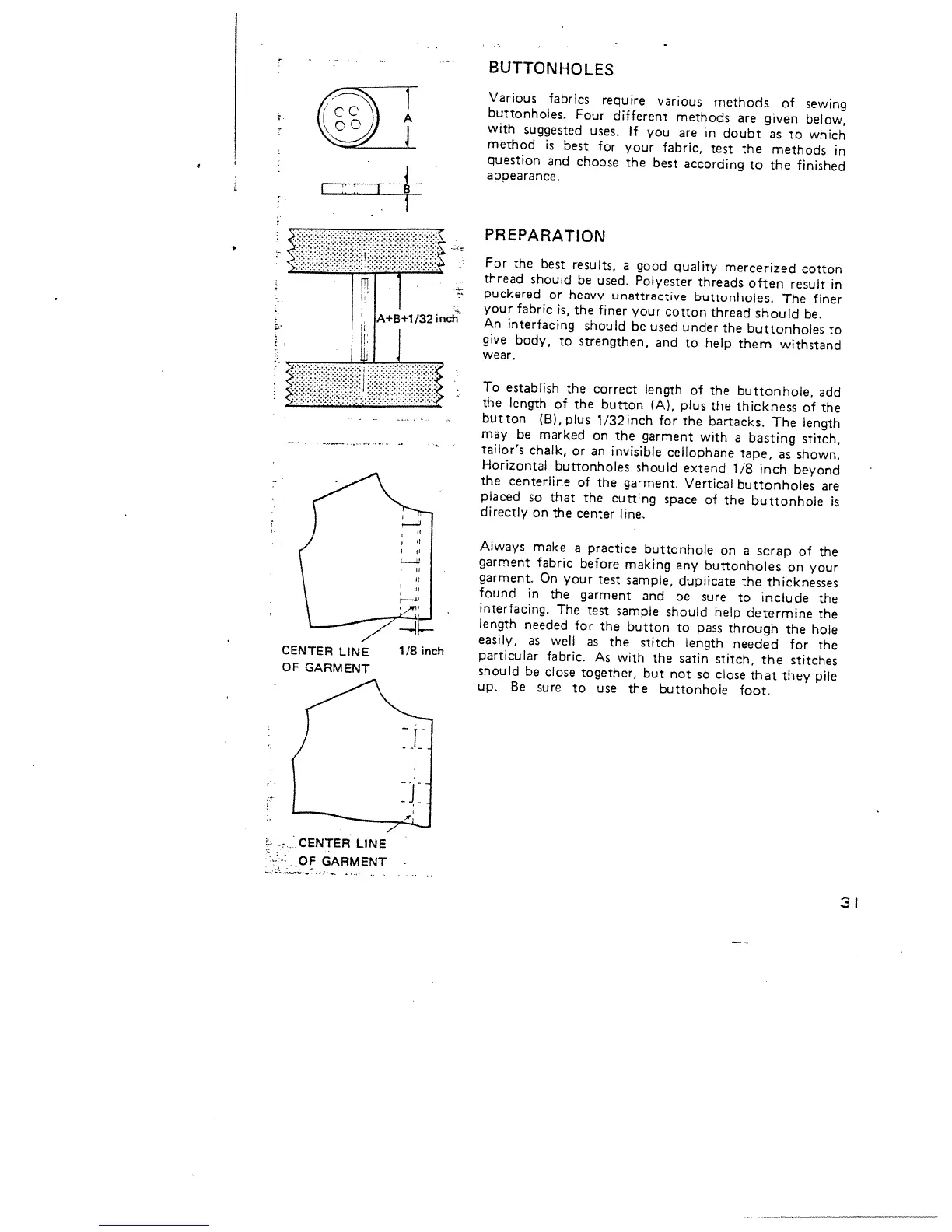
To
establish
the
correct
length
of
the
buttonhole,
add
the
length
of
the
button
(A),
plus
the
thickness
of
the
button
(B),
plus
1/32
inch
for
the
bartacks.
The
length
may
be
marked
on
the
garment
with
a
basting
stitch,
tailor’s
chalk,
or
an
invisible
cellophane
tape,
as
shown.
Horizontal
buttonholes
should
extend
1/8
inch
beyond
the
centerline
of
the
garment.
Vertical
buttonholes
are
placed
so
that
the
cutting
space
of
the
buttonhole
is
directly
on
the
center
line.
Always
make
a
practice
buttonhole
on
a
scrap
of
the
garment
fabric
before
making
any
buttonholes
on
your
garment.
On
your
test
sample,
duplicate
the
thicknesses
found
in
the
garment
and
be
sure
to
include
the
interfacing.
The
test
sample
should
help
determine
the
length
needed
for
the
button
to
pass
through
the
hole
easily,
as
well
as
the
stitch
length
needed
for
the
particular
fabric.
As
with
the
satin
stitch,
the
stitches
should
be
close
together,
but
not
so
close
that
they
pile
up.
Be
sure
to
use
the
buttonhole
foot.
F
I
OF
GARMENT
CENTER
LINE
OF
GARMENT
31

Table of Contents

Related product manuals