of the fun of snowmobiling
is
that each
turn depends on 4 factors - the radius
of the turn, vehicle speed, snow condi-
tions and the weight
on
the skis.
To
make those tight, fast turns that are
the mark of the experienced driver, you
must learn to use the weight or position
of your body, shifting to left or right
as
the turn demands and keeping your cen-
tre of gravity
as
low
as
possible.
In
soft or lightly packed snow, the theory
of weight shifting
is
that by leaning the
body toward the inner side of the turn
you increase the pressure on that edge
of the track and correspondingly lighten
the other edge.
In
effect, you create a
bank of snow under the lighter edge,
so
that the vehicle is banked when turning.
On
hard packed snow, leaning
in
toward
the turn and at the same time keeping
your centre of gravity
as
low
as
possible,
counterbalances the natural tendency of
any vehicle to tilt when turning.
Also, moving your body weight toward
the front of the vehicle, particularly,
in
hard-packed snow, adds pressure to the
skis and ski runners
so
that they bite
more deeply into the snow surface.
IMPORTANT: Thoroughly know your
vehicle and how to drive it before at-
tempting difficult or rapid manoeuvres.
Surface Conditions
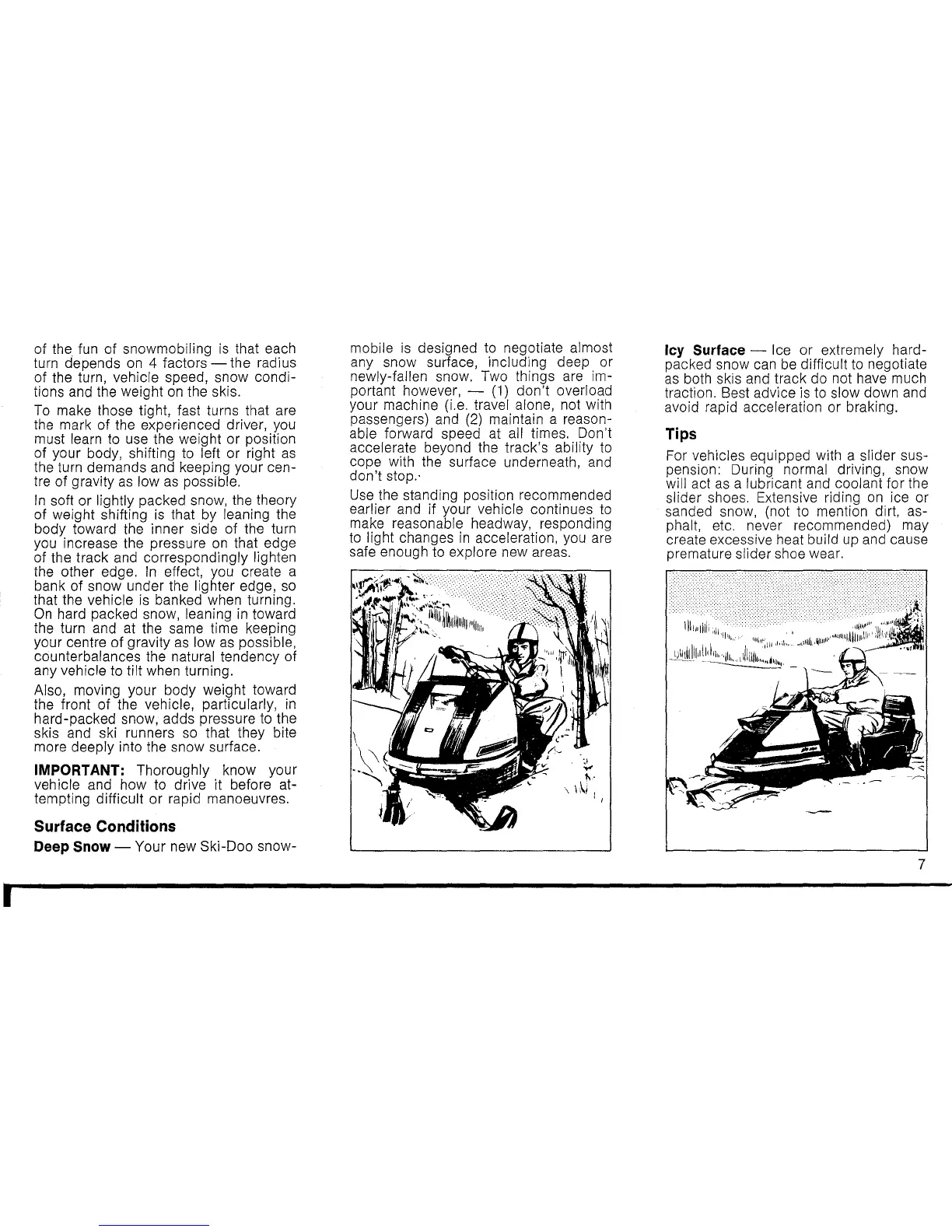
Deep Snow - Your new Ski-Doo snow-
mobile
is
designed to negotiate almost
any snow surface, including deep or
newly-fallen snow. Two things are im-
portant however, -
(1)
don't overload
your machine (i.e. travel alone, not with
passengers) and
(2)
maintain a reason-
able forward speed at all times. Don't
accelerate beyond the track's ability to
cope with the surface underneath, and
don't
stop.·
Use
the standing position recommended
earlier and if your vehicle continues to
make reasonable headway, responding
to light changes
in
acceleration, you are
safe enough to explore new areas.
.,
;....
11·
\ \
,\1
I
I
Icy Surface - Ice or extremely hard-
packed snow can be difficult to negotiate
as
both skis and track do not have much
traction. Best advice is to slow down and
avoid rapid acceleration or braking.
Tips
For vehicles equipped with a slider sus-
pension: During normal driving, snow
will act
as
a lubricant and coolant for the
slider shoes. Extensive riding
on
ice or
sanded snow, (not to mention dirt, as-
phalt, etc. never recommended) may
create excessive heat build up and cause
premature slider shoe wear.
7
...---------------------------------------"



 To Next Page