11
4. The XP water heater must be installed so that gas control
system components are protected from dripping or spraying
water or rain during operation or service.
5. If a new water heater will replace an existing water heater,
check for and correct system problems, such as:
• System leaks causing oxygen corrosion or heat
exchanger cracks from hard water deposits.
6. Check around the water heater for any potential air
contaminants that could risk corrosion to the water heater
or the water heater combustion air supply (refer to the list
on Page 14). Prevent combustion air contamination. Remove
any of these contaminants from the water heater area.
This appliance is certied as an indoor appliance. Do not install
the appliance outdoors or locate where the appliance will be
exposed to freezing temperatures or to temperatures that exceed
100°F.
Do not install the appliance where the relative humidity may
exceed 93%. Do not install the appliance where condensation
may form on the inside or outside of the appliance, or where
condensation may fall onto the appliance. Failure to install the
appliance indoors could result in severe personal injury, death,
or substantial property damage.
This appliance requires a special venting system. If using PVC
the vent connection to the appliance must be made with the
starter CPVC pipe section provided with the appliance. The
eld provided vent ttings must be cemented to the CPVC pipe
section. Use only the vent materials, primer and cement specied
in this manual to make the vent connections. Failure to follow this
warning could result in re, personal injury, or death.
RATINGS
TABLE 6
MODEL NUMBER CSA INPUT MODULATION
BTU/HR
(NOTE 2, 3)
WATER CONTENT
GALLONS
WATER CONNECTIONS GAS CONNECTIONS VENT/AIR SIZE
(NOTE 1, 5)
XWH 150 30,000 - 150,000 1.3 1-1/4" NPT 1/2" 3"/3"
XWH 200 40,000 - 199,999 1.7 1-1/4" NPT 1/2" 3"/3"
XWH 285 57,000 - 285,000 2.4 2" NPT 3/4" 4"/4"
XWH 400 80,000 - 399,999 3.4 2" NPT 1" 4"/4"
XWH 500 100,000 - 500,000 4.2 2" NPT 1" 4"/4"
XWH 600 120,000 - 600,000 4.2 2" NPT 1" 4"/4"
XWH 700 140,000 - 700,000 5.0 2" NPT 1" 6"/4"
XWH 800 160,000 - 800,000 5.7 2" NPT 1" 6"/4"
Notice: Maximum allowed working pressure is located on the rating plate.
1. All XP water heaters require special exhaust venting. Use only the vent
materials and methods specied in this Instruction Manual.
2. Standard XP water heaters are equipped to operate from sea level to 4,500
feet only with no adjustments. The water heater will de-rate by 4% for each
1,000 feet above sea level up to 4,500 feet.
3. High altitude XP water heaters are equipped to operate from 3,000 to 12,000
feet only. The water heater will de-rate by 2% for each 1,000 feet above sea
level. High altitude models are manufactured with a different control module for
altitude operation, but the operation given in this manual remains the same as
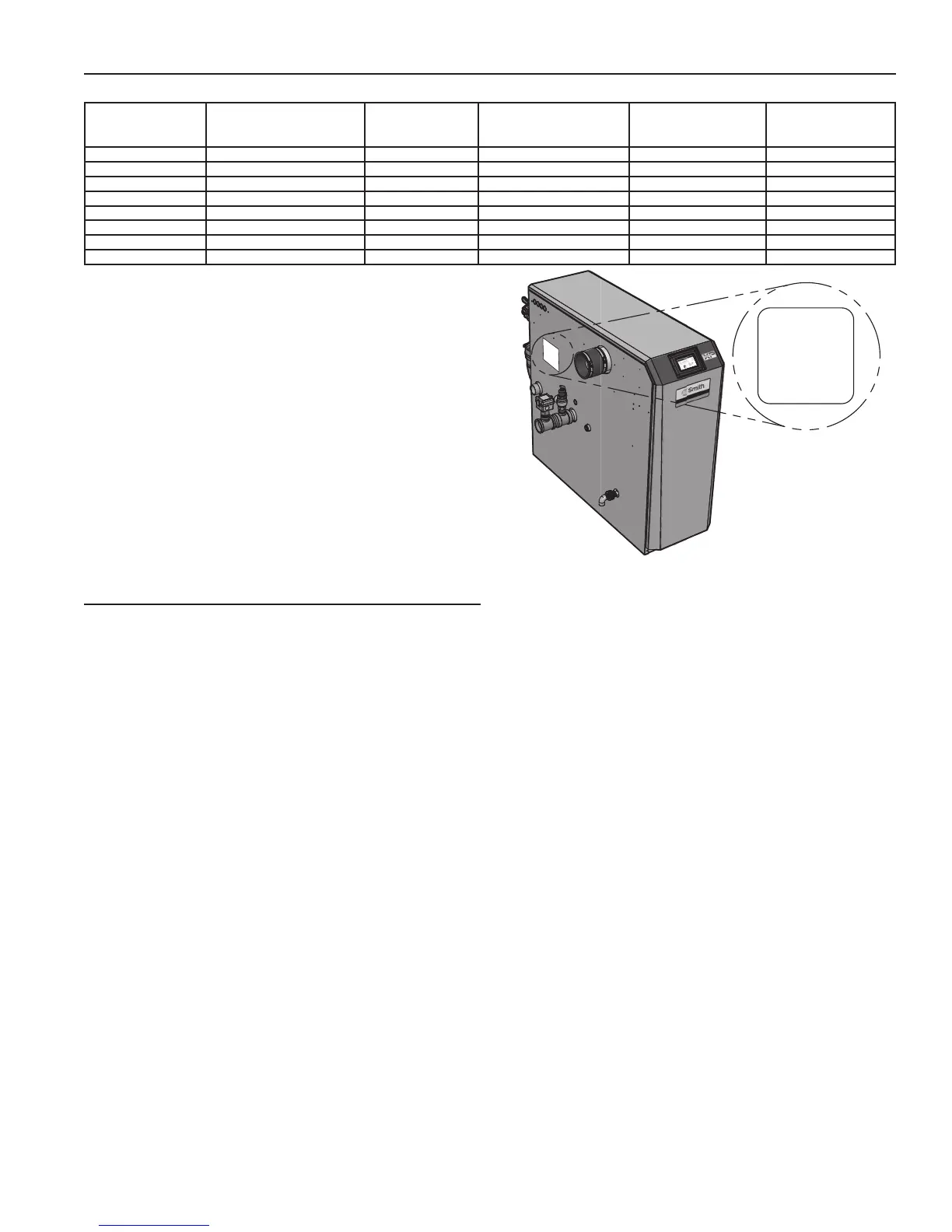
the standard models. A high altitude label (as shown in Figure 1) is also afxed
to the unit.
Derate values are based on proper combustion calibration and CO2’s adjusted
to the recommended levels.
4. The manual reset high limit provided with the XP is listed to UL353. The auto
reset high limit is listed to ANSI Z21.87.
5. The XWH 285 model can be alternatively vented using a 3” vent/air size. If
the 3” vent/air size is used, the maximum vent/air pipe lengths are limited to 60
equivalent feet each.
UNIT EQUIPPED FOR
HIGH ALTITUDE
3,000 FT TO 12,000 FT
Figure 1. High Altitude Label Location
DETERMINE WATER HEATER LOCATION
INSTALLATION MUST COMPLY WITH:
• Local, state, provincial, and national codes, laws,
regulations, and ordinances.
• National Fuel Gas Code, ANSI Z223.1 – latest edition.
• National Electrical Code.
NOTE: The XP water heater gas manifold and controls met safe
lighting and other performance under tests specied in ANSI
Z21.10.3 – latest edition.
BEFORE LOCATING THE WATER HEATER, CHECK:
1. Check for nearby connection to:
• Water piping
• Venting connections
• Gas supply piping
• Electrical power
2. Locate the appliance so that if water connections should
leak, water damage will not occur. When such locations
cannot be avoided, it is recommended that a suitable drain
pan, adequately drained, be installed under the appliance.
The pan must not restrict combustion air ow. Under no
circumstances is the manufacturer to be held responsible for
water damage in connection with this appliance, or any of its
components.
3. Check area around the water heater. Remove any
combustible materials, gasoline and other ammable liquids.
Failure to keep water heater area clear and free of combustible
materials, gasoline, and other ammable liquids and vapors can
result in severe personal injury, death, or substantial property
damage.


 To Next Page