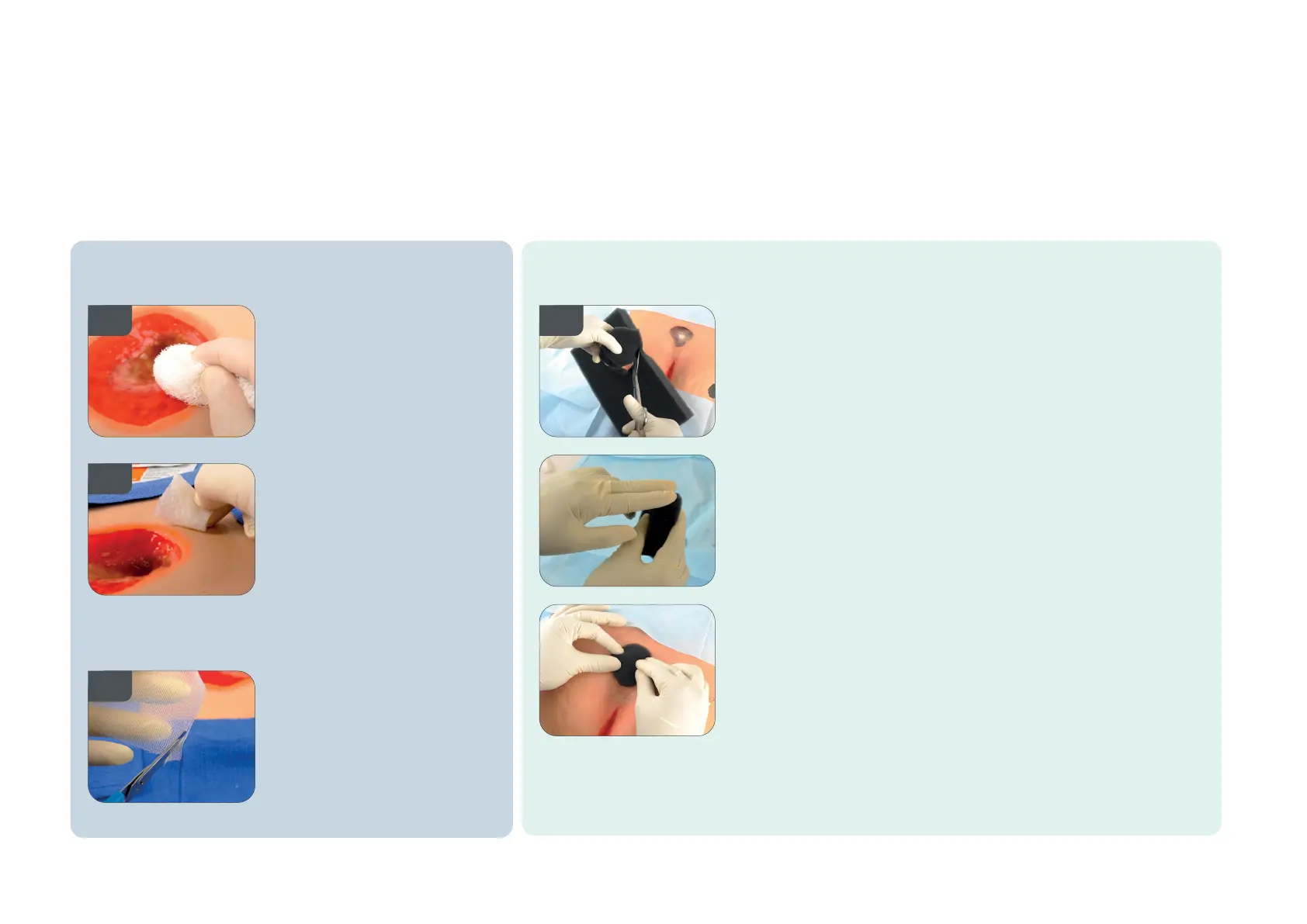
If dressing wound with foam...
Cut foam dressing to t the size and shape of the wound
and place cut foam intothe wound. Avoid over packing.
Foam should completely ll the wound cavity. It may be
necessary to stack pieces of foam in deep wounds.
Precaution: If multiple pieces of wound filler are needed to
fill the wound profile, count and record how many pieces
are present to ensure all pieces are removed atadressing
change to minimise the risk of retention and possible
infection.
Foam should be cut to fit loosely into wound bed. Do not
force or tightly packfoam into any areas ofthe wound to
avoid damaging underlying tissue.
Do not place foam into blind or unexplored tunnels.
If a tunnel of known depth presents, cut foam longer than
the tunnel, to ensure direct contact is made with the foam
in the primary wound cavity.
Do not cut foam directly over the wound cavity toavoid
foam fragments from falling into thewound.
Rub edges of the foam away from the open wound to
remove loose fragments aer cutting.
4
Clean and debride
Debride any devitalized
ornecrotic eschar tissue.
Cleanse the wound
and pat dry.
1
If desired, protect
theperiwound skin
fromexposure to moisture
and adhesive through
theuse ofa skin sealant.
Allow the skin sealant to
dry fully prior to placement
of the transparent lm.
2
If desired, a non-adherent
woundcontact layer may
beapplied. Trim a single
layer ofnon-adherent
gauze andlay across
thewound bed.
3
RENASYS
◊
-F Foam and -G Gauze Dressing Kit
with So Port application
RENASYS
◊
EDGE Quick reference guide 4





 To Next Page