5.2-1
5.1-1
5.1-2
5.1-3
Snap-on EEWH331A
EN 21
5.0 Demounting tube-type tires
A.
For breaking the bead operate as described for the
tubeless tires in section 4.1.A to 4.1.F.
In this case, the valve is part of the tube.
WARNING
BE CAREFUL NOT TO DAMAGE THE TUBE
DURING THE BEAD-BREAKING OPERATION.
THE VALVE SHOULD BE OPPOSITE TO THE
BLADE OF THE BEAD BREAKER.
NOTE: In order to avoid damage to their surface
! nish, alloy rims should be clamped from
the outside only.
Special plastic caps are available as optional extras
for the clamping jaws so that alloy rims can
be clamped carefully.
B. To demount the ! rst bead, place the valve at 3 o’clock
position.
WARNING
DO NOT CATCH THE TUBE WITH THE BEAD
LIFTING TOOL, WHEN LIFTING THE BEAD ON THE
MOUNTING FINGER
After demounting the ! rst bead remove the tube before
demounting the second bead, as described in section 4.1.
5.1 Mounting tube-type tires
A. Proceed as described in section 4.2.A.
D
o NOT lubricate the tube. Talc can be used to assist with
the tube positioning.
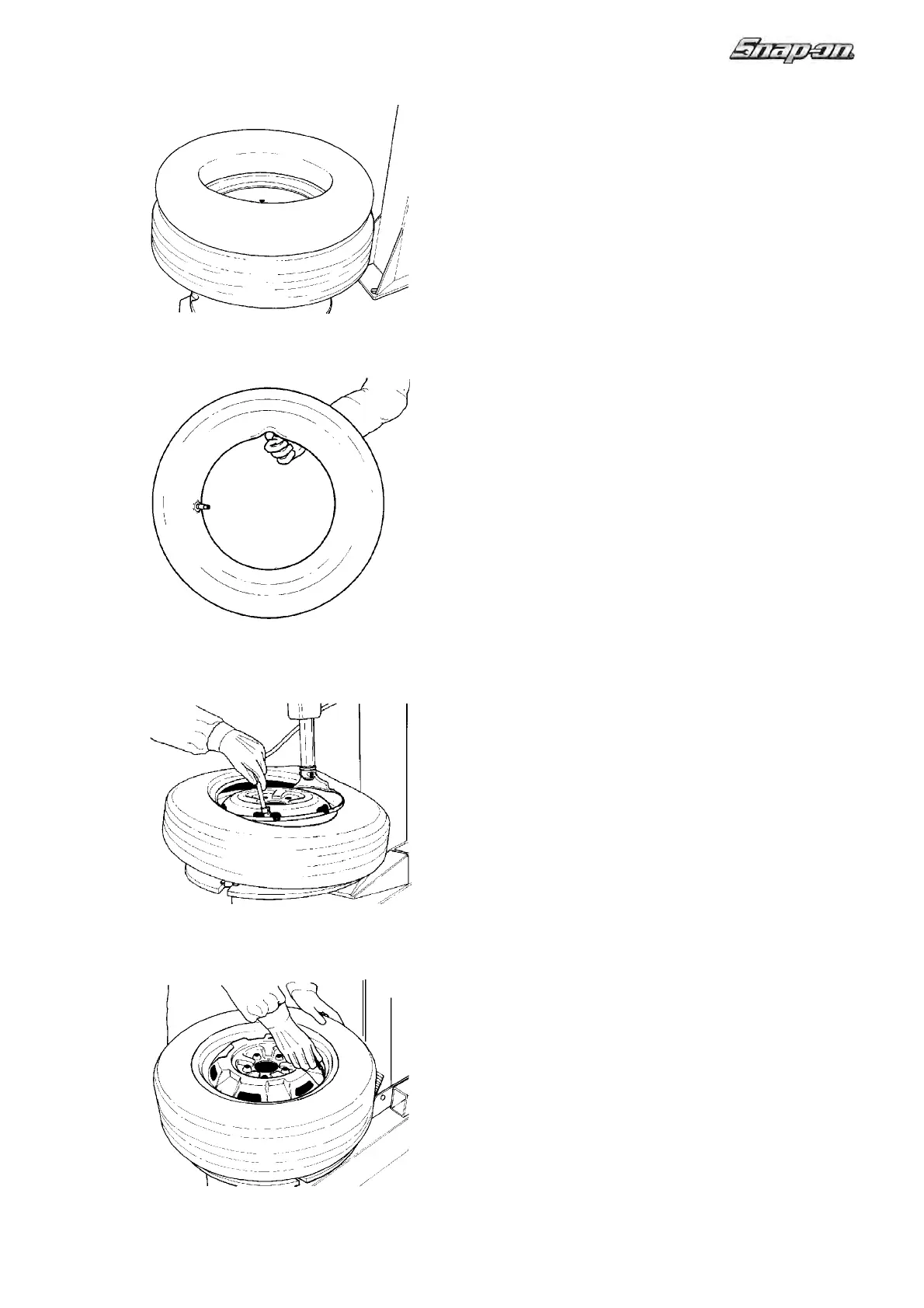
B. Mount the valve core and place the tube onto the tire
to con! rm that the tube is of the correct size (Fig. 5.1-1).
C. In" ate the tube slightly: if held with the index ! nger it
should bend a little (Fig. 5.1-2).
D. Mount the ! rst bead as described in section 4.2.B.
Put the tube inside the tire and secure the valve with the
chuck of the in" ating hose (Fig. 5.1-3).
Mount the top bead following the directions above.
5.2 Infl ating tube-type tires
To in" ate the tires unlock the rim and start in" ating whil
e
pressing the valve towards the inside. This is necessary
to avoid air pockets forming between tube and tire (Fig.
5.2-1).
Ensure that the tire is correctly centered on the rim and
complete in" ation as described in section 4.3.



 To Next Page