EasyManua.ls Logo

Snapper 2 Series - Blade Brake Adjustment; Cutting Blade Service

Snapper 2 Series
16 pages
Print Icon
To Next Page IconTo Next Page
To Previous Page IconTo Previous Page
Loading...
SERVICE
(Continued)
MOWER
SERVICE
&
ADJUSTMENTS
Keep
the
topside
of
the
mower
free
of
grass
cuttings.
Buiidup
of
clippings
could
cause
belt
problems
and
also
might
present
potential
fire
hazard
especially
when
dry.
If
uneven
cutting
is
noted,
check
the
tire
pressure
first
as
this
is
the
most
common
cause.
If
tire
pressure
is
correct
and
uneven
cutting
persists,
move
the
tractor
to
a
flat
level
surface,
such
as
a
garage
floor,
and
check
the
deck
level.
(See
“LEVELING
MOWER”,
Page
12).
To
prolong
the
life
and
efficiency
of
your
mower,
keep
the
underside
of
deck
clean
and
free
of
accumulated
grass
clippings
by
washing
it
down
with
a
hose
and/or
scraping
with
a
wire
brush
and
scraper.
Make
sure
this
is
done
at
the
end
of
the
cutting
season
before
placing
the
mower
in
storage.
BLADE
BRAKE
ADJUSTMENT
The
BLADE
BRAKE
assembly
is
designed
to
stop
blade
rotation
within
3
seconds
after
the
BLADE
CONTROL
LEVER
has
been
pushed
downward
to
“OFF”.
Should
the
blades
not
stop
within
3
seconds,
the
BLADE
BRAKE
must
be
adjusted
as
follows:
1.
Lower
deck
to
lowest
position.
2.
Push
BLADE
CONTROL
lever
downward
to
“OFF”
position.
3.
Loosen
retaining
nut
on
R.H.
OUTSIDE
PULLEY
BELT
COVER
and
swing
cover
out
of
way.
4.
Inspect
BRAKE
BAND
closely
to
determine
approximate
amount
of
adjustment
required.
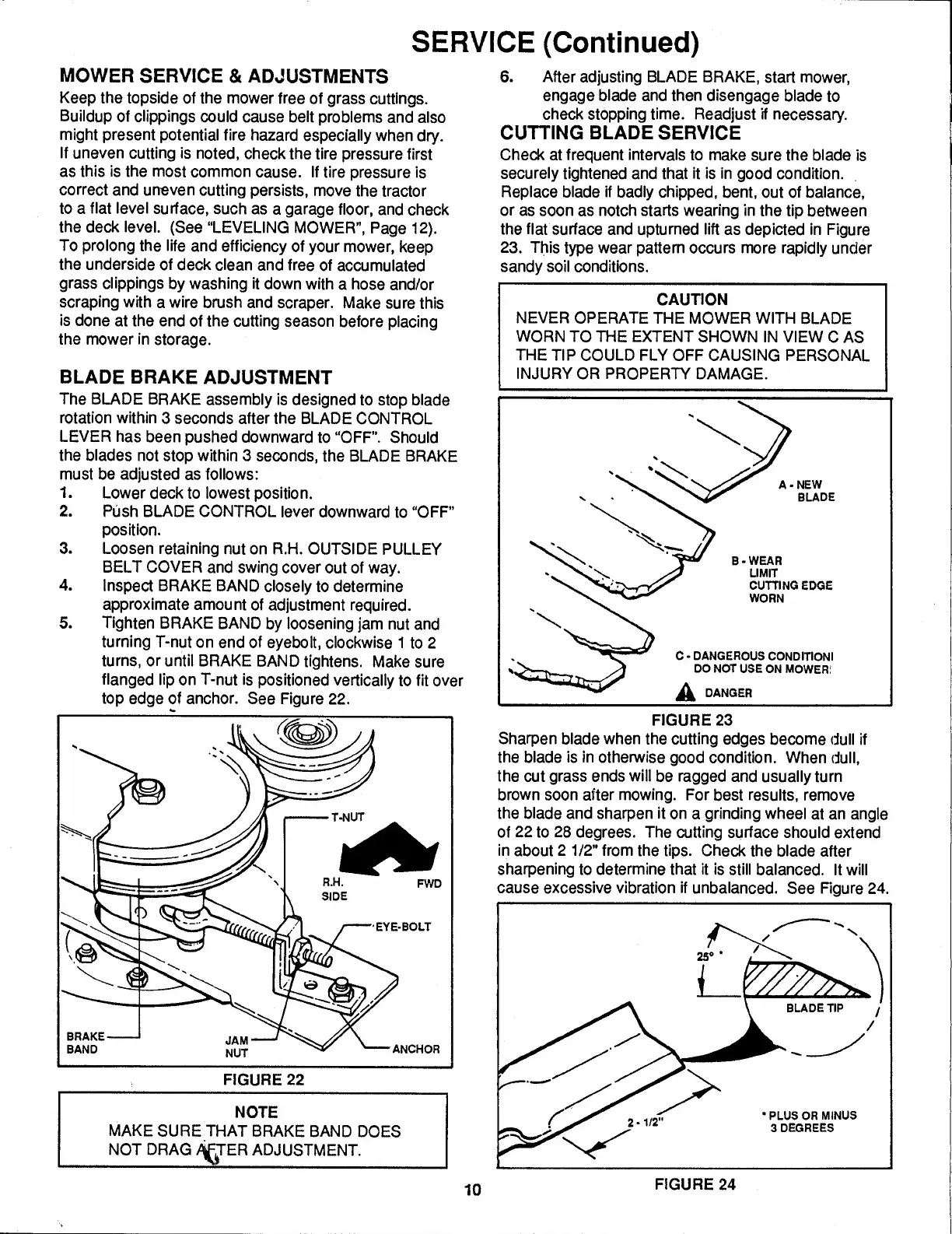
5.
Tighten
BRAKE
BAND
by
loosening
jam
nut
and
turning
T-nut
on
end
of
eyebolt,
clockwise
1
to
2
turns,
or
until
BRAKE
BAND
tightens.
Make
sure
flanged
lip
on
T-nut
is
positioned
vertically
to
fit
over
top
edge
of
anchor.
See
Figure
22.
FIGURE
22
NOTE
MAKE
SURE
THAT
BRAKE
BAND
DOES
NOT
DRAG
/^i^TER
ADJUSTMENT.
6.
A
fter
adjusting
BLADE
BRAKE,
start
mower,
engage
blade
and
then
disengage
blade
to
check
stopping
time.
Readjust
if
necessary.
CUTTING
BLADE
SERVICE
Check
at
frequent
intervals
to
make
sure
the
blade
is
securely
tightened
and
that
it
is
in
good
condition.
Replace
blade
if
badly
chipped,
bent,
out
of
balance,
or
as
soon
as
notch
starts
wearing
in
the
tip
between
the
flat
surface
and
upturned
lift
as
depicted
in
Figure
23.
This
type
wear
pattern
occurs
more
rapidly
under
sandy
soil
conditions.
CAUTION
NEVER
OPERATE
THE
MOWER
WITH
BLADE
WORN
TO
THE
EXTENT
SHOWN
IN
VIEW
C
AS
THE
TIP
COULD
FLY
OFF
CAUSING
PERSONAL
INJURY
OR
PROPERTY
DAMAGE.
Sharpen
blade
when
the
cutting
edges
become
dull
if
the
blade
is
in
otherwise
good
condition.
When
dull,
the
cut
grass
ends
will
be
ragged
and
usually
turn
brown
soon
after
mowing.
For
best
results,
remove
the
blade
and
sharpen
it
on
a
grinding
wheel
at
an
angle
of
22
to
28
degrees.
The
cutting
surface
should
extend
in
about
2
1/2"
from
the
tips.
Check
the
blade
after
sharpening
to
determine
that
it
is
still
balanced.
It
will
cause
excessive
vibration
if
unbalanced.
See
Figure
24.
10
FIGURE
24

Related product manuals