11
THEORY AND PLOWING OPERATION
System Operation Theory
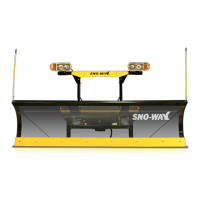
The Skid Steer Straight Blade Snow Plow functions as an
accessory for a skid steer or any vehicle that has a
Universal Mount system.
The plow is mounted to the Universal Mount system, and
the auxiliary hydraulics lines are connected to the swing
cylinders. The plow is raised or lowered using the loader
arms. The blade is angled when the auxiliary hydraulics
are turned on. The fluid pressure from the auxiliary
hydraulics causes one of the angling cylinders to become
pressurized and therefore extend. The extended cylinder
causes the blade to angle. The fluid from the retracting
cylinder returns to the skid steer fluid reservoir tank via the
other auxiliary hydraulics port. To cause the blade to
angle in the opposite direction, the auxiliary hydraulics
flow is reversed. The connection of the hoses for left to
right orientation is vehicle dependent as to which auxiliary
port connects to which cylinder.
To limit the angling speed of the blade, an orifice is
located in the left cylinder elbow.
NOTE: Any altering or removal of this orifice voids the
warranty.
A cross over relief system protects the unit from potential
damage. When the blade hits an obstacle it causes the
blade to angle. If the load is higher than 2000 PSI. in the
cylinders, then the cylinder rod retracts via the cross over
relief and protects the blade from potential damage. The
blade, however, is not protected if the cylinder is fully
retracted and against the stops. Potential damage to the
blade and the stops can occur if significant obstacles are
encountered while the blade is against a stop.
Plow Operational Limits
Figure 2-1
The Sno-Way Skid Steer Plows are designed to plow
snow within certain operational limits. A pair of floating
links enable the plow to "float" over the contours of an
uneven grade during operation. In addition, these links
are designed to be the "weakest link" of the plow system.
If excessive loading is encountered the links will collapse,
requiring replacement. Plowing with all four skid steer
wheels "on the ground" is recommended for optimum
plowing performance and reduced loading on plow
components.
Plowing Operation
Before The Season Begins
1. Inspect safety equipment for proper operation;
headlights and windshield wipers.
2. Inspect the plow, plow frame and all attaching
hardware for wear and corrosion. Replace worn or
damaged parts and clean and repaint exposed metal
parts with a high quality, corrosion resistant enamel.
3. Inspect all fasteners to insure that they are properly
tightened. If any fasteners are loose, re-tighten to the
proper torque (refer to the Torque Specification Chart in
this manual) and carefully inspect the adjacent area for
damage or wear as well as carefully inspecting all
adjacent fasteners for proper torque.
4. Apply a small amount of light oil to the Hitch Pins and
pivots, to Pivot Pins between the Blade Assembly and the
Swing Frame, between Swing Cylinder pivot Pins and the
Lift Linkage.
5. Check for excessive free play between the A-Frame
and Swing Frame Pivot. If there is excessive free play
adjust the Swing Frame Pivot Pin as described in the of
this manual.
6. If wear is noticed between the A-Frame and Swing
Frame apply a good quality Anti-Seize lubricant to this
area.
Clearing Driveways
NOTE: For better clean up of hard-packed snow, raise
the disc shoes so that the cutting edge of the blade
comes into direct contact with pavement.
1. Head into driveway with the blade angled to plow
snow away from buildings. Continue to widen drive path
by rolling snow away from buildings on successive
passes.
1. If there is a garage at the end of the driveway, plow to
within several vehicle lengths of the garage. Then push
as much snow as possible off the driveway.
1. With a raised straight blade, drive through remaining
snow to building. Drop blade and “back-drag” snow away
from garage door at least one and one-half vehicle
lengths. Repeat as necessary.
1. Back vehicle to garage door and plow forward toward
street, removing the remaining snow.
FLOATING LINK



 To Next Page
 Loading...