Need help?
Do you have a question about the Snom M18 KLE and is the answer not in the manual?
Basic safety precautions for using telephone equipment to reduce risk of fire, electric shock, and injury.
Basic safety precautions for using telephone equipment to reduce risk of fire, electric shock, and injury (French).
Compliance with FCC rules for digital devices, covering interference and RF exposure guidelines.
Compliance with Canadian digital apparatus requirements and licence-exempt RSS.
Outlines the user manual's content for installation, configuration, and operation of the M18 KLE deskset.
Lists key features such as LCD display, speakerphone, SIP accounts, Key System Emulation, and directories.
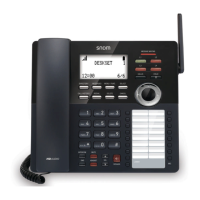
Identifies and describes the external buttons and controls of the cordless deskset.
Explains the default configuration of line keys (L1-L4) for shared line access and call handling.
Instructions on how to use the directory card to record speed dial numbers.
Instructions for installing the mounting bracket for a low tabletop position.
Instructions for installing the mounting bracket for a high tabletop position.
Detailed steps for mounting the deskset onto a wall using the mounting bracket.
Instructions on how to connect a 2.5mm corded telephone headset to the deskset.
Step-by-step guide for registering the deskset to the base station.
Instructions on how to deregister the deskset from its current base station.
How to use the base station's locator button to ring desksets.
Explains the meaning of various icons displayed on the deskset screen for status indication.
Description of the idle screen and available actions from it.
Instructions on how to make outside calls using the deskset.
Steps to initiate an intercom call to another device on the system.
How to answer incoming calls using the handset or speakerphone.
How to handle multiple incoming calls simultaneously.
Procedures for ending an active call.
How to turn the speakerphone on or off during a call.
How to adjust the listening volume during a call.
How to mute or unmute the deskset's microphone during a call.
How to handle incoming calls when already on a call.
How to ignore an incoming call and handle it later.
How to dismiss an incoming call without answering or picking it up later.
How missed call alerts are displayed on the idle screen.
How to answer internal calls from other handsets or desksets.
How to place an active call on hold.
Steps to retrieve a call that was previously put on hold.
How to initiate a new call while a current call is on hold.
How to put a shared call on private hold to prevent others from retrieving it.
How to switch between two active calls.
Steps to send a one-way audio page to another device on the system.
How to receive and end a page from another device.
Explanation of shared calls, how they are displayed, and system administrator configuration.
Steps to access and view the Call List for managing calls.
How to "barge in" on a shared call in progress on another handset.
How to enable or disable call privacy to prevent barging in.
Explanation of how Key System Emulation uses line keys for call management.
Explains the meaning of LED light activity on line keys for call status.
Steps for performing an announced call transfer to another party.
Steps for performing a blind call transfer to another party.
Steps to transfer a current call to a call that is already on hold.
Steps to transfer a call to another device within the same system.
Guide to initiating a conference call with an external number.
Steps to create a conference call using an existing held call.
Steps to initiate a conference call with another internal device.
Information on how network conferences are hosted and managed by service providers.
Instructions on how to access and listen to voicemail messages.
Steps to access and view local, base, or blacklist directories.
Methods to call a contact from a directory entry.
Steps to search for contacts within the directories.
Instructions for adding a new contact to the directory.
Steps to edit an existing contact entry in the directory.
Steps to delete a specific contact entry from the directory.
Instructions to delete all entries from a selected directory.
Steps to access and view missed, received, and dialed calls.
How to call a contact directly from a Call History entry.
Steps to save a Call History entry into a directory.
How to delete individual or all entries from the Call History.
Instructions for programming speed dial numbers for quick dialing.
Steps to edit programmed speed dial entries.
Instructions for deleting programmed speed dial entries.
How to turn the Do Not Disturb (DND) feature on or off for accounts.
How to configure call forwarding settings (always, busy, no answer).
How to block incoming calls that do not display caller ID.
How to make outgoing calls anonymously by hiding caller ID.
How to enable or disable alerts for missed calls.
How to enable or disable alerts for incoming calls during an active call.
Steps to access the Status menu for network and software information.
How to find the deskset's software version.
How to change the deskset's display language.
How to set the deskset's date and time.
How to change the deskset's name from the default.
Steps to program the functions of the line keys (L1-L4).
Steps to program the functions of the hard keys.
Descriptions of available key types for programming line and hard keys.
Explains the meaning of LED light activity on line keys for call status.
How to change the contrast of text and graphics on the deskset LCD.
How to configure the deskset's LCD backlight settings.
How to set the ringer tone and adjust the ringer volume.
How to select speakerphone or headset as the default audio output.
How to enable or disable the low battery warning tone.
How to enable or disable the tone indicating a lost link to the base.
How to enable or disable audible tones for key presses.
Refers to sections on registering and deregistering the deskset.
Guide to accessing and using the Web User Interface for configuration.
Steps to find the deskset's IP address and log in to the WebUI.
Information displayed on the System Status page, including general, account, and network details.
Information on the Handset Status page showing registration status of cordless devices.
How to configure call settings like DND and Call Forward via the WebUI.
Settings for Anonymous Call Reject and Anonymous Call via WebUI.
Settings for enabling or disabling Do Not Disturb via WebUI.
Settings for Call Forward Always, Busy, and No Answer via WebUI.
How to configure the WebUI language setting.
Overview of managing base directory entries, sorting, editing, and importing/exporting.
Steps to add a new contact entry to the base directory via WebUI.
Steps to edit an existing contact entry in the base directory via WebUI.
Instructions for importing contact data files into the base directory.
Instructions for exporting contact data from the base directory.
Overview of the Blacklist feature, similar to Base Directory.
How to configure up to three server-hosted Remote XML directories.
How to change the user password for the WebUI.
Common issues like deskset not working or LCD being black.
Troubleshooting steps for when Caller ID is not functioning.
Steps to resolve issues with deskset registration to the base station.
Troubleshooting steps for inability to make external calls.
Steps to resolve issues with not receiving incoming calls.
Troubleshooting steps for when the deskset cannot be located via paging.
Tips for resolving poor audio quality or speech cutting out.
General advice on handling and caring for the telephone.
Precautions regarding water exposure and handling wet devices.
Safety advice during electrical storms.
Instructions on how to clean the telephone safely.
 General
| Type | DECT Cordless Phone |
|---|---|
| Range (Indoors) | Up to 50 meters |
| Range (Outdoors) | Up to 300 meters |
| Audio Quality | HD audio |
| Connectivity | DECT |
| Supported Protocols | SIP |
| Languages | Multiple languages supported |
| Standby Time | Up to 150 hours |
| Headset Jack | 3.5 mm |
| DECT Security | DECT Security |
| Supported Codecs | G.722, G.726 |
| Power over Ethernet | Yes |

 To Next Page