Need help?
Do you have a question about the Snom D7C and is the answer not in the manual?
Follow safety guidelines for device usage, including connection and mounting restrictions. Avoid hazardous environments.
Details compliance with essential health, safety, and environmental requirements for European, UK, and US standards.
Confirms that input/output connections comply with Safety Extra Low Voltage (SELV) requirements.
Lists safety standards, connectors (USB 2.0, 5V DC jack), and power supply requirements for the device.
Provides guidance on proper disposal of the electronic device according to European directives and local regulations.
Recommends using an anti-static cloth for cleaning and advises against liquids to prevent damage.
Lists the items included in the delivery package: base unit, footstand, connectors, and quick installation guide.
Step-by-step instructions for attaching the footstand to the expansion module for upright or horizontal positioning.
Detailed guide on physically connecting the D7C expansion module to compatible Snom phones using provided connectors.
Explains how to connect multiple D7C modules in series (daisy-chain) and power requirements for each.
Instructions on how to safely disconnect the expansion module from the phone by releasing the connector levers.
Guidance on connecting a wireless headset's USB adapter to the expansion module or phone's USB port.
Describes the screen layout, including function keys, labels, separators, and page navigation indicators.
Details how text, numbers, and line breaks are displayed on the function key labels on the module's screen.
Explains how the LEDs on the function keys indicate the status of key events, lighting up when active.
How to select UI color themes (light, dark, colorful, industrial) for the expansion module via the phone's settings.
Instructions for adjusting backlight intensity for activity and idle modes using the phone's settings menu.
Configuration of backlight intensity and dimming timers for the expansion module via the phone's web interface.
Adjusting font size for main and sub text, and text alignment (left/right) for function keys on the phone.
Steps to assign functions, types, and numbers to specific keys on the expansion module via the phone's menu.
Setting font size and text alignment for the expansion module's display via the phone's web interface.
Configuring function keys by selecting context, type, number, and label via the phone's web interface.
Details on using XML tags for mass provisioning of function key settings, including format and examples.
Explanation of parameters like fkey idx, context, label, default_text, perm, and argument for function keys.
Provides examples of XML arguments for various function types like extension, speed dial, intercom, and transfer.
Details the fkey idx, PUI, and WUI numbering for phone and D7C expansion modules on D735 phones.
Details the fkey idx, PUI, and WUI numbering for phone and D7C expansion modules on D765 phones.
Details the fkey idx, PUI, and WUI numbering for phone and D7C expansion modules on D785 phones.
Step-by-step guide for updating the expansion module firmware manually using the phone's web interface.
Instructions for updating expansion module firmware automatically or semi-automatically using provisioning settings.
The Snom D7C Expansion Module is designed to enhance the functionality of compatible Snom D717, D735, D765, and D785 phones, providing additional programmable function keys and an intuitive display. This module integrates seamlessly with the Snom phone system, extending its capabilities for users who require more direct access to various features and contacts.
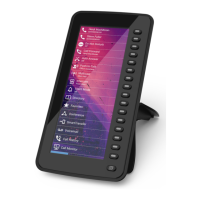
The D7C Expansion Module features 16 function keys, each equipped with an LED indicator, and a page key for navigating through three distinct function key pages. This setup allows for a total of 48 programmable functions per module. The display screen allocates a field to each key, which can show text that is either left-aligned or right-aligned. A blue line at the bottom of the screen visually indicates the currently active page.
The function keys on the D7C module operate similarly to the SmartLabel keys with LEDs found on Snom D717, D735, and D785 phones, and the function keys with LEDs on the D765. These keys are freely programmable, allowing users to assign various functions such as speed dial, extension monitoring, intercom, call forwarding, and more. The settings for these keys are stored directly on the connected Snom phone, ensuring that they persist even if the expansion module is disconnected or replaced. This means that if a module is swapped, the new module will automatically adopt the settings previously configured for that position.
The module supports "SmartLabels," which dynamically display context-sensitive information. In its default setting, the icon and name of the function type are shown in the label area. If a specific text is entered in the "Label" field, it will be displayed instead of the function type. If a value is entered in the "Number" field without a "Label" text, the value will appear as a second line below the function type. For displaying two lines of text, such as a name and a phone number for an extension, the <br> tag can be used within the "Label" field. The display also provides real-time context information, showing key event details when a key is pressed or an event occurs, and reverting to idle content when the event concludes.
The LEDs associated with each function key illuminate when a key event occurs or when the key is pressed, and turn off once the event has ended or the key is pressed again. This visual feedback helps users quickly ascertain the status of their programmed functions.
Setting up the D7C Expansion Module involves attaching a footstand, which can be configured for either an upright or a more horizontal position using different "legs" on the footstand. The module connects to a Snom phone via a USB cable, with specific connectors (A, B, C) designed for different phone models and for daisy-chaining multiple D7C modules. Up to three D7C modules can be connected to a single Snom phone. The first module receives power from the phone via its USB cable, while subsequent modules may require a separate power adapter, especially if a power-intensive USB device is connected to the module's USB port. It is crucial to daisy-chain the D7C modules correctly, as connecting them to multiple USB ports on the phone or using a USB hub can render the function keys inoperable.
Configuration of the function keys can be done either directly on the phone's user interface or through its web interface. On the phone, users can access the "Settings" menu, navigate to "Preferences," then "Display," and finally "Expansion Modules" to adjust appearance settings. This includes selecting one of four standard UI color themes (light, dark, colorful, industrial) and adjusting the font size and text alignment for the main and subtext lines displayed on the keys. The intensity of the backlight can also be adjusted for both active and idle periods.
Through the phone's web interface, users have similar control over display settings. They can select UI color themes, and for advanced customization, specify a URL for a custom background image. When using a custom image, it's important to ensure it meets specific size and file requirements to avoid defaulting back to the standard UI color theme. The backlight timer, which determines when the display switches to idle intensity, is also configured via the web interface.
Programming the function keys involves selecting the desired key, choosing its "Context" (e.g., "Active" for all identities or a specific identity), and then selecting the "Type" of function (e.g., "Extension," "Speed Dial," "Intercom," "Call Forwarding," "Multicast," "Transferring call"). Depending on the chosen function type, users will be prompted to enter relevant information, such as a phone number or a descriptive label. The "Label" field supports custom text, while the "default_text" attribute can dynamically insert information like $name (label or extension/phone number) and $state (key's status like free or busy).
The D7C also supports XML provisioning for mass configuration of settings, allowing administrators to define precise settings for each function key using specific XML tags and arguments. This enables efficient deployment and management of multiple expansion modules across an organization.
The D7C Expansion Module is designed for indoor use only, and users are advised against installing it in high-humidity environments or exposing it to liquids. Cleaning the device should be done with an anti-static cloth, avoiding cleaning liquids that could damage the surface or internal electronics.
Firmware updates for the D7C module can be performed manually via the phone's web interface or automatically through provisioning. For manual updates, the module must be connected to the phone, and the update file (snomD7C-
For updates via provisioning, the phone must be running a compatible firmware version, and the update file must be located on a reachable server. The phone's update policy settings (auto_update or ask_for_update) will determine how the update is initiated. Similar to manual updates, provisioning updates should also be performed one module at a time. The firmware_uxm parameter in provisioning settings is used to prevent repeated downloads of the update file after a successful update, ensuring efficient management of firmware versions across multiple modules.
 General
| Product color | Black |
|---|---|
| Number of buttons | - buttons |
| Compatible products | D717, D735, D765, D785 |
 Weight and Dimensions
| Dimensions (WxDxH) | 160 x 105 x 220 mm |
|---|

 To Next Page