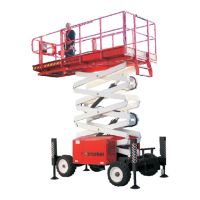
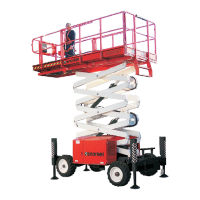
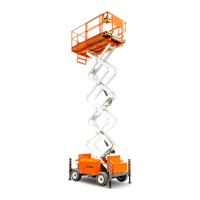
The aerial platform can tip over if it becomes unstable.
Death or serious injury can result from a tip-over acci
-
dent.Donotdriveorpositiontheaerialplatform forele-
vatedusenear any drop-off,hole,slope,softor uneven
ground, or other tip-over hazard.
Do not operate the aerial platform within 4 (1.2 m) of
any drop-off or hole.
It is best not to transfer from the platform to another struc-
ture or from the structure to the platform, unless that is the
safest way to do the job. Judge each situation separately
takingtheworkenvironmentintoaccount.If it isnecessary
to transfer from the platform to another structure the fol-
lowing guidelines apply:
1. If you are using a fall restraint,transfer your anchor-
age from one structure to the other before stepping
across.
2. Remember that you might be transferring to a struc-
ture where
personal fall arrest
is required.
3. Use the platform entrance, do not climb over the
guardrails.
Do not raise the platform outdoors or in the wind.Do not
add anything to the aerial platform that will increase the
wind loading such as billboards, banners, flags, etc.
Never operate the aerial platform without all parts of the
guardrail system in place and the safety chain or gate
closed.Make sure that all protectiveguards, cowlings, and
doors are securely fastened.
Do not exceed the platform capacity as indicated on the
platform rating placard on the platform. Do not carry
loads that extend beyond the platform guardrails without
prior written consent from Snorkel.
Do not operate the aerial platform from trucks, trailers,
railway cars, floating vessels, scaffolds, or similar
equipment unless the application is approved in writing
by Snorkel.
Do not use the aerial platform as a crane, hoist, jack, or
for any purpose other than to position personnel, tools,
and materials.
Do not climb on the guardrails or use ladders, planks, or
other devices to extend or increase the work position
from the platform.
Take care to prevent rope, electrical cords, and hoses, etc.,
from becoming caught in or on the aerial platform. If the
platform or scissors structure becomes caught on an adja-
cent structure or other obstacle and is prevented from nor-
mal motion, reverse the control to free the platform. If
control reversal does not free the platform, evacuate the
platform before attempting to free it.
Electrical System
Charge the batteries in a well-ventilated area free of
flame, sparks, or other hazards that might cause fire or
explosion.
Do not operate any of theaerial platform functions while
the battery charger is plugged in.
Batteries give off hydrogen and oxygen that can
combineexplosively.Death or serious injurycanre-
sult from a chemical explosion. Do not smoke or
permit open flames or sparks when checking the
batteries.
Battery acid can damage the skin and eyes.Serious
infection or reaction can result if medical treatment
is not given immediately. Wear face and eye protec-
tion when working near the batteries.
Batteries contain sulfuric acid that can damage your
eyes or skin on contact. Wear a face shield, rubber
gloves, and protective clothing when working around
batteries. If acid contacts your eyes, flush immediately
with clear water and get medical attention. If acid con-
tacts your skin, wash off immediately with clear water.
Hydraulic System
The hydraulic system contains hoses with hydraulic
fluid under pressure.
Hydraulic fluid escaping under pressure can have
enough force to inject fluid into the flesh. Serious
infection or reaction can result if medical treatment
is not given immediately. In case of injury by escap-
inghydraulicfluid,seek medicalattentionatonce.
Do not place your hand or any part of your body in front
of escaping hydraulic fluid.Use a piece of cardboard or
wood to search for hydraulic leaks.
Placards and Decals
The aerial platform is equipped with placards and de-
cals that provide instruction for operation and accident
prevention. Do not operate the aerial platform if any
placards or decals are missing or not legible.
S1930 – 0361266 3-3
Chapter 3. Safety
ADANGER
ADANGER
ADANGER


 To Next Page