Appendix A. Glossary
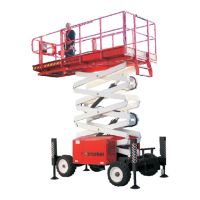
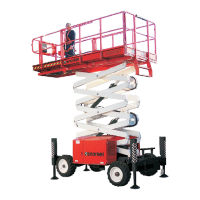
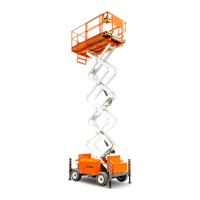
aerial platform—amobile devicethat has an adjustableposi
-
tion platform, supported from ground level by a structure.
authorized personnel—personnel approved as assigned to
perform specific duties at a specific location.
base—the relevant contact points of the aerial platform that
form the stability support (e.g. wheels, casters, outriggers,
stabilizers).
battery tray—a swing-out compartment that holds the batter-
ies and the battery charger.
center of gravity—the point in the aerial platform around
which its weight is evenly balanced.
chassis—the integral part of the aerial platform that provides
mobility and support for the scissors structure.
fall restraint—a system that is used while working on a boom
lift within the boundaries of platform guardrails to provide re-
straint from being projected upward from the platform. This
system includes a harness or belt, lanyard, and a lanyard an-
chor.Although federal regulations, OSHA, ANSI, and Snorkel
do not require the use of fall protection beyond the platform
guardrails on scissors lift aerial platforms, local, state, or em-
ployer rules may require their use.
floor or ground pressure—the maximum pressure, ex-
pressed in pounds per square inch, a single wheel concen-
trates on the floor or ground.
free-wheeling valve—a needle valve that when adjusted
open allowshydraulic fluidtoflow through the wheel drivemo-
tors. This allows the aerial platform to be pushed or towed
without damage to the drive motors.
gradeability—the maximum slope that the aerial platform is
capable of travel.
groundfault circuitinterrupter(GFCI)—a fast-actingcircuit
breaker that opens to stop electrical circuit flow if it senses a
very smallcurrent leakage toground.TheGFCI isusedto pro-
tectpersonnel againstapotentialshockhazardfrom defective
electrical tools or wiring.
guardrail system—a vertical barrier around the platform to
prevent personnel from falling.
hazardous location—any location that contains, or has the
potentialto contain,anexplosiveor flammableatmosphereas
defined by ANSI/NFPA 505.
hydraulic tray—a swing-out compartment that holds the
electrical panel forthe lower controls,the hydraulicdirectional
control valve, the free-wheeling valve, the pump, and the hy
-
draulic fluid filter.
lowercontrols—the controls located atground level for oper
-
ating some or all of the functions of the aerial platform.
maximum travel height—the maximum platform height or
the most adverse configuration(s) with respect to stability in
which travel is permitted by the manufacturer.
maximum wheel load—the load or weight that can be trans-
mitted through a single wheel to the floor or ground.
Minimum Safe Approach Distance—the minimum safe dis-
tance that electrical conductors may be approached when us-
ing the aerial platform. Also called M.S.A.D.
operation—the performance of any aerial platform functions
within the scope of its specifications and in accordance with
the manufacturer’s instructions, the users work rules, and all
applicable governmental regulations.
personal fall arrest system—a fall protection system that is
used while working on an unprotected edge (such as a roof
top with no guardrail). This system includes a harness, lan-
yard or other connecting device, a fall arrestor, an energy ab-
sorber or decelerator, an anchorage connector, and a secure
anchorage such as a building beam, girders or columns. An
aerial platform is not a fall arrest anchorage.
platform—the portion of an aerial platform intended to be oc-
cupied by personnel with their tools and materials.
platform height—the vertical distance measured from the
floor of the platform to the surface upon which the chassis is
being supported.
qualified person—a person, who by reason of knowledge,
experience, or training is familiar with the operation to be per-
formed and the hazards involved.
rated work load—the designed carrying capacity of the ae-
rial platform as specified by the manufacturer.
stow—to place a component, such as the platform, in its rest
position.
unrestricted rated work load—the maximum designed car-
rying capacity of the aerial platform allowed by the manufac-
turer in all operating configurations.
upper controls—the controls located on or beside the plat-
form used for operating some or all of the functions of the ae-
rial platform.
S1930 – 0361266


 To Next Page