Chapter 6. Batteries
The battery tray contains 4, 220 amp hour, 6 volt batter
-
ies. These batteries supply 24 volt DC electrical power
to operate the aerial platform drive and platform control
systems. Proper machine operation depends on well
maintained and charged batteries.
General Maintenance
Always keep the batteries clean, free of dirt and corro-
sion. A film on top of the battery can accelerate dis-
charge.
Cold reduces battery capacity and retards charging.
Heat increases water usage and can result in over-
charging. Very high temperatures can cause thermal
run away whichmay lead toan explosionor fire.Consult
a battery charger specialist if extreme temperature use
is unavoidable.
Battery acid can damage the skin and eyes.Serious
infection or reaction can result if medical treatment
is not given immediately. Wear face and eye protec-
tion when working near the batteries.
Use distilled water to refill the batteries. Avoid water
containing metallic solids such as iron.
Charging
Fully recharge the batteries,immediatelyafter use.One
charging cycle per day is preferred. Fully charged bat-
teries perform best. The deeper the discharge, the
fewer number of cycles a battery will deliver. Deep dis-
charges deteriorate the battery quicker than light shal-
low cycles.
An overly discharged battery may need to be cycled a
fewtimesbeforeitcanfullyrecover.Ifa battery begins to
heat before becoming fully charged, it may be neces-
sarytorechargeanddischarge the battery a fewtimes.
The aerial platform is equipped with an automatic bat-
tery charger that will completely recharge the batteries
and turn off after the charge cycle is completed.
Batteries give off hydrogen and oxygen that can
combineexplosively.Death or serious injurycanre-
sult from a chemical explosion. Charge the batter-
ies only in a well ventilated area away from sparks
or flame.
The batteries can be overcharged and/or damaged
if the charger fails to shut off automatically. Do not
leavethe batterycharger onformore than twodays.
It may take from 1
1
/2 to 16 hours to recharge the batter
-
ies depending on the amount of discharge.If the charg
-
ing cycle exceeds 16 hours without the batteries being
fully recharged, shut off the charger and have the bat-
teries checked.
Use the following procedure to charge the batteries.
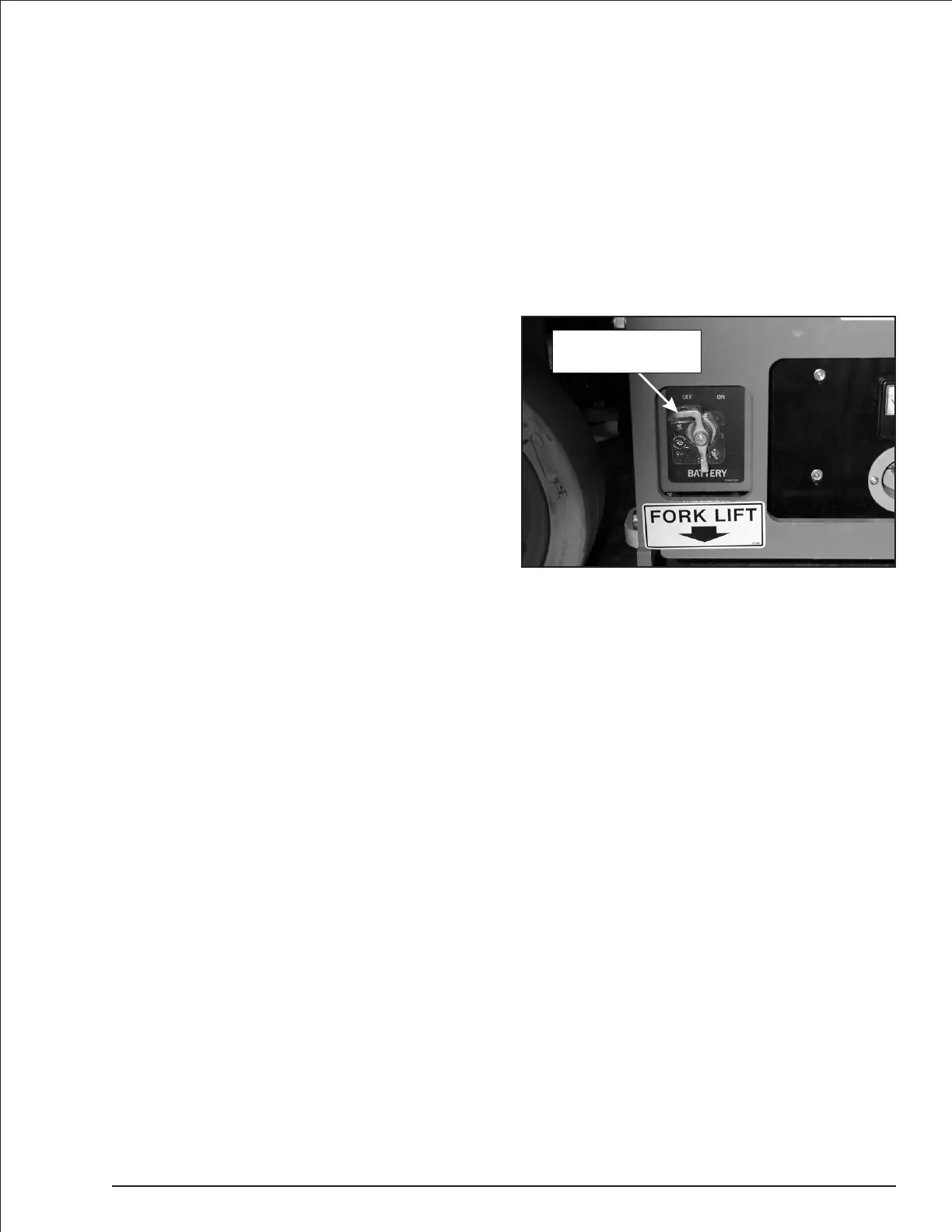
1. Turn the battery disconnect switch off (refer to Fig-
ure 6.1). The switch is next to the latch on the bat-
tery tray.
Figure 6.1—Battery Tray
2. Check the battery water level.Add water to individ-
ual cells only if the plates are exposed.Replace the
battery caps.
3. Plug the charger into a properly grounded outlet
(115 volt AC, 60 Hz) using a 3 conductor, 14 gauge
or larger extension cord. The extension cord must
beas short as possible and in good electricalcondi-
tion. The charger will turn on three to five seconds
after a complete electrical connection is made.The
ammeter (refer to Figure 6.1) will indicate near 20
amps initially then taper off to 5 to 10 amps as the
batteries charge.
Note
If the batteries are fully charged when the charger is
plugged in, the ammeter will initially read 15 to 20 amps
then quickly read zero.
4. Leavethechargerpluggedinuntilitshuts itself off.
5. Unplug the extension cord after the battery charger
turns itself off. Allow the batteries to cool off after
charging.
6. Check the battery water level.Add water to individ-
ual cells only if the plates are exposed.Replace the
battery caps.
S1930 – 0361266 6-1
ADANGER
ADANGER
ACAUTION
Battery
Disconnect Switch



 To Next Page