MIVI Technical Manual
REF: 379/4 14
2.3 Practical advices
2.3.1
Flow damper
Each sensor is equipped with a flow damper (tube) in order to stabilize the flow around the vibrat-
ing rod. The fluid renewal is done through the slits of the damper. Slits length and width have
been set by SOFRASER according to the full scale range of the sensor and the type of mount-
ing (on pipe, on reactor, on flow cell …).
It is advised to keep it on the sensor unless the sensor is used in particular conditions: on flow cell
mounting, sanitary use, very viscous fluids. At the time of the assembly on the mounting
flange and during transport, it also protects the rod from mishandling. Before installing the
MIVI on its mounting accessory check that flow damper is firmly screwed on the neck of the
MIVI sensor.
2.3.2
Tightness
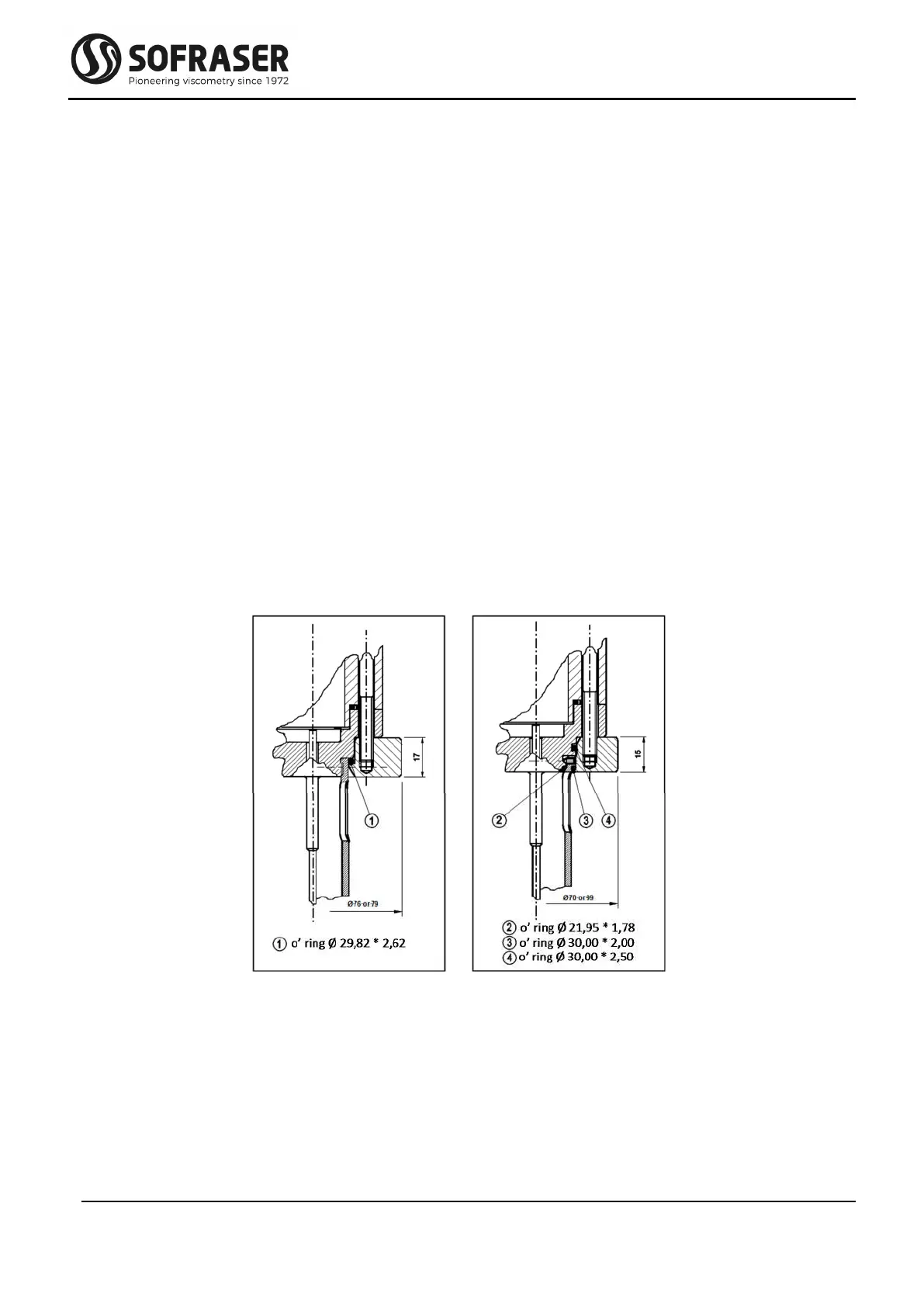
Tightness between MIVI sensor and its mounting accessory is assured by one O-ring (three for the
sanitary model). Check that the O-ring(s) material is compatible with your fluid and the op-
erating temperature.
The flow damper of MIVI with base design (left drawing) is screwed on the neck of the vibrating
rod flange. But removing the flow damper of MIVI with sanitary design requires to unscrew
the 4 M3 STHC screws (right drawing) in order to release it from the neck of the vibrating rod
flange.
When the MIVI sensor is installed without the flow damper, the replacement ring delivered with
the mounting accessory (see technical leaflets ref. 320, 328 or 329), that has the same dimen-
sions than the flow damper base, must be placed on the head of the MIVI sensor in order to
maintain the O-ring(s) and ensure tightness.
Check that the maximum operating pressure of your process is within the nominal pressure of
your MIVI sensor.
MIVI sensor with cable gland is rated IP67. Nevertheless, for long term utilization, cable gland and
cable must be oriented in the bottom direction. IP 67 tightness is only secured when the


 To Next Page