EasyManua.ls Logo

Sony CRF-230B - Page 9

Sony CRF-230B
60 pages
Print Icon
To Next Page IconTo Next Page
To Previous Page IconTo Previous Page
Loading...
CRF-230B
Product
Detector
for
Single-Sideband
Reception:
Input
Level
(dB)
30
A
product
detector
is
a
type
of
heterodyne
detector.
Single-sideband
signals
can
be
recovered
by
passing
them
through
nonlinear
device
after
being
mixed
with
a
carrier
identical
in
frequency
to
that
used
during
modulation
at
the
transmitter.
That
is,
these
two
signals,
sideband
and
carrier,
are
converted
into
two
beat
signals,
upper
and
lower,
against
the
carrier
frequency
by
heterodyne
action.
The
upper
beat
signal
is
eliminated
by
passing
through
the
filter
circuit
and
the
lower
beat
signal
is
fed
to
the
next
stage
as
audio
signals.
In
the
model
CRF-230B,
the
detector
utilizes
the
square-law
characteristic
(output
current
pro-
portional
to
the
square
of
the
effective
value
of
the
input
voltage)
of
a
diode
for
the
nonlinear
device.
To
minimize
distortion,
two
diodes
D502
and
D503
are
connected
in
reverse
each
other
and
applied
the
signals
respectively
positive
in
phase.
That
is
-
ia
ae
-
<
because
the
range
of
square-law
curve
of
one
diode
is
narrow
causing
distorted
detection
for
strong
input
signal.
The
BFO
injection
voltage
used
for
carrier
re-
insertion
is
comparatively
high
(about
0.8
volt
is
optimum)
to
set
the
operating
point
of
the
detector
within
a
linear
portion
of
the
diodes’
characteristic.
This
results
to
minimize
distortion
of
the
recovered
40
50
60
70
BO
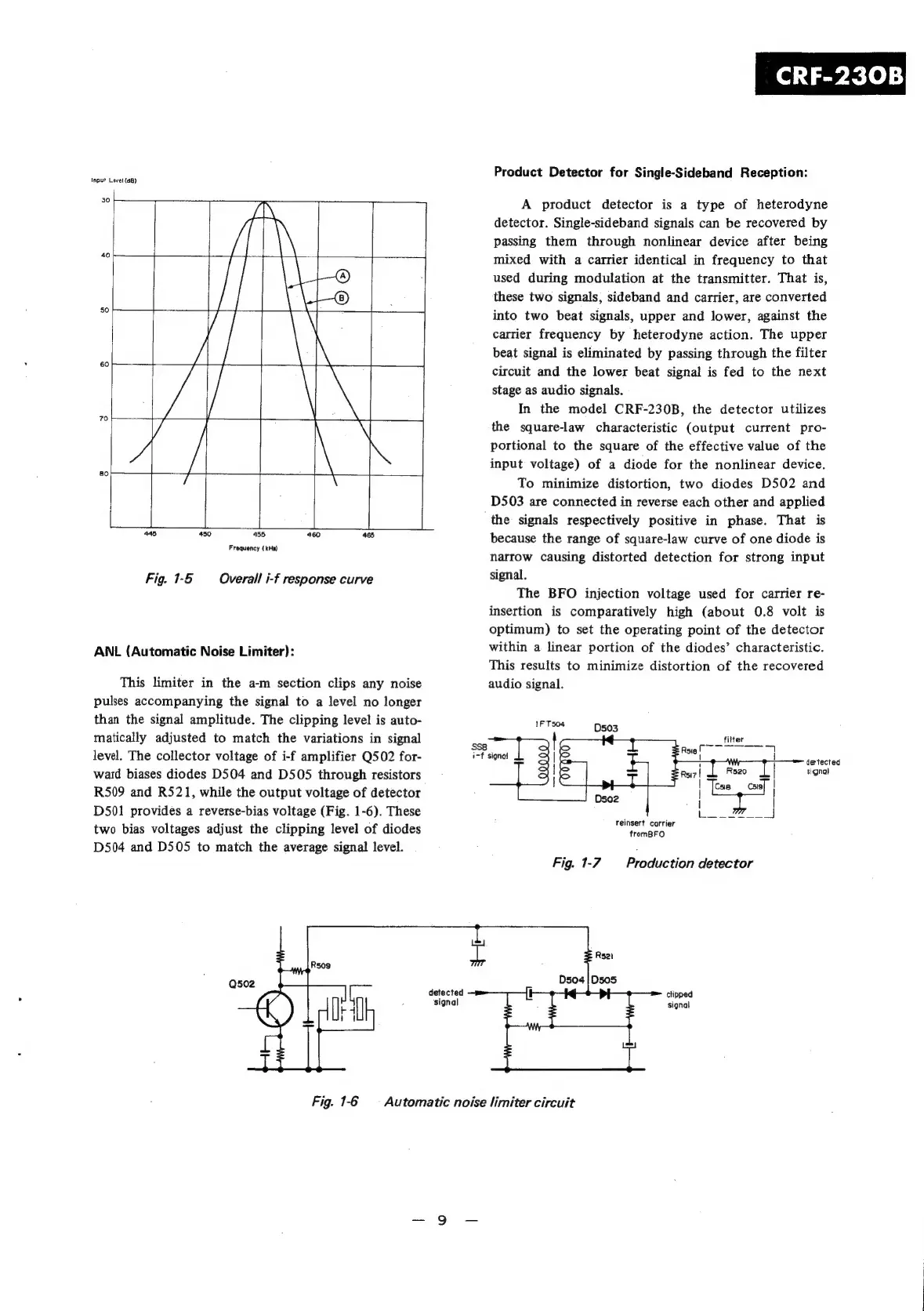
Fig.
1-5
Overall
i-f
response
curve
ANL
(Automatic
Noise
Limiter):
This
limiter
in
the
a-m
section
clips
any
noise
audio
signal.
pulses
accompanying
the
signal
to
a
level
no
longer
than
the
signal
amplitude.
The
clipping
level
is
auto-
IFT504
matically
adjusted
to
match
the
variations
in
signal
ras
T
—1¢
7
pa
Lis
level.
The
collector
voltage
of
i-f
amplifier
Q502
for-
if
signal
ad
7
Wy
~—we-
detected
Rsi7
|
Rs20
|
signal
Cae
Csi9
ward
biases
diodes
D504
and
D505
through
resistors
R509
and
R521,
while
the
output
voltage
of
detector
D501
provides
a
reverse-bias
voltage
(Fig.
1-6).
These
two
bias
voltages
adjust
the
clipping
level
of
diodes
habit
D504
and
D505
to
match
the
average
signal
level.
|
Lov
2i
a
Fig.
1-7
Production
detector
D504
|
0505
detected
clipped
signal
signal
Fig.
1-6
|
Automatic
noise
limiter
circuit

Related product manuals