EasyManua.ls Logo

Sony ICF-2001D - Improving Reception and AM Modes; Antenna Adjustment Techniques; AM Mode Selection; Synchronous Detection Tuning

Sony ICF-2001D
78 pages
Print Icon
To Next Page IconTo Next Page
To Previous Page IconTo Previous Page
Loading...
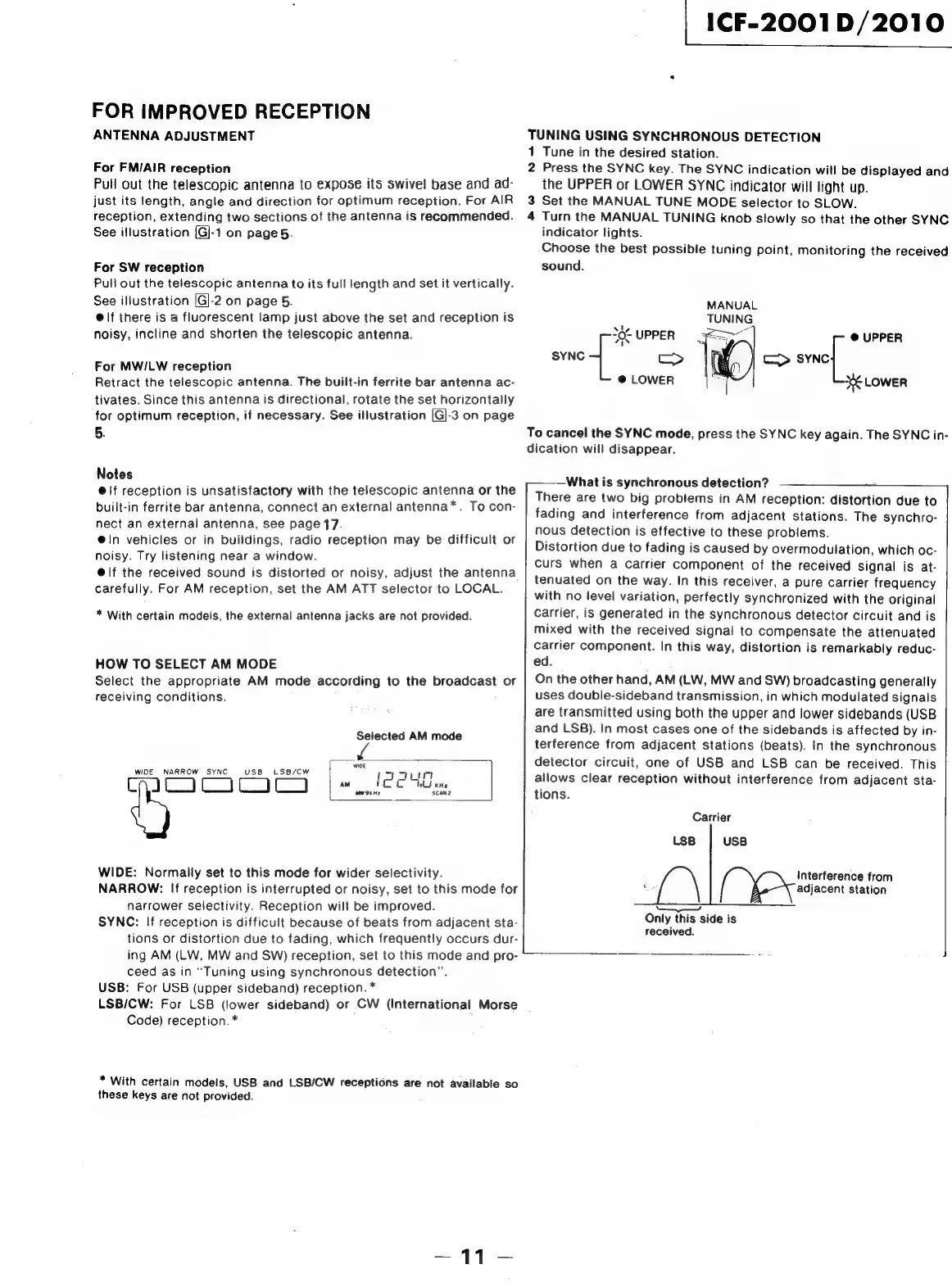
FOR
IMPROVED
RECEPTION
ANTENNA
ADJUSTMENT
For
FM/AIR
reception
Pull
out
the
telescopic
antenna
to
expose
its
swivel
base
and
ad-
just
its
length,
angle
and
direction
for
optimum
reception.
For
AIR
reception,
extending
two
sections
of
the
antenna
is
recommended.
See
iflustration
(G]-1
on
page
5.
For
SW
reception
Pull
out
the
telescopic
antenna
to
its
full
length
and
set
it
vertically.
See
illustration
(G]-2
on
page
5.
@lf
there
is
a
fluorescent
lamp
just
above
the
set
and
reception
is
noisy,
incline
and
shorten
the
telescopic
antenna.
For
MWILW
reception
Retract
the
telescopic
antenna.
The
built-in
ferrite
bar
antenna
ac-
tivates.
Since
this
antenna
is
directional,
rotate
the
set
horizontally
for
optimum
reception,
if
necessary.
See
illustration
[G]-3
on
page
5.
Notes
@!f
reception
is
unsatisfactory
with
the
telescopic
antenna
or
the
built-in
ferrite
bar
antenna,
connect
an
external
antenna*.
To
con-
nect
an
external
antenna,
see
page
17.
@in
vehicles
or
in
buildings,
radio
reception
may
be
difficult
or
noisy.
Try
listening
near
a
window.
@lf
the
received
sound
is
distorted
or
noisy,
adjust
the
antenna
carefully.
For
AM
reception,
set
the
AM
ATT
selector
to
LOCAL.
*
With
certain
models,
the
external
antenna
jacks
are
not
provided.
HOW
TO
SELECT
AM
MODE
Select
the
appropriate
AM
mode
according
to
the
broadcast
or
receiving
conditions.
Selected
AM
mode
“Wide
WIDE
NARROW
SYNC
USB
LSB/CW
AM
MW
OK
v
8
2
2
x
WIDE:
Normally
set
to
this
mode
for
wider
selectivity.
NARROW:
If
reception
is
interrupted
or
noisy,
set
to
this
mode
for
narrower
selectivity.
Reception
wil!
be
improved.
SYNC:
If
reception
is
difficult
because
of
beats
from
adjacent
sta-
tions
or
distortion
due
to
fading,
which
frequently
occurs
dur-
ing
AM
(LW,
MW
and
SW)
reception,
set
to
this
mode
and
pro-
ceed
as
in
“Tuning
using
synchronous
detection”.
USB:
For
USB
(upper
sideband)
reception.
*
LSB/CW:
For
LSB
(lower
sideband)
or
CW
(International
Morse
Code)
reception.
*
*
With
certain
models,
USB
and
LSB/CW
receptions
are
not
available
so
these
keys
are
not
provided.
ICF-2001D/2010
TUNING
USING
SYNCHRONOUS
DETECTION
1
Tune
in
the
desired
station.
2
Press
the
SYNC
key.
The
SYNC
indication
witl
be
displayed
and
the
UPPER
or
LOWER
SYNC
indicator
will
light
up.
3
Set
the
MANUAL
TUNE
MODE
selector
to
SLOW.
4
Turn
the
MANUAL
TUNING
knob
slowly
so
that
the
other
SYNC
indicator
tights.
Choose
the
best
possible
tuning
point,
monitoring
the
received
sound.
MANUAL
TUNING
306
UPPER
aang
©
UPPER
SYNC
>
>
SYNC
@
LOWER
6
LOWER
To
cancel
the
SYNC
mode,
press
the
SYNC
key
again.
The
SYNC
in-
dication
will
disappear.
—What
is
synchronous
detection?
There
are
two
big
problems
in
AM
reception:
distortion
due
to
fading
and
interference
from
adjacent
stations.
The
synchro-
nous
detection
is
effective
to
these
problems.
Distortion
due
to
fading
is
caused
by
overmodulation,
which
oc-
curs
when
a
Carrier
component
of
the
received
Signal
is
at-
tenuated
on
the
way.
In
this
receiver,
a
pure
carrier
frequency
with
no
level
variation,
perfectly
synchronized
with
the
original
carrier,
is
generated
in
the
synchronous
detector
circuit
and
is
mixed
with
the
received
signal
to
compensate
the
attenuated
carrier
component.
In
this
way,
distortion
is
remarkably
reduc-
ed.
On
the
other
hand,
AM
(LW,
MW
and
SW)
broadcasting
generally
uses
double-sideband
transmission,
in
which
modulated
signals
are
transmitted
using
both
the
upper
and
lower
sidebands
(USB
and
LSB).
In
most
cases
one
of
the
sidebands
is
affected
by
in-
terference
from
adjacent
stations
(beats).
In
the
synchronous
detector
circuit,
one
of
USB
and
LSB
can
be
received.
This
allows
clear
reception
without
interference
from
adjacent
sta-
tions.
Carrier
LSB
USB
Interference from
i
adjacent
station
pana
Only
this
side
is
received.

Related product manuals