EasyManua.ls Logo

Sony SQD-2020 - TECHNICAL DATA; WHAT IS THE SQ SYSTEM?

Sony SQD-2020
42 pages
Print Icon
To Next Page IconTo Next Page
To Previous Page IconTo Previous Page
Loading...
Frontal
gauche
Left
back
Arriére
gauche
"SQ"
encoder,
Links
hinten
{Codeur
“SQ”
Left
front
Links
vorn
©
LT
=Lf-jO.707Lb
+0.707Rb
$Q-Kodier-
gerat
Right
back
Arriére
droit
Rechts
hinten
Right
front
Frontal
droit
Rechts
vorn
RT
ORT
=Rf
+j0.707Rb
—0.707Lb
Fig.
1
Abb.
1
Left
channel
*
Modulation
du
™-
Modulation
du
canal
gauche
Position
of
modulated
groove
canal
droit
Linke
Kanal-
Position
du
sion
modulé
Rechte
Kanal-
modulation
Modulierte
Rillenflanke
modulation
Stylus
tip
Pointe
de
stylet
Nadelspitze
y
“Right
channel
,
SOF
v
Fig.
2.
Abb.
2
Left
back
modulation
Right
back
modulation
Modulation
arriére
gauche
Modulation
arriére
droite
Linke
Hinter-Modulation
Rechte
Hinter-Modulation
Fig.
3
Abb.
3
Left
Front
Frontale-gauche
Links-vorn
Right
Front
Frontale-droite
Rechts-vorn
Left
Back
Arriére-gauche
Links-hinten
Right
Back
Arriére-
droite
Rechts-hinten
36
Fig.
4
Abb.
4
TECHNICAL
DATA
WHAT
IS
THE
SQ
SYSTEM
?
In
the
SQ
system,
a
quadraphonic
program
is
converted
into
a
two-track
program
by
an
encoder
prior
to
cutting
the
SQ
record.
During
playback,
the
encoded
program
on
the
SQ
record
pro-
duces
four-channel
signals
after
being
processed
by
a
decoder.
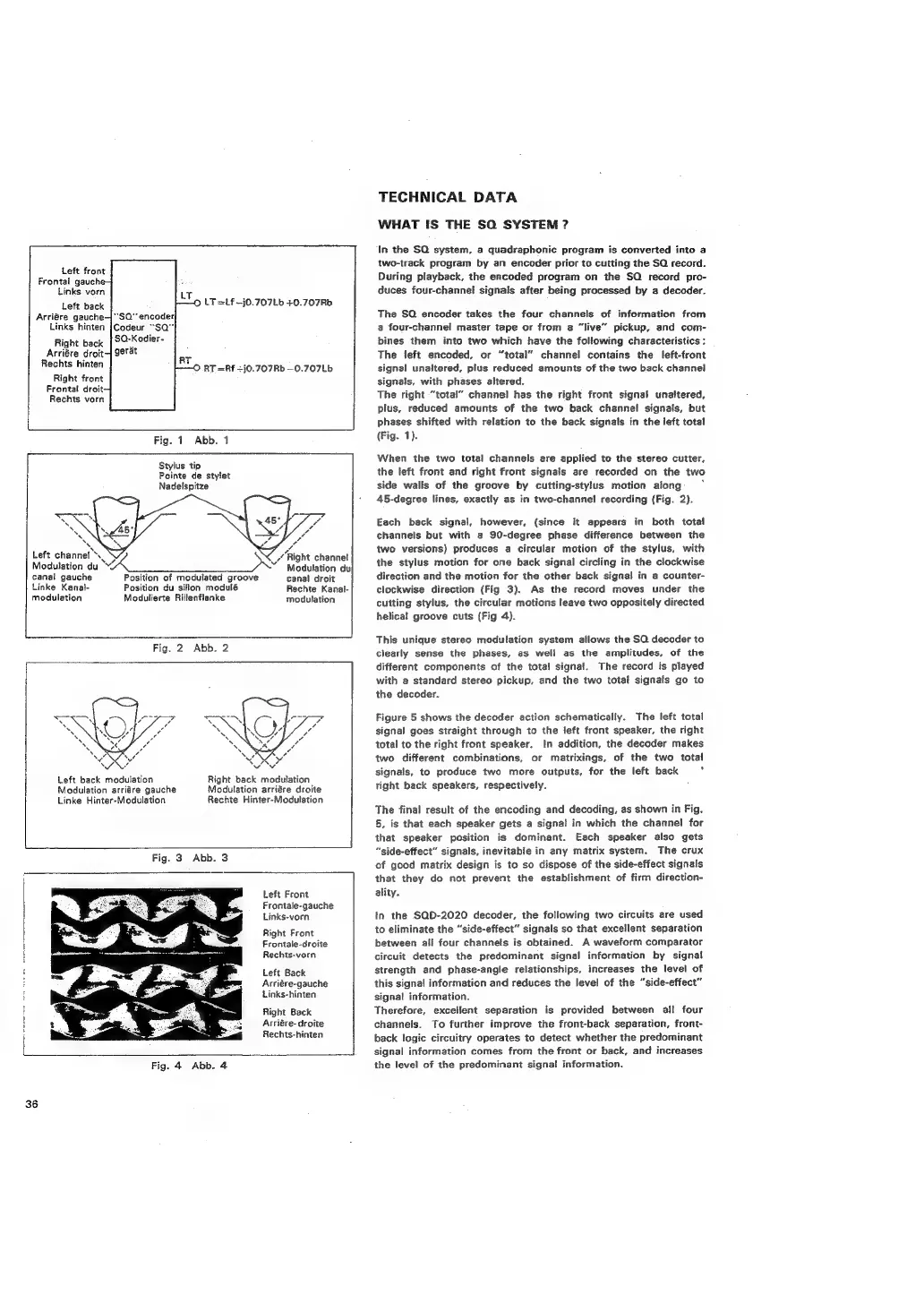
The
SQ
encoder
takes
the
four
channels
of
information
from
a
four-channei
master
tape
or
from
a
“live”
pickup,
and
com-
bines
them
into
two
which
have
the
following
characteristics
:
The
left
encoded,
or
“total”
channel
contains
the
left-front
signal
unaltered,
plus
reduced
amounts
of
the
two
back
channel
signals,
with
phases
altered.
The
right
“total”
channel
has
the
right
front
signal
unaltered,
plus,
reduced
amounts
of
the
two
back
channel
signals,
but
phases
shifted
with
relation
to
the
back
signals
in
the
left
total
(Fig.
1).
When
the
two
total
channels
are
applied
to
the
stereo
cutter,
the
left
front
and
right
front
signals
are
recorded
on
the
two
side
walls
of
the
groove
by
cutting-stylus
motion
along
45-degree
lines,
exactly
as
in
two-channel
recording
(Fig.
2).
Each
back
signal,
however,
(since
it
appears
in
both
total
channels
but
with
a
90-degree
phase
difference
between
the
two
versions)
produces
a
circular
motion
of
the
stylus,
with
the
stylus
motion
for
one
back
signal
circling
in
the
clockwise
direction
and
the
motion
for
the
other
back
signal
in
a
counter-
clockwise
direction
(Fig
3).
As
the
record
moves
under
the
cutting
stylus,
the
circular
motions
leave
two
oppositely
directed
helical
groove
cuts
(Fig
4).
This
unique
stereo
modulation
system
allows
the
SQ
decoder
to
clearly
sense
the
phases,
as
well
as
the
amplitudes,
of
the
different
components
of
the
total
signal.
The
record
is
played
with
a
standard
stereo
pickup,
and
the
two
total
signals
go
to
the
decoder.
Figure
5
shows
the
decoder
action
schematically.
The
left
total
signal
goes
straight
through
to
the
left
front
speaker,
the
right
total
to
the
right
front
speaker.
In
addition,
the
decoder
makes
two
different
combinations,
or
matrixings,
of
the
two
total
signals,
to
produce
two
more
outputs,
for
the
left
back
.
tight
back
speakers,
respectively.
The
final
result
of
the
encoding
and
decoding,
as
shown
in
Fig.
5,
is
that
each
speaker
gets
a
signa!
in
which
the
channel
for
that
speaker
position
is
dominant.
Each
speaker
also
gets
“side-effect”
signals,
inevitable
in
any
matrix
system.
The
crux
of
good
matrix
design
is
to
so
dispose
of
the
side-effect
signals
that
they
do
not
prevent
the
establishment
of
firm
direction-
ality.
In
the
SQD-2020
decoder,
the
following
two
circuits
are
used
to
eliminate
the
“side-effect”
signals
so
that
excellent
separation
between
all
four
channels
is
obtained.
A
waveform
comparator
circuit
detects
the
predominant
signal
information
by
signal
strength
and
phase-angle
relationships,
increases
the
level
of
this
signa!
information
and
reduces
the
level
of
the
“side-effect”
signal
information.
Therefore,
excellent
separation
is
provided
between
all
four
channels.
To
further
improve
the
front-back
separation,
front-
back
logic
circuitry
operates
to
detect
whether
the
predominant
signal
information
comes
from
the
front
or
back,
and
increases
the
level
of
the
predominant
signa!
information.