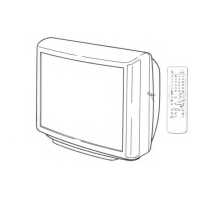
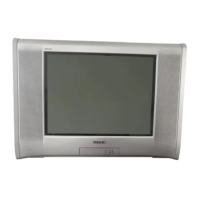
This document is a service manual for the Sony Trinitron Color TV, specifically models KV-S3411A, KV-S3411B, KV-S3411D, KV-S3413E, and KV-S3412U, which operate on the AE-2 chassis. The manual provides comprehensive information for servicing and maintaining these television sets.
The KV-S341 series is a color television with stereo sound capabilities. It supports various television systems including PAL B/G/H, D/K, L, I, and NICAM Stereo, covering a wide range of channel frequencies in VHF and UHF bands. The color systems supported are PAL, SECAM, NTSC 4.43, and NTSC 3.58 (for video input).
Important Technical Specifications:
- Sound Output: The television delivers a robust audio experience with a sound output of 2 x 15 Watts RMS (Root Mean Square) or 2 x 35 Watts (Music).
- Power Requirement: It operates on a power supply of 220-240V.
- Dimensions: The approximate dimensions are 813 x 648 x 596 mm (width x height x depth).
- Weight: The unit weighs approximately 79 kg.
- Connectors: The TV is equipped with multiple input/output options:
- 21-pin Euro connectors (CENELEC standard): Three such connectors are available.
- One provides inputs for audio and video signals, and RGB inputs, with outputs for TV video and audio signals.
- Another offers inputs for audio and video signals, and S-video inputs, with selectable outputs for audio and video signals.
- A third provides inputs for audio and video signals, and S-video inputs, with outputs for audio and video signals (monitor out).
- 4-pin DIN S-video inputs: Two such inputs are available.
- Audio inputs (L, R): Phono jacks.
- S-video output: 4-pin DIN.
- Audio outputs: Phono jacks (both fixed and variable).
- External speaker terminals: 2-pin DIN.
- Front panel connections: Video input (phono jack), audio inputs (phono jacks), S-video input (4-pin DIN), and headphone jacks (stereo minijack).
- Remote Control (RM-832): The supplied remote commander operates on 3V DC, powered by two R6 (size AA) batteries. Its dimensions are approximately 65 x 222 x 21 mm (width x height x depth) and it weighs about 157g (without batteries).
- Special Features: NICAM (Near-Instantaneously Companded Audio Multiplex) for high-quality stereo sound and FASTTEXT for quick teletext access.
Usage Features:
The television offers a range of user-friendly features accessible via the TV set's buttons or the RM-832 remote commander.
- Basic Operation:
- Switching On/Off: The TV can be turned on/off using the main power switch on the TV or the standby button on the remote.
- Programme Selection: Channels can be selected using PROGR +/- buttons or number buttons on the remote. Double-digit numbers require pressing the -/-- button first.
- Volume Adjustment: Volume is controlled via the 4 +/- buttons on the remote.
- Menu System:
- Accessing Menu: The MENU button on the remote displays the main menu, allowing access to various settings.
- Language Selection: Users can choose their preferred menu language.
- Channel Presetting: Channels can be preset automatically or manually. Automatic presetting stores all receivable channels, while manual presetting allows for individual channel storage and allocation of programme numbers to video input sources.
- Programme Exchange: Users can reorder programme positions.
- Skipping Programme Positions: Unused programme positions can be skipped when using PROGR +/- buttons.
- Captioning Station Name: Channels or video input sources can be named with up to five characters for easy identification.
- Manual Fine-Tuning: This function allows for fine adjustment of picture reception, especially when the automatic fine-tuning (AFT) is insufficient.
- Parental Lock: This feature enables blocking undesirable broadcasts.
- Picture and Sound Adjustment:
- Picture Control: Adjustments for contrast, brightness, color, hue (NTSC only), sharpness, format (4:3 Normal, 16:9 Wide screen), and resolution (Normal, High) are available.
- Sound Control: Adjustments for volume, treble, bass, balance, loudness (on/off), space (on/off), and dual sound (A: left channel, B: right channel, stereo mono) are provided. Headphone volume and dual sound can also be adjusted.
- Nicam Broadcasts: The TV supports Nicam broadcasts, allowing selection between stereo Nicam (mono 2-channel) or bilingual (Channel A Nicam, Channel B Nicam, mono).
- Sleep Timer: The TV can be set to automatically switch to standby mode after a specified time period.
- Picture-In-Picture (PIP): This function allows displaying a small picture (PIP screen) within the main TV picture, enabling simultaneous viewing of two sources. The PIP source can be selected, and its position on the screen can be changed.
- Teletext: The TV supports teletext, offering an information service with various pages (weather, news). Features include direct page selection, page-catching, superimposing teletext on TV programme, and Fastext for quick access to color-coded menus.
- Remote Control of Other Equipment: The TV remote commander can control other Sony video equipment (Beta, 8mm, VHS VTRs, video disc players) and can be programmed to control audio/video equipment from other manufacturers.
Maintenance Features:
The service manual outlines various procedures for maintenance and repair, emphasizing safety and proper component replacement.
- Safety Precautions:
- Mains Lead and Fuse: The flexible mains lead is supplied with a B.S. 1363 fused plug (5 amp capacity). Fuse replacement requires a 5 AMP FUSE approved by ASTA to BS 1362. If the plug is unsuitable, it should be cut off and replaced with an appropriate plug, ensuring the severed plug is destroyed.
- Isolation Transformer: An isolation transformer should be used during any service to prevent electric shock due to the live chassis. The chassis is directly connected to the AC power line.
- Safety-Related Components: Components identified by shading and a mark on schematic diagrams, exploded views, and parts lists are critical for safe operation and must be replaced with Sony parts specified in the manual or supplements.
- Anode-Cap Removal: Before removing the anode-cap, it is crucial to short-circuit the anode of the picture tube and the anode cap to the metal chassis, CRT shield, or carbon painted on the CRT.
- Disassembly Procedures: Detailed steps are provided for removing the rear cover, speakers, chassis assembly, and various circuit boards (M, V, A1, D2, B1, Extension, F bracket, J, P boards).
- Set-Up Adjustments:
- Beam Landing: This involves adjusting the deflection yoke and purity control to ensure correct red, green, and blue beam landing on the screen.
- Convergence: Horizontal and vertical static convergence adjustments are detailed, including the use of H.STAT control and V.STAT magnet. Dynamic convergence adjustments using CXA 1526 settings are also provided.
- Focus: Adjusting the focus to optimize screen clarity.
- White Balance: Screen G2 setting and white balance adjustments using CXA 1587S settings are described.
- Electrical Adjustments:
- Service Mode: Instructions on how to enter and navigate the service mode using the remote commander.
- Specific Adjustments: Detailed procedures for +B (+135V) adjustment, H.FREQ adjustment, PLS WDTH, AGC adjustment, Y-filter adjustment, stereo-separation adjustment, sub brightness, sub contrast, sub color, and deflection system adjustments using CXD 2018 settings.
- Error Message Diagnosis: The manual includes a table of errors and LED blinking patterns for diagnosing issues with the IC Bus Diagnosis System in the AE-2 chassis.
- Troubleshooting: A section dedicated to common problems and their solutions, such as no picture/sound, poor picture, no color, and remote commander malfunction. It advises seeking qualified personnel for persistent issues.

 Need help?

 To Next Page
 General