PVM-2950Q/2950Q M
RM-854
SAFETY CHECK-OUT
( US model only)
After correcting the original seiv1ce problem, perform the
following safety checks before releasing the set to the customer :
l. Check the area of your repair for unsoldered or
poorly-soldered connections. Check the entire board surface
for solder splashes and bridges.
2. Check the interboard wiring to ensure that no wires are
"pinched" or contact high-wattage resistors.
3. Check that all control knobs, shields, covers, ground straps,
and mounting hardware have been replaced. Be absolutely
certain that you have replaced all the insulators.
4. Look for unauthorized replacement parts, particularly
transistors, that were installed during a previous repair. Point
them out to the customer and recommend their replacement.
5. Look for parts which, though functioning, show obvious
signs of deterioration. Point them out to the customer and
recommend their replacement.
6. Check the line cord for cracks and abrasion. Recommend the
replacement of any such line cord to the customer.
7. Check the condition of the monopole antenna (if any).
Make sure the end is not broken off, and has the plastic cap
on it. Point out the danger of impalement on a broken
antenna to the customer, and recommend the antenna's
replacement.
8. Check the B+ and HY to see they are at the values specified.
Make sure your instruments are accurate;be suspicious of
your HY meter if sets always have low HY.
9. Check the antenna terminals, metal trim, "metallized" knobs,
screws, and all other exposed metal parts for AC leakage.
Check leakage as described below.
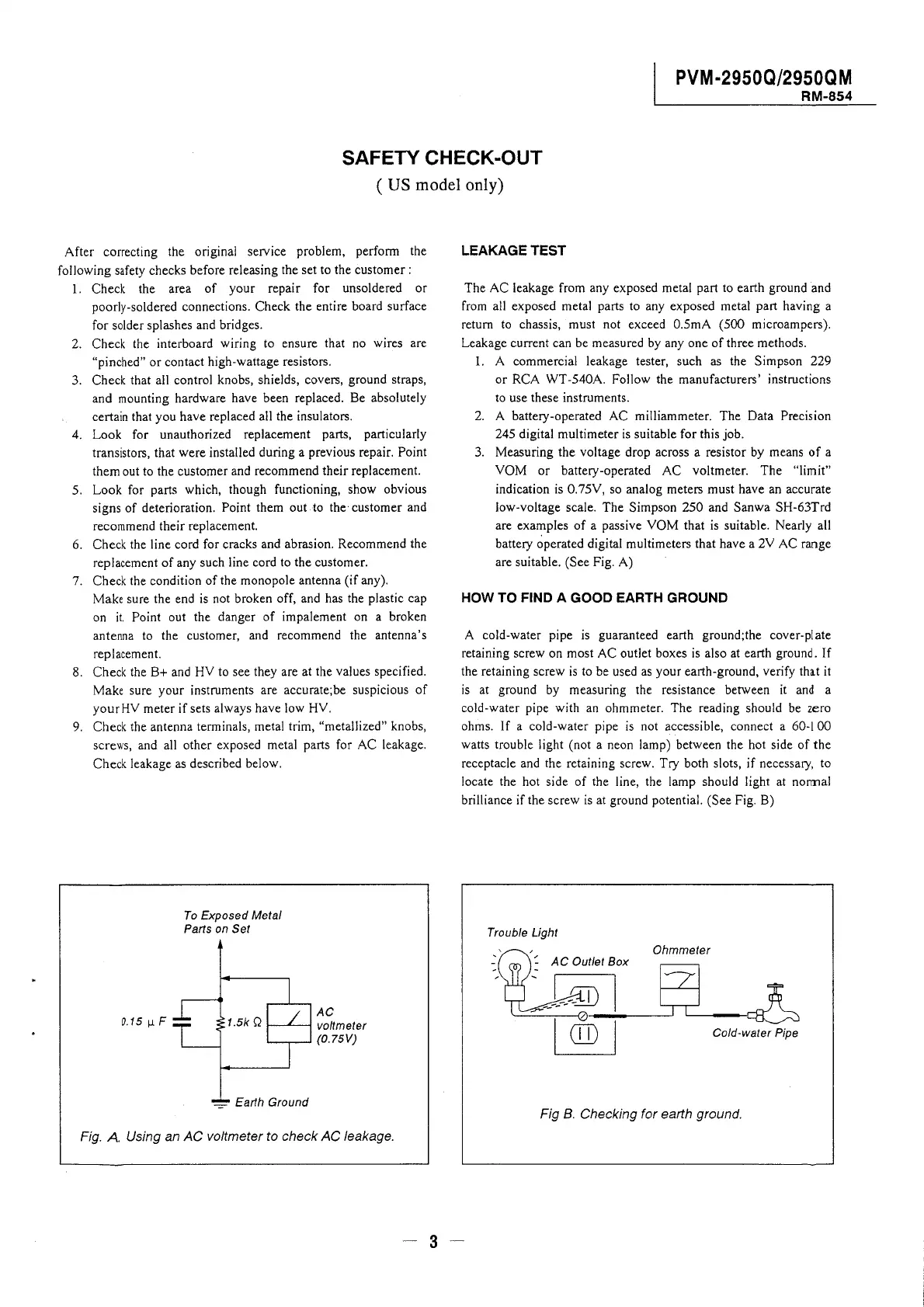
0.15 µ F
To Exposed Metal
Parts on Set
1.5k Q
-=- Earth Ground
AC
voltmeter
(0.75V)
Fig. A Using an AC voltmeter to check AC leakage.
LEAKAGE TEST
The AC leakage from any exposed metal part to earth ground and
from all exposed metal parts to any exposed metal part having a
return to chassis, must not exceed 0.SmA (500 microampers).
Leakage current can be measured by any one of three methods.
1. A commercial leakage tester, such as the Simpson 229
or RCA WT-540A. Follow the manufacturers' instructions
to use these instruments.
2. A battery-operated AC milliammeter. The Data Precision
245 digital multimeter is suitable for this job.
3. Measuring the voltage drop across a resistor by means of a
YOM or battery-operated AC voltmeter. The "limit"
indication is 0.75Y, so analog meters must have an accurate
low-voltage scale. The Simpson 250 and Sanwa SH-63Trd
are examples of a passive YOM that is suitable. Nearly all
battery operated digital multimeters that have a 2Y AC range
are suitable. (See Fig. A)
HOW TO FIND A GOOD EARTH GROUND
A cold-water pipe is guaranteed earth ground;the cover-plate
retaining screw on most AC outlet boxes is also at earth ground. If
the retaining screw is to be used as your earth-ground, verify thil.t it
is at ground by measuring the resistance between it and a
cold-water pipe with an ohmmeter. The reading should be zero
ohms. If a cold-water pipe is not accessible, connect a 60-1 00
watts trouble light (not a neon lamp) between the hot side of the
receptacle and the retaining screw. Try both slots, if necessary, to
locate the hot side of the line, the lamp should light at normal
brilliance if the screw is at ground potential. (See Fig. B)
Trouble Light
'~""""
, ~-L® I
______ _,
~
Ohmmeter
Cold-water Pipe
Fig 8. Checking for earth ground.
-3-





 To Next Page