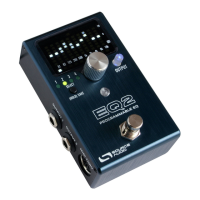
computer using a USB cable. The computer will automatically recognize the EQ2, which will be
identified as “One Series EQ2 Programmable EQ” in the operating system.
USB connectivity brings many benefits, such as the ability to connect with the Neuro Desktop Editor
for downloading EQ2 firmware updates, accessing an advanced set of effect editing parameters, and
downloading alternate engines. The USB port is also provides MIDI connectivity to a DAW.
USB-MIDI
The EQ2 will appear as a MIDI device in your computer’s operating system. As a result, the EQ2 can
communicate with audio production software that utilizes MIDI, such as Pro Tools, Ableton Live,
Logic Pro, and more. MIDI messages can be sent directly to the EQ2 using the USB connection, which
allows for full automation of the EQ2 within host software such as a DAW. For example, a frequency
band can be automated by outputting MIDI continuous controller messages from the host software
to the EQ2 via the USB connection. For more details, see MIDI Implementation.
Specifications
Dimensions
• Length: 11.63 cm (4.58 inches)
• Width: 7.00 cm (2.75 inches)
• Height (not including knobs and footswitches): 3.71 cm (1.46 inches)
• Height (including knobs and footswitches): 5.61 cm (2.21 inches)
Weight
• 280 grams (0.625 pounds)
Power
• 180mA @ 9V DC
• Center negative, Barrel positive plug, 2.1 mm inner diameter, 5.5 mm outer diameter
Audio Performance
• Maximum Input Level: +6.54 dBV = 8.76 dBu = 2.12 V RMS = 6.0 V p-p
• Full Scale Output Level: +6.54 dBV = 8.76 dBu = 2.12 V RMS = 6.0 V p-p
• Input Impedance: 1 Mega Ohm (1 MΩ)
• Output Impedance: 600 Ohm (600 Ω)
• 110 dB DNR Audio Path
• 24-bit Audio Conversion
• 56-bit Digital Data Path
• Universal Bypass (relay-based true bypass or analog buffered bypass)
Troubleshooting
Restore Factory Settings
In order to revert the EQ2 to its factory settings, clearing all user data, presets, expression mappings,
and changes to the MIDI mapping, use either the Neuro Mobile App or Neuro Desktop Editor and


 To Next Page