
 Need help?
Do you have a question about the Source Audio Reflex and is the answer not in the manual?
Outputs are independently configurable for taper, polarity, range, LFO, and other parameters for different expression standards.
Steps for connecting the Reflex to a standard passive expression port on a device using a TRS cable.
Instructions for inserting the 9V battery and powering on the Reflex pedal.
How to connect a device to Expression Output 1 using a 1/4" TRS plug for basic operation.
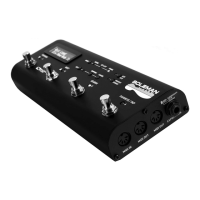
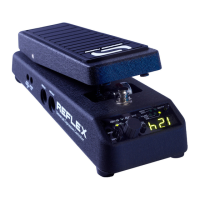
Details physical connections on the left side, including Treadle, Footswitch, Expression Outputs, Power, and USB.
Details physical connections on the right side: MIDI Out, MIDI In, Sensor Out, and Multi-Function In.
Explains how the Footswitch mutes outputs and their behavior when muted (min value, zero, center value).
Steps to calibrate the treadle's range of motion for proper operation and to create dead zones.
Procedure to save the current configuration to one of 128 preset locations using the Save button.
Procedure to load a previously saved configuration from preset memory using the Load button.
How the Reflex syncs LFOs to MIDI clock tempo for synchronized musical timing.
Explains how the Reflex appears as a MIDI device for DAWs and allows automation via USB.
Configures expression output for passive TRS tip connection, common for many pedals. Requires stereo cable.
Configures expression output for passive TRS ring connection, used by companies like Zoom and Korg. Requires stereo cable.
Configures expression output for passive TS mono connection, common for Line 6 and Eventide devices. Requires mono cable.
Configures output for active control voltage (CV) mode, used with modular synthesizers. Requires mono cable.
How to adjust treadle friction using a screw under the treadle heel.
Addresses issues like the unit appearing dead, wrong power supply, or corroded cables.
Guidance on restoring original firmware via a hard reset to resolve operational problems.
 General
| Input Impedance | 1 MΩ |
|---|---|
| Inputs | Expression Pedal Input |
| Outputs | 1 x 1/4" output |
| Power | 9V DC (negative tip) |
| Control Range | 0-5V |


 To Next Page