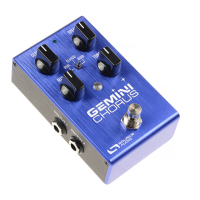
SA242 Gemini Chorus User’s Guide 16
We recommend you choose between the active analog bypass (a.k.a. buffered bypass) and relay-
based true bypass based on what is needed in your signal chain. Ideally, the first pedal in a signal
chain is a buffered input followed by true bypass in the rest of the signal chain.
Both bypass methods have pros and cons associated with them. Buffered bypass provides consistent
input impedance so that if the source is susceptible to variations in input impedance (similar to a
guitar pickup), there won’t be a noticeable change in tone. True bypass has the benefit of providing a
dedicated hardwired bypass signal path. The Gemini features small-signal relays for true bypass
switching that offer reduced pops and clicks compared to the traditional true bypass switching
method using a mechanical switch.
Stereo Routing
The Gemini works great as a mono chorus effect, but its stereo inputs and outputs also make it a true
stereo effect as well as a flexible signal router. It can act as a stereo splitter, merger, or true stereo
effect, and it can also be set up in a number of other unique signal routing modes. By default, the
Gemini works in true stereo mode (input 1 goes to output 1, and input 2 goes to output 2). To
configure a different stereo routing mode, use the USB editor software or the Neuro App.
A few different routing options are displayed below. The right side of each diagram shows inputs 1
and 2, the left side shows outputs 1 and 2, and chorus effects A and B are in the center.
Many more routing options are possible. Check the USB Editor or Neuro App for more details.
Parametric EQ
The Gemini features a built-in 4 band parametric EQ that can be configured using the Neuro App or
the USB Editor. Different EQ settings can be saved for each of the three effect types, as well as for
the user preset.
Mono In, Stereo Effect
A
B
1
2
1
Stereo In, Mono Effect
A1
1
2
Mono Effect, Dry Thru
A1
2
1
Mono Effect, Double Output
A1
2
1




 To Next Page