SA240 Mercury Flanger User’s Guide 12
By default, the Mercury uses a sine wave for its LFO, but other wave shapes can be selected using the
Neuro App or USB Editor Software.
Effect Types
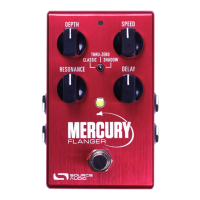
The Mercury includes three basic effect types, with more effects available in the USB editor software
or the Neuro mobile app.
Classic
The Classic Flanger effect combines the original dry input signal with a single modulating clone signal,
creating the simple sound of two voices in unison. It is very similar to the classic chorus effect except
that the delay time is relatively long in a chorus effect and relatively short in a flanger effect.
Thru-Zero
The Thru-Zero Flanger effect tries to recreate the original tape flange effect in which the two tape
machines would alternately be slowed down and sped up so that their signals would pass in front of
and behind each other. Obviously, this is a difficult feat to pull off during a live performance (without
the assistance of a time machine). The Mercury achieves this effect with two delay lines, one of
which is very short, but stationary, which functions as the dry signal - the other signal modulates. As
the modulating signal passes through and moves ahead of the stationary tap, we hear the classic
through zero twist (a split second of complete phase cancellation) as the frequency response inverts.
Shadow
The Shadow Flanger effect features two modulating signals. This setup generates a more animated
flanging effect, with the primarily flange closely shadowed by a subtle, more resonant reflection.
Additional Effect Types
Additional effect types can be loaded into the Mercury using the Neuro App on your mobile device
(iOS / Android) or the built-in USB port (Mac / Windows).
The Mercury Flanger is compatible with Source Audio’s Phaser and Chorus effects, so it is possible to
load chorus, phaser, and flanger effects on the Mercury at the same time.



 To Next Page