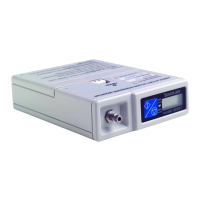
Ambulatory Blood Pressure Monitor 90217 Service Manual
4-9
Maintenance
Pressure Leakage
1 In the sphygmomanometer test configuration, use a hemostat to clamp the hose going to the
90217 and pump the pressure to 280 mmHg ±4.
2 Clamp the hose going to the squeeze bulb with a hemostat and measure the leakage rate
(system leakage).
3 Unclamp the hoses going to the 90217 and squeeze bulb.
4 Repump the system to 280 mmHg, reclamp the hose to the bulb and measure the leakage rate
(90217 + system leakage).
5 Subtract the first leakage rate (system leakage) from the second leakage rate (90217 + system
leakage).
6 Verify that the pressure drop due to 90217 leakage is <6 mmHg per minute, or <4 mmHg per
4 minutes for 90217-41 (Japan) and <4 mmHg per 2 minutes for 90217-32 units (German).
7 Release the system pressure.
Over-Pressure Checks
1 Press the Esc key (the Main Menu should return).
2 From the Main Menu, select 9. HARDWARE OVERPRESSURE TEST.
3 Verify that the pump starts and continues to run, building pressure until the hardware over-
pressure limit is achieved. Verify that the pressure value appearing at the bottom of the screen
falls between 285 and 295 mmHg.
4 Press the Esc key.
Over-Pressure Relief Valve Check
1 Power OFF the 90217.
2 Disable the hardware over-pressure circuit by connecting TP8 (over-pressure test point) to TP9
(ground) using a small patch cable.
3 Power ON the 90217.
4 From the initial menu, select 2. MAKE CONTACT WITH MONITOR.
5 When the Main Menu appears, select 9. HARDWARE OVERPRESSURE TEST.
6 The pressure will increase until it opens the over-pressure relief valve. When the pressure
increase levels off at a rate of 3 sec/mmHg, check the pressure displayed on the manometer
and verify that it falls between 300 and 325 mmHg.
7 Remove the jumper between TP8 and TP9.
8 Power OFF the 90217.
9 Press the Esc key.
10 Power ON the 90217.


 To Next Page